Peek A Boo, I See You (Ghost In The Shell (1995) review)

Deus ex machina are supposed to reveal truths of the world, not leave it covered in darkness. Which is why this film is rather prophetic, and should probably be in the queue for monthly consumption, at a minimum.


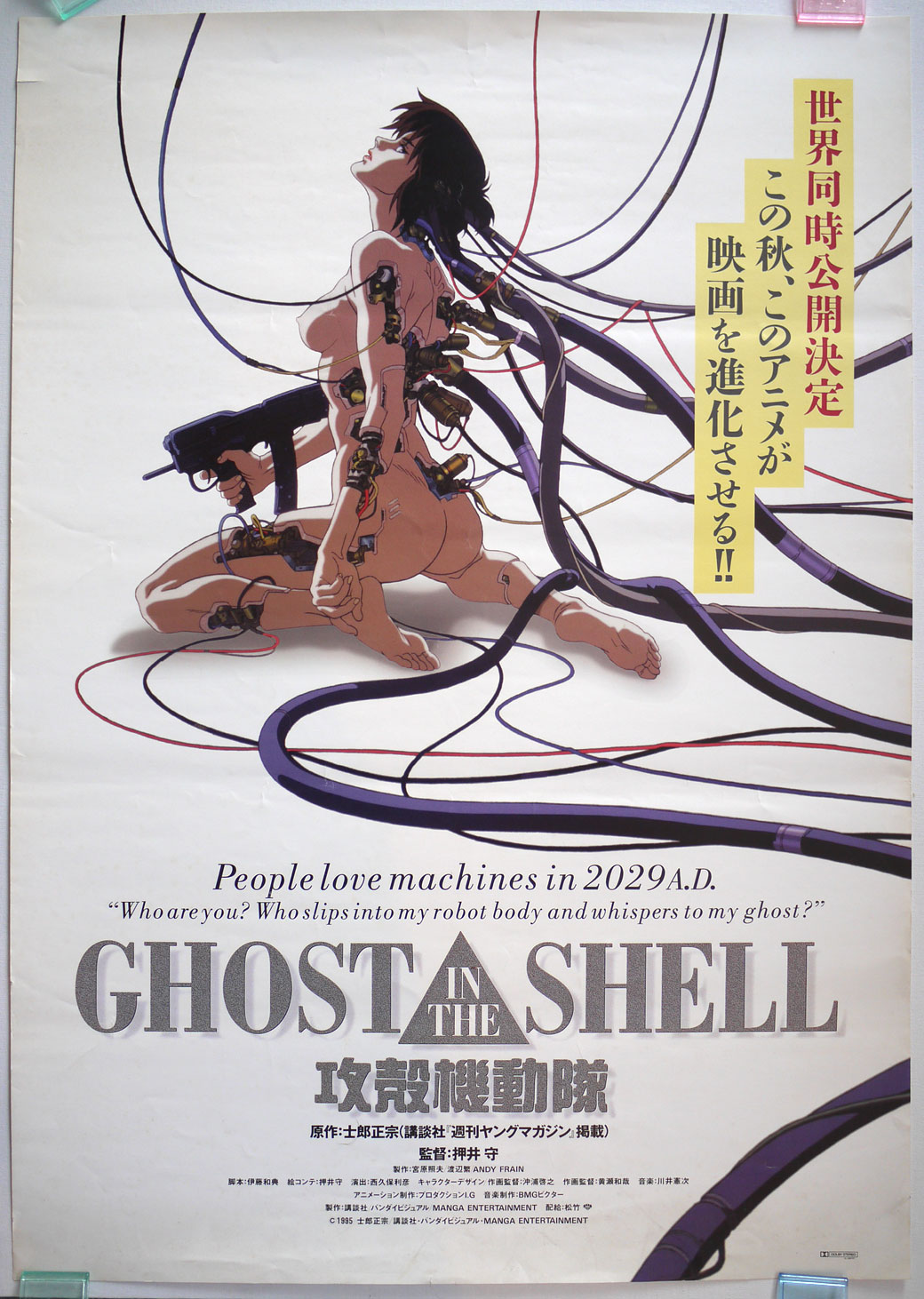
Ghost In The Shell (1995)

Cast: Atsuko Tanaka, Akio Otsuka, Koichi Yamadera, Yutaka Nakano, Tamio Oki, Tessho Genda
Director: Mamoru Oshii
re-released on blu-ray Sep 23, 2014
********* 9/10
IMDB: 8.0
Rotten Tomatoes: 96%, Audience Score 89%
The Guardian: ****/*****

Mamoru Oshii is a Japanese director and screenwriter. He has directed a ton of anime films and television shows, including Urusei Yatsura, Red Spectacles, Ghost in the Shell, Avalon, and Patlabor 2: The Movie. His directorial style has often been detailed in how different it is to most films made in the United States, with visuals being the most important element to him, followed by story, and then characterizations.

The Wachowskis and James Cameron have been in awe of his work for decades, especially with Ghost in the Shell, so I thought it fitting to time my review of the original film with the release of the live-action remake. Because, well, it’s even more relevant today than it was 20+ years ago.

Courtesy of Wikipedia

In 2029, with the advance of cybernetic technology, the human body can be “augmented” or even completely replaced with cybernetic parts. Another significant achievement is the cyberbrain, a mechanical casing for the human brain that allows access to the Internet and other networks. An often-mentioned term is “ghost”, referring to the consciousness inhabiting the body (the “shell”).

Major Motoko Kusanagi (Atsuko Tanaka) is an assault-team leader for the Public Security Section 9 of “New Port City” in Japan. Following a request from Nakamura (Tessho Genda), chief of Section 6, she successfully assassinates a diplomat of a foreign country to prevent a programmer named Daita (Mitsuru Miyamoto) from defecting.

The Foreign Minister’s interpreter is ghost-hacked, presumably to assassinate VIPs in an upcoming meeting. Believing the perpetrator is the mysterious Puppet Master (Iemasa Kayumi), Kusanagi’s team follows the traced telephone calls that sent the virus. After a chase, they capture a garbage man and a thug. However, both are only ghost-hacked individuals with no clue about the Puppet Master. The investigation again comes to a dead end.

Megatech Body, a “shell” manufacturer with suspected close ties to the government, is hacked and assembles a cybernetic body. The body escapes but is hit by a truck. As Section 9 examines the body, they find a human “ghost” inside its computer brain. Unexpectedly, Nakamura arrives to reclaim the body. He claims that the “ghost” inside the brain is the Puppet Master himself, lured into the body by Section 6. The body reactivates itself, claims to be a sentient being and requests political asylum. After the Puppet Master initiates a brief argument about what constitutes a human, a camouflaged agent accompanying Nakamura starts a diversion and gets away with the body.

Having suspected foul play, Kusanagi’s team is prepared and immediately pursues the agent. Meanwhile, Section 9 researches “Project 2501,” mentioned earlier by the Puppet Master, and finds a connection with Daita, whom Section 6 tries to keep from defecting the country. Facing the discovered information, Daisuke Aramaki (Tamio Oki), chief of Section 9, concludes that Section 6 created the Puppet Master itself for various political purposes. This is why Section 6 is desperately trying to reclaim the body.

Kusanagi follows the car carrying the body to an abandoned building. It is protected by a large walking tank. Anxious to face the Puppet Master’s ghost, Kusanagi engages the tank without backup and is nearly killed. Her partner Batou (Akio Otsuka) arrives in time to save her, and helps connect her brain to the Puppet Master’s.

The Puppet Master explains to Kusanagi that he was created by Section 6. While wandering various networks, he became sentient and began to contemplate his existence. Deciding the essence of humanity is reproduction and mortality, he wants to exist within a physical brain that will eventually die. As he could not escape section 6’s network, he had to download himself into a cybernetic body. Having interacted with Kusanagi (without her knowledge), he believes she is also questioning her humanity, and they have a lot in common. He proposed merging their ghosts, in return, Kusanagi would gain all of his capabilities. Kusanagi agrees to the merge.

Snipers from Section 6 approach the building, intending to destroy the Puppet Master’s and Kusanagi’s brains to cover up Project 2501. The Puppet Master’s shell is destroyed, but Batou shields Kusanagi’s head in time to save her brain. As Section 9 closes in on the site, the snipers retreat.

“Kusanagi” wakes up in a new cyborg child body in Batou’s safehouse. She tells Batou that the entity within her body is neither Kusanagi nor the Puppet Master, but a combination of both. She promises Batou they will meet again, leaves the house and wonders where to go next.

For me, it’s tough not to watch this movie and be reminded of The Matrix. I had the unfortunate experience of watching that movie a great many years before this classic, and the repeated viewings of The Matrix trilogy over the years haven’t helped either. And so, the story is a familiar one, exploring self-identity as we relate to machines in a time when humans and machines have become interchangeable. God praise the internet, amirite? And the timeline is not that far away either, in both the film and reality.

Consciousness, humanity, autonomy, empathy, and mortality are all explored in a relatively short hour and twenty-some minutes. In a time when international corporations have basically done away with national identity too.The ghost in the shell is literally a play on the wandering consciousness that inhabits the meaty husk, and it wants to know if we hear it’s voice.

Pros: Visually compelling and with a message which has allowed it to age far better then films like Blade Runner or Total Recall, Ghost in the Shell is violent, emotional, and poetic to experience.

Cons: The individual characters are difficult to warm up to, but it might just be all of the robot parts they have imbedded.

Runtime: 1 hour 23 minutes

Points of Interest: Motoko’s eye are intentionally animated to not blink very often, giving her a feel of a doll, rather then a human. The title of the manga which inspired the film is written as an homage to the Arthur Koestler work, The Ghost in the Machine.

theories Summarized

So is the 2017 film better than the 1995 one? I’d like to think not, and not for the obvious whitewashing allusions that have been to popular on the internet over the past year or so. In fact, Mamoru Oshii has gone on record to state that the Major may or may not be Japanese, but regardless of her current appearance, her name and body have changed numerous times, and so it is in fact acceptable to have Scarlett Johansson in that role.

But I think the problem is that the anime far better depicts the story at hand, and that the visuals are far more compelling with their mix of traditional drawing and CGI. The Matrix will never be the same for me. And that’s no theory.

And speaking of things that The Matrix tried to wreak… Andre and I have a new Watch Culture video up for your viewing pleasure. Please tell us if you agree that Equilibrium is worth a watch, and if not, your comments are appreciated.

Tim!

For Teh Lulz (Email Communication)

I know. You’re sick of explaining to your clients what your performance rates are… I mean how many times is going to take for them to realize you are creative professional and that you won’t work for anything less then the cost of the labour and materials?!?

And THAT is for charity work.

If we’re talking about a professional show or a corporate portrait, you gotta get paid, dear readers!

Earlier this month, I committed to the idea that basic communication is essential in all interactions; if you don’t have good communication skills, you are going to struggle with all of the ups and downs of life, from the small to the large ones. Ultimately this means you are moving against the flow of life OR being led by the flow, but never setting up your own course of navigation.

Why Don’t You Write A Book About It?

All great navigators know how to control the movement of their vessel from one place to another, and while navigation is defined by land, sea, air, and space, communication is divided up into 4 main forms – written, oral, non-verbal (gestures, words, facial expressions, body language), and interpersonal (personal relationships). And I’ve chosen to start this topic off right or rather write, with written communication.

But why writing timotheories?

Because writing is the form that I am interacting with you in this specific moment, dear readers. You creative cuties!

After all, true writing (read: contextual and encoded writing) has been with us since the bronze age of history, with proto-writing likely preceding 2000 BC, but definitely in that ballpark of time. Though to be clear, this was not a sudden change throughout the world, but a slow one, which developed from symbols and tablets.

History lesson aside, what that means is that written communication is here to stay, and we better figure out how best to interpret it, less we become even more delayed in our growth. Which would suck.

PC Load Letter, What The F Does That Mean?

Speaking of suckage, have you ever seen the Mike Judge classic Office Space? I’m not going to go into a bunch of detail on the movie, instead, you should wait for our upcoming Watch Culture on it, but I will share this little clip and some wisdom.

Life is already difficult as it is, so leave the jargon at the door! You’ve got memos, reports, bulletins, email, text messaging, and a host of other types of written communication to juggle on a daily basis, and thanks to smart phones, these things pile on quick.

It’s not so difficult to manage though, if you rely on a checklist of etiquette and follow through with it, of course. Let’s use the ever-so-popular email format as a basis in demonstrating the  7 C’s of communication (clear, concise, concrete, correct, coherent, complete, and courteous). And clean language too if you want to emphasise courtesy, unlike what Mr. Bolton just did.

  1. Respond to emails promptly. This is one I personally struggle with, as I want to be attentive in my responses, but responding within 24 hours is ideal, within 8 even more preferable, and within 1 if you want to be a rock star.
  2. Proofread your work, and think twice before sending. It should go without saying, but leaving your emotions out of a response can be extremely difficult, and written communication is so easy to do, you can articulate your thoughts and rearrange them. Also, spend some time reading over your work, typos are the worst.
  3. Know your audience. In case it isn’t obvious, don’t blind copy everyone in a response either. Knowing your audience in every instance is difficult to be perfectly honest, but if you pay close attention, you CAN learn others motivations and keep projects moving forward amicably.
  4. Also, please stop forwarding your junk onto others. For example, if you like sharks, and want to let the world about shark week, but your work buddy lost his family in freak shark tank incident, he probably doesn’t want to deal with your email.
  5. Brevity is king. Keep emails brief. People hate reading long boring things. See?

It’s up to you obviously in how you go about enabling these new habits, but at the very least, you now have some basic tools of written communication that will help you better convey your ideas to others. And just like that printer that Michael hated, people can give messages which just don’t make sense… Frustrating for sure.


theories Summarized

You don’t want to be like that printer folks. That printer eventually got taken out to pasture and bludgeoned to death with a baseball bat and a few swift kicks to the paper tray. And yes, maybe that’s an extreme example of the risks of bad communication, but worse things have happened in real life. And unlike a theory, I’ll share some examples in the next post of this series to prove it.

Tim!

Netflix and Take A Pill (timotheories presents: Watch Culture)

Internet culture is cool right? Reshoots and disputes and set leaks galore.

Oh wait, nope, that’s not cool at all.

It’s all just a hype machine and it sucks. Because legitimacy of so many of the films coming out right now aside (read: Justice League, Baywatch, Pirates of the Caribbean), we don’t need to spend hours upon hours of our time reading click-bait themed single paragraph articles from buzz sites, tweeting from similar newsfeeds that should be reporting on politics, and binging on YouTube video theories and opinions. I mention this because we’re talking about things which haven’t even come out yet.

It’s weird though, because culture has shifted.

You probably didn’t notice it, did you?

Yeah, funnily enough, the notion of hyping movies has been around for a while. You see dear readers, there used to be a time when we would get on a hype machine ahead of a release date, but we didn’t have a place to vomit all of our millions of ideas about it. And people didn’t capitalize on all of the theory, using their particular geek skills to funnel people Then the internet came along. And we lived a happy place between hype and geek culture for a few years.

So what happened and where’s the shift?

Culture Conundrum

Well, I think at some point publishers of ideas, and cultural icons realized that the volume of new content being created reached far beyond their own individual capacities to give opinions on it, so they instead choose to focus only on the new and glamorous, adding in their two cents as it were. Luckily for the vast majority of us, technology has shifted too and our attention spans for the new and novel are increasing, so we don’t have time to look at everything. We instead spend five minutes on one thing we care about, to then move onto another five minutes segment about the thing we care about.

Content creators benefit from this in a big way, and everyone is happy. Because we can all share in that hype machine, never really contributing anything in the way of constructive feedback and driving our subscribers to purpose.

Which is why I decided to introduce a new series of video posts called WatchCulture into the mix. In this series, I will be sharing brief recommendations on movies which have been around for more than a year, and which I think you should watch for your own cultural edification. These are going to be short videos on film, music, art, etc., which fit into the cultural norm, but the difference is that instead of saying netflix and chill, I’m going to ask you to take the red pill.

theories Summarized

You can thank André Lindo, the producer of my Cross Talk series, for this idea, and a greater insight into my own thoughts and feelings on what culture we should be consuming at any given time. Expect to see Watch Culture episodes cropping up every week, very soon.

But for now, I’ve no more theories to share. Only well wishes and a hope for a new tomorrow.

Tim!


The Matrix Effect (Cross Talk Ep.2)

Hey there dear readers! I hope your weekend has been excellent and full of art and all kinds of awesome and amusing things!

Oh thanks, but how are you doing Tim?

Oh, very good, thanks for asking!

Well, actually I’m feeling a little out of touch with reality, to be honest. My weekend started on the 13th of February and is finishing up tomorrow before I head back to the regular grind.

You see, I took some overdue and much needed vacation time to catch up on some of my personal to-dos, which effectively resulted in a 10 day weekend for me. I’m making that sound like I didn’t get anything accomplished, that’s note true, I got a lot done, in fact!

However, the consequences of this decision are just starting to get back to my brain.

You see, dear readers, when you break from routine too much it can cause your body to fight against you, which has been proven time and time again in various studies on the difficulties of changing habits. And this is topic is something we’ve touched on before here at timotheories. However, we haven’t really addressed the opposite side of the coin, which can also have disastrous results…

If you do too much of the same thing, you will experience what I theorize is similar to the effect Neo experienced in the first film in The Matrix trilogy (the one most everyone enjoyed), which I will very carefully call The Matrix effect for now, but not claim ownership of, for fear of long-term copyright infringement issues.

Essentially what this means is that if you see too much of the same thing, over and over again, without any careful and deliberate subtle shifts of that thing to make each entry appear unique, your brain starts to recognize the pattern and wakes up from the state of comfort, it often operates in.

This is a bad thing.

1c2b72c0-84ad-0133-b2cf-0e438b3b98d1

But luckily for you friends, I have a good thing to share with you instead!

That’s right, it’s that time of month when timotheories shares with you a new episode of Cross Talk! So strap in, hold on tight, and get ready for our discussion on the topic of – Realism VS Escapism in film, or how films deal with logic gaps that can potentially break your attention from the story.

This is going to be a great topic where Chris and I explore the successes and failures of movie tropes, typecasting, when science and art intersect, and how movies address their fantasy elements to create franchises, among other things.

I’ve included a direct link to the video for you here, but as mentioned before we now offer you embedded video on the blog so you don’t have to navigate away from the post. Please take a look below to watch Episode 2 of Cross Talk!

I’m out of theories for now, but check back tomorrow for a fun Melodic Monday entry from a group out of the Ukraine.

Tim!


The Red Pill (Stock Photography)

The future is bleak.

That’s what I would tell you if was a robot and not a human being. Because I am human, I am more than logic. I have a heart which is filled with faith and so I have hope. I have hope that we can solve issues of hunger, inequality, pollution, and war. I may have paraphrased that idea from Jacques Cousteau, but I think it’s incredibly relevant today.

Especially today.

avengers-i-am

Being a self-proclaimed futurist in the same class as one Anthony Stark, I recognize that there is always something more interesting along the horizon, and it can be difficult for me to sit still long enough to capture the now and be present.

I have this incredible desire to see life organized and efficient, conversations delivered in messages that I can absorb when I feel like and products available at the click of a button. But on the other hand, I want to pause in moments of isolation and really see what’s in front of me, engaging with life.

Thusly is the struggle of someone who has an analytical mind, but a heart driven to curate and create.

Which is why what I am going to share with you today will fit both the analytical and the creative minds in our ranks.

All day I’ve felt this pull to give some credit back to my fellow bloggers out there. Maybe it’s because it’s been a little over a year since I started this venture, and almost six months since I really hunkered down and started planning my posts, but I don’t think I’ve written about the business of writing at all yet.

And one of the elements of writing a good blog post is putting up an interesting header image or “feature image” as WordPress terms it.

I’m going to share a secret with you, one which many of you probably realize already – I don’t personally create a vast majority of the photos I attach to my posts. *Gasp!*

I use stock photography. *Double Gasp!*

I do have a future goal to start to use my own images more often, but that’s a goal for 2016 and beyond. So let’s get back to the topic at hand.

If any of you aren’t familiar with stock photography I’ve provided a handy definition from Wikipedia just below.

Stock photography is the supply of photographs, which are often licensed for specific uses. It is used to fulfill the needs of creative assignments instead of hiring a photographer, often for a lower cost.

We are very fortunate in this day and age because stock photography is readily available on the internet, and there a number of ways you can get a hold of it, paying a lot for premium photos, a little less for decent photos, and nothing for photos that are typically of poor quality.

You can also steal images from search pages like Google or take images from the Public Domain (AKA free to use for commercial or personal use).

When you purchase images you have the option of getting royalty-free images which are typically a one time purchase, and can be used over and over again, but you also can purchase images that are associated with a brand or licensed and subject to usage rules.

I typically swing back and forth between public domain and royalty-free images, but have recently been using public domain images more often because I enjoy the online hunt a lot more than I should.

This is the part where you say, “so where do you go to find images timotheories?”

Well dear readers, you can use paid services I’ve looked into such as Shutterstock, Getty Images, ThinkStock (by Getty Images), and fotolia, for starters. These are all solid choices. But they may not be for you.

Now here comes the fun part. What if I told you there was a way to get premium quality photos, without have to pay for them, in order to get yourself started or thinking differently about your image choices?

I bet you would be into that. Wouldn’t you friends?

Okay, well I’ll show you how deep the rabbit-hole goes. The truth is that there are all kinds of photographers, from commercial to personal, and everything-in-between. This article from DigitalImpact has provided a list of 40+ free stock photography sites, many of which feature photographers that are just getting started or want to extend their reach to different clientele.

The thing to keep in mind with stock photography is that it represents generic types of imagery and so it is a very competitive field.

However, if you are interested in unique images that provide a specific service, you should ALWAYS go to a professional photographer who is an expert in a particular field. I say this in case you think I am condoning stock photography over traditional methods. This is not the case at all.

And that’s all I’ve got for today. Only 1 more sleep until my last post of the season. It’s gonna be a fun one and I hope you enjoy it. Till then, enjoy the snow and if you are celebrating Christmas I hope you get all your presents sorted out tomorrow.

Tim!