The Meaning of Art (Vinson Lim, photographer, videographer, designer, entrepreneur interview)

Human beings have a knack for finding meaning in just about anything. It’s supposedly in our collective nature to assign those meanings so that we can make the world around us just a little more clearer and lovely.

We don’t do this to grow into some ultimate truth, but because there is just far too much information to take in at any given moment. And consequently understanding each other isn’t any easier as we age. Loving people, reducing a need for gratification, overcoming fears (and a host of other insecurities), and accepting ourselves are all important lifestyle choices in the quest for meaning.

But what if you are a creative person?

Vinson Lim generally takes the position that being an artist shouldn’t elevate you above other humans beings, it really should only work as an expression of self… and at the core of his answers is the theme of acceptance in life. By letting go of hate, and truly being present at all times, that’s when we are able to create interesting work.

Whether it’s through a practice of meditation, as addressed in the interview preview, or by simply spending time with our families, Vinse accepts that his art will always be evolving based on how he is living his life.

And he is especially aware of this having just entered into fatherhood for the first time. But unlike so many other creative people, his art doesn’t inform his life choices, but rather his life choices determine how he demonstrates his creativity.

Vinse might be acting as a photographer today, but he is willing to switch hats on the fly to access his videography skills, graphic design education or even to play some music for friends and family.

I’m not going to give away his viewpoints on the meaning of life, art, and everything in-between. But I can say with utmost confidence, that this interview will make you think, and we’re both hoping that just might make you feel too.

I think you’ll learn something from Mr. Lim

theories Summarized

I always find it cathartic to have a heavier discussion on the meaning of it all, dear readers. I hope that this interview resonated the same way for you.

But even if it didn’t, please let us know what you thought of the interview! What was your favourite question? Do you agree with what Vinson Lim said? Do you disagree? He is a very talented photographer, so if  you’re interested, feel free to check out his Facebook page, Instagram, and website for yourself! The meaning of life might still be one of the greatest questions of all time, but dammit if Vinse isn’t fascinating to listen to.

And special thanks to Vinse for being vibrant, vulnerable and virtuous. Without his thoughts on the meaning of it all, I might not have come to the realization that being positive and standing in my truth isn’t enough, it’s important to reach out to the lost and the lonely too. A pretty good theory.

Tim!

Conjunction Junction (Interpersonal Communication)

Language sure is weird.

Did you ever hear the expression “all dogs are mammals, all mammals are animals, therefore all dogs are animals?” Well I’m sure you have dear readers, but I have to wonder if you know the reason why it’s used fairly commonly (read: not that commonly) in academics or by people who want to be academics.

This statement is a syllogism associated with predicate logic; a type of logic which shows how the subjects and predicates of such statements relate to those in other statements in an argument. To put it another way, syllogisms are an instance of reasoning in which a conclusion is drawn from propositions that share a commonality and one final statement that combines second terms of the initial propositions in a way to infer a conclusion.

Another very well known example is that “all men are mortal, Socrates is a man, therefore Socrates is mortal.”

Hooking up words and phrases and clauses.

The Challenge Of Language

Communication is exactly that though. Making sense of language, verbal and nonverbal, as well as written, in order to best exchange information, feelings and meaning between a pair of people or to a group of people.

This is where interpersonal communication comes in. It’s a communication process that happens between two or more people. It is a face-to-face interaction that further addresses two of the three previous topics we’ve already covered in the communication basics series. Verbal and nonverbal communication.

To Put In

Interpersonal communication skills really are the most essential of skills in life, in my opinion, of course. We deal with so many daily challenges, rare opportunities and unexpected encounters throughout our time on this spinning ball of dirt that we need to be prepared to communicate well, whether at work or in our personal lives. The truth of it is, well, the truth is that people who have invested the time in developing their interpersonal skills get further along in life.

Probably because those people are more charismatic and appealing. And if we’re being honest, we can all benefit from being more appealing. Also, you can’t stop interpersonal communication from happening. No matter who you are and where you are going in life, you just can’t stop interpersonal communication from happening.

Because even when we are silent, nonverbal communication works in full force. And just as the old adage says, once you say something, you can’t take it back. We make silent judgments of others all the time.

That person should go to hell. He looks fat in those pants. She wears too much makeup. Who raised this kid?

That internal dialogue happens whether we want it to or not. But as I’ve mentioned in the previous posts, it is possible to work on both your verbal and nonverbal communication skills. And even more importantly, it’s so necessary. The single best thing you can do to become better at both arenas is to work on your listening skills.

And that is going to be the next major topic we’ll focus on in another post. I don’t want to spend too much time today digging into it, but I will say this – The better of a listener you are, the less people will concern themselves with your verbal and nonverbal skills.

theories Summarized

When you learn to use your interpersonal communication skills effectively creative cuties, not only will you have excellent verbal and nonverbal communications down, but you will get more accomplished in life. I know that sounds like a quick fix, because it takes time, but you can expect a lot more discussion on this in future months. For now, I’m out of theories.

Tim!

Basic Training (Communication Basics)

Here at timotheories I believe it’s important to provide you dear readers with a depth and breadth to my content which is fairly uncommon in many blogs of the day.

I write about the arts (music, film, events), share global wisdom and learnings I’ve uncovered on how to maintain and flourish as a creative professional, and build lots of stimulating content about the value of art, often focusing on the medias of movies, table top gaming, and interviews with salt of the earth artists. I follow a monthly schedule to ensure I release a lot of quality content: written and video.

One of the reasons I do this because I believe that good communication is one of the key skills you need in life. Another of the reasons I have this workflow down pat is because good teachers and leaders practice what they preach.

#sobasic

So many of the lessons I share are cyclical,  the kind of stuff you’ll hear over and over in your life and which you really need to learn, those things you run away from until you finally own up to your obstacles and face them head on. It’s one of those theories that is so compelling when life is going great, but difficult to accept when you’ve just been handed a shit sandwich after life pummeled you and then ran over your dog.

Nothing ever goes away until it has taught us what we need to know.

Pema Chodron

I found this quote from Pema Chodron, an American Tibetan and practising Buddhist. One who happens to be both an ordained nun and acharya. In case you’re wondering what an acharya is, it’s someone who is a senior instructor in religious matters. They teach the next generation of monks and nuns, and are generally expected to stay put, rather than wander the earth as so many Buddhist monks do.

Communication is at the root of us facing our fears in life creative cuties. As soon as you recognize that other people aren’t actively trying to limit your actions, but rather further their own lives (just as you do), it becomes way easier to recognize that the EST models of life are a real thing – exist, survive OR thrive.

As I mentioned in my first post on communication, there are seven aspects of communication to consider and make crucial in your life – clear, concise, concrete, correct, coherent, complete, and courteous. I’m not going to spend the rest of this post outlining how those aspects all work and what to do with them, though I can see that becoming a future series down the road, if I get enough interest from you fine folks…

Instead I want to go over the basics of communication.

All About That Base

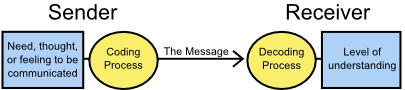
I found this really cool chart from Psychology Today which demonstrates how communication works. I’m not sure if they made the chart themselves or got it from somewhere else, but kudos to whoever came up with this diagram. It’s on point.

You see friends, communication can happens with multiple people simultaneously, but more importantly it is always a process that happens between a sender and a receiver. I could be delivering a presentation to a group of fifty people, but no matter how many people I present to, I am conducting individual communications with each party in the room.

So while nineteen people could understand the message I am relaying about marketing, one person might shut down as soon as I mention how we need to use more third party services as an annual media mix. This is because as the sender I have a responsibility to consider how I encode my message for the receiver and to be sure I truly understand the subject matter I’m speaking to. If I have complicated thoughts and feelings about the topic, I may not explain myself well, and so the listener is more likely to miss the message.

Now from the perspective of the receiver, a few things could happen which led to the misunderstanding. They could have not really been listening to the message for one, and for two, they might not have the comprehension skills needed to decode the message, but refuse to acknowledge their limitations. Which is a whole other loaded challenge of its own. And third, by adding a separate meaning to the message from what was intended. i.e. the person might think I’m suggesting incompetence in them and by stating we should hire more third party groups, I am affirming to the receiver that I want another company to support the workload because they are more talented.

theories Summarized

All that said, communication is most definitely something we can all learn to do better, and while it is a two way street, as you become more competent you’ll succeed more,. That means choosing your words and expressions more carefully, as well as being aware of your shortcomings in communication AND asking others to explain back to you what you’ve shared. Then you can expect to have better results getting help with editing your videos, distributing your brand new EP, or booking that photography shoot with the paint night lady.

It might not be a basic instinct, but communication really is key to success in the arts, and business in general. Just a theory I have.

Tim!

How To Get Good At Anything Within A Day (Accelerated Learning, Josh Kaufman)

Always be closing.

That’s one of those expressions that a lot of people know about but few follow through on. It is supposedly a great philosophy when it comes to sales. I’ve personally never seen the movie, shocker I know, but it differs only from the play on one count. You know what I’m referring to, the scene which Alec Baldwin was injected into to produce this famous speech.

Always Be Closing

The sequence sends chills down my spine literally every time I watch it. But here’s the thing, while I haven’t seen the whole movie, I have seen Boiler Room. Another movie about sales, and one which features the talents of Ben Affleck, Giovanni Ribisi, and Vin Diesel – Some of my favourite actors.

If I’m being brutally honest, I think Ben Affleck does an even better job of upping the ante on this line of thought because he explains the sales process from end to end, keeps it short, and leaves an entire room full of men confused about their talents. He is able to do this because it comes after the recruits have been there for some time and he has already delivered a killer orientation speech. Ribisi is even told to watch Glengarry Glen Ross for inspiration on how to close sales. Though I suspect Affleck got him on the right track in a better way from the outset.

Always Be Learning

Now here’s where I turn this idea on it’s head. What if you considered for a second that coffee really equates to success and closing means learning? Then you would always be learning.

Which is where the conversation get’s really interesting.

Have you ever wanted to learn a new skill, but realized you were older than twenty five and already had a fully formed and functioning adult brain? Then you just said fuck it and went back to browsing the internet and watching Netflix?

Yeah, me too man. Me too.

But the problem with that theory is that it assumes things. First, while the brain might be less malleable after twenty five, it’s ridiculous to think that adults have no discipline to sit through a few more reps to gain those mental muscles. And second, the theory forgets that children are incredibly insulated with their own thoughts and self-centric world views. New things can be learned by anyone at any age as long as the student doesn’t have any physical limitations that impair their mental ability.

Hunger is an incredible motivator after all.

I know it sounds like a lot of baloney, but a friend of mine recently convinced me that I could learn anything in under 24 hours. He didn’t do this intentionally mind you, he was actually showing me an interview to help me learn some camera techniques for framing my interviews and Cross Talk videos better. It was a matter of convenience that I stumbled upon this gem.

Accelerated Learning

Josh Kaufman agrees that you can master anything after 10,000 hours of experience. But he questions the logic of it all. After all, who really has 10,000 hours to dedicate to mastery, when most of us have full lives and are only interested in certain aspects of a skill set? For instance, let’s say you want to learn how to light a setting for interviews – Well common instruction methods say that you should learn how light works in all settings and get the full exposure to photography and videography methods. Only then will you be properly equipped for implementing light equipment.

That’s just not true. You really need to follow these five points, and you’re on your way.

1. Have specific goals and a strong curiosity
2. Deconstruct the skill into sub-skills
3. Learn each sub-skill adequately to practice it and self-correct
4. Eliminating distractions of practice
5. Commit to the first 20 hours of practice

If you know what you want to know how to do, you can break apart the techniques of lighting into sub-skills and focus on the key sub-skills you personally need. Then you practice that set of skills until you have a good understanding of them. At the point of 20 hours you will be proficient at lighting and you can learn other skills in that wheelhouse as they come up. It’s kinda brilliant. But hey, it’s only a theory.

So why not try it out and prove Kaufman wrong?

Tim!

Here For A Good Time, Not A Long Time (Pomodoro Technique)

Wednesday is very easily becoming my favourite day of the week, dear readers! I get to share with you resources to better yourselves, ways work on your skill set, inspiring figures to keep you motivated, and all the while provide you with a framework to build your art around so that you are creating work that you care about.

No easy task, for sure. But damn if it isn’t a fun challenge for me!

Today’s post is no different as I have another great element of the skills to invest in series that I want to spend some more time on.

Get it, because we are going to focus a bit more on Time Management. That’s right, time management, the area of life that we all feel a lack of control over. I may have been inspired by Daylight Savings Time or it may have been conveniently timed, but time is precious, and there are a number of people that would tell you “time is money,” which is the equivalent of saying, use up your time and get value out of life.

vc5y58j

I would argue the opposite way on this topic. Time is precious, money comes and goes, so don’t trade your time for money. Instead learn to work with time and be conscious of it, so that you can respect it properly. Time wont wait for you – much like common sense, everyone has a different perception of the concept, and reality is far different than what we usually think.

b442b638de69594f9821731b875c70e6dc70474152deff32a4d2d7268d87212e

So what does that mean for us, timotheories? How do we become better at respecting time and understanding the value of it?

Well, I am glad you asked friends, because this week’s post is all about one of my favourite time management tools. It’s incredibly easy to pick up, improves your results quickly, and is a decent amount of fun. Which is hard to believe, I know.

4087d5ee489e56ad50fb958ff051ecfaed5998e2b29fd9cf7273d351fb5e7b2d

I read about it on Reddit of all places a few years ago. Shocker, I know. It’s called the Pomodoro technique, and according to their official website more than 2 million people have already read and benefited from its teachings.

It really is an interesting process and I would be doing the process a disservice by detailing it myself, so I’ve decided to use Wikipedia’s break down for you, exactly as how it works.


There are six stages in the technique:

  1. Decide on the task to be done.

2. Set the pomodoro timer to n minutes (traditionally n=25)

3. Work on the task until the timer rings. If a distraction pops into your head, write it down, but immediately get back on task.

4. After the timer rings, put a checkmark on a piece of paper.

5. If you have fewer than four checkmarks, take a short break (3-5 minutes), then go to step 1.

6. Else (i.e. after four pomodoros) take a longer break (15-30 minutes), reset your checkmark count to zero, then go to step 1.

But that’s not the only important part of the technique – the elements of planning and tracking are key to making it work too.

You have to put your tasks for the day into a “to-do” list and estimate time needed for each task. As you complete your pomodoros, you add checkmarks, icons, or whatever visual symbol you like to each task. This is to identify how long the task truly takes as well as provide yourself with positive feelings about your commitment to working in this way. If you complete a task inside of a pomodoro, you spend the remaining time overlearning the task, to help aid in automation of the task and further reinforcement of the technique.

The breaks also help to maintain focus during the periods of work and keep your mind and body active throughout the work period, avoiding burnout and managing distractions better.

I think the coolest aspect of the Pomodoro technique though is that you are learning to work with time, rather than finding it as an adversary. And if you are stuck for ideas of how to spend your short breaks, you can do some simple desk exercises, organizational chores, short self-administered hand or neck massages, or getting a light snack in.

But what do you think?

24f9f65f2a1d912ad542b35eb4357bd6aec17c0ddd451572f3f393c4b11592c7

Please leave some comments, subscribe to the blog if you haven’t yet, and if you want to get social, please like my Facebook page, follow my Instagram, and follow my Twitter too! See you tomorrow with something timely my friends.

Tim!