The Shape of Water, A Filet or A Flop? (Cross Talk EP 35)


This should be a fairly straightforward post.

I’ve already written a fairly in-depth review on the movie The Shape of Water – and I made my love of the film known pretty clearly there. But too be perfectly honest, Chris doesn’t care for the movie, and I value his opinion a lot, so we decided it would be fun to put together a deep dive episode on the movie and talk about our differing opinions. Which as some of you know, is one of the reasons why I started Cross Talk in the first place.

To discuss movies, music, board games etc. and present topics in a more meaningful way then your average review or criticism video.

Don’t get me wrong, there are lots of great channels out there where the presenters have a degree in film criticism, others where the reviews are purely based on if the movie is enjoyable or not, and still others where the film is dissected and all of the symbolism is put on display. But that’s not how people really talk about movies necessarily.

When you are chatting about a movie like The Shape of Water with your friends, you’ll get lost in incidental details like the way the government facility looked, or the musical score choices, or whether Doug Jones did a better job playing Abe Sapien, the Faun, the Pale Man or  “the Asset.” And if you’re a movie geek like us, you might even start entertain interesting theories about why the movie is a fairy tale, and not an alternate reality where mermen exist.

Or maybe you’ll point out how there are so many more movies that do star-crossed lovers in a better way, with more compelling characterizations. And you’ll get passionate about it. Wondering why an amazing film like Get Out only got attention for it’s screenplay.

And so this is episode thirty five of Cross Talk.

theories Summarized

Do you think my theory about Giles having invented the majority of the story is right? Or am I completely off the rails with this one dear readers? Chris has a better appreciation of why I relate to the story so well now, but maybe I’m projecting, and the movie isn’t anything more then what you see on screen.

In that case, maybe the submerged bathroom scene is completely ludicrous.

But that doesn’t mean the film isn’t worth talking about, we managed to fill a 20 minute space talking about it, and you didn’t even see all of the outtakes we have! Until next time, please like and share the content! And subscribe to the mailing list if you haven’t yet. I’ve got a blue review on Jack White coming up tomorrow!

Tim!

Folding Paper Into Shape (In This Corner of the World review)

Paper is such a beautiful substance. Capable of so much expression, but entirely dependant upon communication and engagement support from whoever it interacts with. This film is like paper in all of it’s glory.


In This Corner of the World (2016)

Cast: Yoshimasa Hosoya, Laura Post, Jason Palmer, Todd Haberkorn, Rena Nounen
Director: Sunao Katabuchi
released on blu-ray November 14, 2017
********* 9/10

IMDB: 7.9
Rotten Tomatoes: 98%, Audience Score 95%
The Guardian: ***/*****

Sunao Katabuchi is a Japanese director, writer and voice actor of anime film, with over 30 years of experience in both film and television production. Having been active since the mid 1980s, Katabuchi is best known for his work on Kiki’s Delivery Service, Black Lagoon, Mai Mai Miracle, and most recently In This Corner of the World. He is married to fellow director of anime Chie Uratani, and keeps a fairly modest life outside of the lime light.

In This Corner of the World was co-written by Katabuchi and his wife, but he did take upon full directorial duties for this film. It is set in between 1930s-1940s Japan, focusing on areas of Kure and Hiroshima. It is a brilliantly executed film that depicts how war changes the traditional culture of Japan through the eyes of house-wife Suzu. While it might seem quite mundane in it’s depiction of life in a generational home, the emotional weight of what takes place during those years demands a complete cross-section.

Courtesy of Wikipedia

A young woman named Suzu, who is innocent and loves drawing, lives in a seaside town called Eba in Hiroshima City. In 1944, 18-year-old Suzu, working for her grandmother’s small family business of cultivating Nori (edible sea weed), is told by her parents that an unknown young man has come to propose marriage to her. The man, whose name is Shūsaku, lives in Kure City, a large naval port city 15 miles away from Hiroshima City, as a navy civilian. Suzu decides to marry him and moves to join Shūsaku’s family in Kure. As Suzu adjusts to her new life in Kure, the threat of the Pacific War slowly begins to encroach on the daily lives of the townspeople.

Suzu, as a young housewife in a Tonarigumi,[c] takes turns overseeing food distribution and attends training against air raids. Like other Japanese housewives, she makes women’s trousers fit for emergency evacuation by cutting traditionally designed clothing, such as kimonos, into parts. As officially allocated food becomes scarce, Suzu looks for any way to feed her family, picking edible plants and trying recommended recipes. The family build the air-raid shelter in the garden. Her daily lives are full of humorous and lovely episodes.

The family house of Suzu & Shūsaku is located on a hillside in the suburbs of Kure, with a view of the Japanese Naval Fleet in the harbor, including the largest battleships, Yamato and Musashi. One day, as Suzu draws pictures of floating warships, the military police accost her and come close to accusing her of espionage. In December 1944, a navy sailor named Tetsu comes to visit Suzu: he was a childhood friend of hers, and he has been assigned to the Japanese cruiser Aoba, which is stationed in Kure. Understanding it might be Suzu’s last chance to see Tetsu alive, Shūsaku leaves them alone to talk without a chaperone. The next spring, Shūsaku is drafted by the Navy and temporarily quartered with troops in Otake City, 40 miles away from Kure.

In July, urban areas of Kure are firebombed, and most of the city burns. Suzu is nearly killed by a U.S. low-level strafing run, but saved by Shūsaku. Like many other Japanese, Suzu is unable to avoid tragedy; in addition to the death of her brother Yōichi, Suzu loses her niece, Harumi, and her right hand, which she describes as an “irreplaceable” part of her body due to its dominance. As she suffers from depression, Suzu debates returning to the relative safety of her hometown (Eba) in Hiroshima City in time for the local summer festival on August 6; when she is unable to see a doctor, however, she decides to stay an extra week in Kure.

Soon, Suzu learns what has occurred in Hiroshima City; a new, devastating bomb has fallen on the town, destroying countless citizens and buildings in Hiroshima City. For a while, Suzu is unable to enter or get information about her hometown.

A few days later, in a radio address, the Emperor of Japan announces the end of the War. Soon, the times begin to change rapidly: US occupation forces, no longer the enemy, come to Kure and provide food for its citizens. Suzu visits her grandmother Ito’s family house in Kusatsu,[d] a rural town to the west of Hiroshima and out of the affected area, to see her sister Sumi, who took refuge from deserted Hiroshima and is the only survivor of Suzu’s family. Sumi informs Suzu of the fate of their parents; Sumi herself has fallen seriously ill from the radiation left behind by the atomic‐bomb radiation. Shūsaku, who returns from his naval service, meets with Suzu by chance in a deserted area of Hiroshima and tells her that he has found a new job. They come across a little girl, a war (atomic bomb) orphan struggling to survive in the ruins after losing her mother, and adopt her into their home in Kure. Suzu regains her passion for life slowly, with the courage and affection of her friends and family. As the credits roll, their adopted daughter is shown growing up in Suzu & Shūsaku’s family home, sewing clothes with her own hands, aided by Suzu in peaceful post-war Japan.

It is an affecting and carefully constructed story which does an excellent job of showcasing Suzu’s life before and during the second World War. I’ll admit that it is challenging to watch the story and not immediately predict how it will impact Suzu, knowing she is from Hiroshima, but that doesn’t make the events any less significant, or emotional.

Pros: Beautifully animated, with deliberate detail drawn upon from historical photographs and documentation, including those families that live on the hills above the city. The daily routines of the family are entertaining and painful to observe with the change.

Cons: As much as I hate to say this, the film does seem to drag on, it might be because the plot is so plain in construction without much detail of goings on a national or international scale. But it intriguing to see how the surrender of Japan feels through Suzu’s eyes – one of anger rather then relief.

Runtime: 2 hours 10 minutes

Points of Interest: The movie was inspired by a graphic novel, and there is an extended cut of the film in the works which hopes to expand upon the details of supporting characters and Suzu’s own feelings about her unique circumstances in time.

What I also enjoyed about this film so much was the relationship established between realistic animation and more expressive surreal moments. This is intentional as Suzu is herself an artist and a daydreamer. It might seem trivial, but when a film can capture the essence of a character through other tools then dialogue, it’s a huge win in my books.

theories Summarized

Movies don’t always have to be full of astounding visual effects, violence or ambient sound to produce a result. For a film to be gentle and unfocused like it’s protagonist Suzu is as much of a conscious decision with consequence as giving an unfeeling assassin or a zany pirate the microphone. I didn’t know I wanted to hear this story, but I’m glad I gave it a chance. Otherwise I would have missed a historical drama that happens to be animated.

That said and speaking of paper, we need to do an about-face and get back into the realm of comedy ASAP because Andre and I have an amazing review to make on the cult classic Office Space. Seriously such a funny movie. It’s so funny that both of us cracked up at several moments as we fumbled our way through it. Watch it!

Tim!

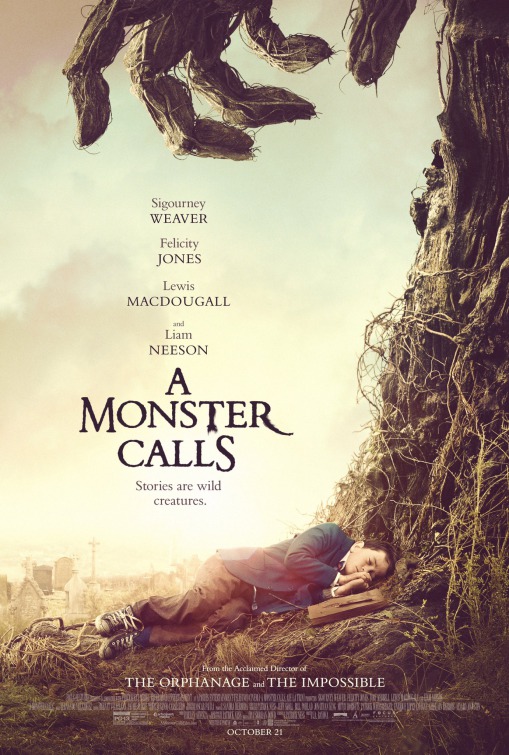
Too Old To Be A Kid, Too Young To Be A Man (A Monster Calls review)

Why is the stories from our youth always seem to have the most impact on us as adults? They leave a legacy all their own and one which compounds over and over again, creating ripples in the lives of those around us.


A Monster Calls (2016)

Cast: Lewis MacDougall, Sigourney Weaver, Felicity Jones, Toby Kebbell, Liam Neeson, James Melville
Director: J.A. Bayona
released on blu-ray March 28, 2017
********* 9/10

IMDB: 8.0
Rotten Tomatoes: 82%, Audience Score 88%
The Guardian: ****/*****

Juan Antonio García Bayona, better known as J. A. Bayona, is a Spanish film director. He is the guy responsible for The Orphanage, The Impossible, and now A Monster Calls. Which should probably have been called The Monster. Just saying. Anyway, he is now set to direct the fifth instalment of the Jurassic Park film series, Jurassic World II.

Bayona is now going three for three, so I’d say it’s a safe bet that this is a heartfelt and glowing review. Just look at the plot, if you don’t believe me. Taken from Wikipedia…

Young Conor O’Malley (Lewis MacDougall) must face his mother’s (Felicity Jones) terminal cancer, his strict grandmother (Sigourney Weaver), his estranged father (Toby Kebbell), and his school bully, Harry (James Melville). One night at 12:07 a.m., Conor encounters the tree-like Monster (Liam Neeson), who tells Conor it has come to relate three true stories, after which Conor will tell the Monster his own story, the truth behind his nightmare. They continue to meet at 12:07 to tell the stories.

First story

An old king who has lost his entire family, save a young grandson, remarries a beautiful young woman. He dies before the prince comes of age, and many believe the queen poisoned the king. Not wanting to hand the kingdom over to the prince in a year, she plots to marry the prince and remain queen. The prince runs away with a farm girl he loves. They stop and sleep under a yew tree (the Monster), but in the morning he finds the young woman murdered. The prince tells the villagers that the queen, a witch, must have done it, and they rally to overthrow her. The monster awakes and joins the mob. Before the commoners can reach the queen, the Monster carries her away to a far-off land where she lives out the rest of her life in peace. Though she was indeed a witch, she did not kill the young woman or the king. The prince had murdered the young woman in order to inspire his people to back him into overthrowing the queen.

Second story

An apothecary follows old traditions and beliefs, using herbs and brews to cure ailments. His business becomes less popular as a local parson tells his congregation not to accept the apothecary’s old ways. When the parson’s two daughters become sick, the parson asks the apothecary to save their lives after all other resources are exhausted. When the apothecary asks why he should help a man who has turned people away from his skills and denied him the yew tree, his best source of healing ingredients, the parson promises to give him the tree and deliver the parishioners to him as customers. Yet the apothecary says that he cannot help, and the girls die. The Monster awakens from the yew tree to destroy the parson’s house and raze it to the ground as punishment.

While the apothecary was a greedy man, he was a healer and would have saved lives, including the girls’, if the parson had allowed him his way of life. The parson was a man of belief, but was willing to discard his beliefs when they were in the way. The healing traditions followed by the apothecary require belief in order to work; without the parson’s, the apothecary was unable to treat the two girls. Belief is half the cure.

Third story

A man was invisible because no one ever saw him. Tired of this, he summoned the Monster to ensure people would take notice.

Fourth story

Conor must confront his nightmare to tell the fourth story. His mother has been pulled to the edge of a cliff by a sudden collapse of the ground, and Conor must hold her hand to save her from falling. Eventually, his grip fails and his mother falls. The Monster forces Conor to confess the truth: Conor loosened his grip on purpose. While he could have held on longer, he let go in order to stop the pain of having to hold on. Conor ultimately understands the complexities of human beings, and that though he doesn’t want his mother to die, he understands it is inevitable and something he must accept, and that he wants the experience to be over.

After this, Connor returns, with the Monster by his side, to comfort his mother one last time, and she dies at 12:07. He returns home with his grandmother, who becomes caring towards him and gives Conor a room of his own, a room that used to be his mother’s. In the room he finds his mother’s old art book, which depicts the characters of the stories that have been told by the Monster, and a drawing of his mother as a child with the Monster.

Sad, thoughtful, and penetrating, A Monster Calls tells a story that we can all relate to, or at the very least, one which means something for the kid in all of us. I don’t know about you, but films which feature the loss of a parent always get me tearing up, but whether that is true for you or not, I can say with damn near perfect timing that Lewis MacDougall has the acting chops necessary to get you to feel the pain of bereavement. It simply is worthwhile.

Pros: The message is accessible, ushering away the monsters of youth with wonderment and fateful stories. Even the darkest moments of the film are made brighter by the authenticity of it’s narrative. Lewis MacDougall shines.

Cons: It can be a struggle to see Sigourney Weaver as a grandmother, and the bullies of the film feel more like pieces to be moved then real characterizations.

Runtime: 1 hour 48 minutes

Points of Interest: Liam Neeson appears as Conor’s grandfather in the photo of Conor’s mother as a little girl being carried by her father. The sixth time that Liam Neeson has voiced a CGI character –  three times as Aslan in the Chronicles of Narnia franchise, Phango in Khumba, and Good Cop/Bad Cop in The Lego Movie.

Too old to be a kid, too young to be a man. That’s how this films opens on the story of Conor, who is watching is mother die of a terminal illness. Where the fantasy intersects with reality is the beauty of this story, and it reminds me of the widely underrated film, Bridge to Terabithia, which also took advantage of childhood fantasy as a device for growing up amidst personal tragedy.

theories Summarized

The stories the Monster tells are really and truly for Conor’s sake, to aid him in his healing. It’s all beautiful and symbolic given that the Monster is a yew tree (known for it’s healing properties), while the Monster and the stories he tells are in fact derivative of Conor’s mothers own childhood drawings.

Most of all there is something moving in knowing that Conor doesn’t understand everything yet, and that might not ever, and the theory that monsters aren’t always what they seem.

Tim!

Return of the Prequel (Rogue One: A Star Wars Story review)

Let me tell you a story from when I was a young lad. A story that always reminds me of the past, but not because it is of my own past, but because it is a story of another history, one of long ago and far away.

I first really and truly watched Star Wars when I was eleven years old. At Christmas time, no less. But I was actually exposed to it in would be one of many common experiences of my childhood. My dad was in the living room on a weekend evening  and I strolled in to find him just in the midst of a Star Wars marathon. I sat down and was enthralled immediately.

An odd kid looking to escape from the doldrums of youth. I had found one of my many happy places. Then again, as I mentioned, the next Christmas I found a box set of Star Wars under the tree with my name on it.

Thus began a lifetime of fandom.


Rogue One: A Star Wars Story (2016)

Cast: Felicity Jones, Diego Luna, Alan Tudyk, Donnie Yen, Wen Jiang, Ben Mendelsohn, Forest Whitaker, Mads Mikkelsen, Riz Ahmed
Director: Gareth Edwards
released on blu-ray April 4, 2017
********* 9/10

IMDB: 8.0
Rotten Tomatoes: 82%, Audience Score 88%
The Guardian: ****/*****

Gareth Edwards is a fairly young director. At age 41 he has directed only three major films. The first was Monsters, an independently made science fiction feature, followed up by the 2014 Godzilla remake, and now, the first of the Star Wars anthology films – Rogue One.

Rogue One is the original Star Wars fan film. It hits all the major heartstrings, while providing enough visual interest to feel different than the the original trilogy – a future that has already happened.

Now, I’m going to do my best not to retell the whole plot of Rogue One, because I think that this story deserves to be seen first rather then read. But I will give you a brief overview out of consideration for what this movie does.

Galen Erso (Mads Mikkelson) has hidden his family away from the Empire. One day Director Orson Krennic (Ben Mendelsohn) arrives to get assistance in completing the Death Star. In the process Galen’s wife Lyra is killed, Galen is captured, while daughter Jyn escapes and is taken to safety by Rebel extremist Saw Gerrera (Forest Whitaker).

Jump forward fifteen years, and Empire cargo pilot Bodhi (Riz Ahmed) has defected, and smuggled a message from Galen to Saw… One that will set forward the next three films in the main Star Wars story. During this story we see adult Jyn (Felicity Jones) meet fellow rebels Cassian Andor (Diego Luna), reprogrammed Imperial droid K-2SO (Alan Tudyk), and Jedha temple monks Chirrut Imwe () and Baze Malbus ().

Cassian is on a mission to kill Galen, and prevent the Death Star from being completed, while Jyn wants to get Bodhi to the Alliance to prove her fathers worth. Because of this conflict Krennic does everything he can to tie up loose ends, destroying cities, killing members of the Empire and Rebel Alliance alike, even gaining the attention of Lord Vader.

In one of the most epic wartime sequences ever, we witness The Battle of Scarif, where the Alliance fights to gain essential intel on the Death Star. There are heavy losses on both sides, but in the end the Rebels gain a victory and set up the beginning of A New Hope – mere moments later.


This is a movie for the fans, made by someone who is a fan of the Star Wars mythology. With direct tie-ins to Episodes I, II, II, IV, and the animated series Rebels, Rogue One is Star Wars. Which probably seems vague, but what I mean is that it is so clearly miming the 1977 Star Wars film, before it became Episode IV, that it can’t help but make us happy. Because it looks new but retains that retro future aesthetic we’ve come to love.

Pros: The fast pacing and limited interactions we get with each character only further demonstrate the impact of war on life, appearing at once fully, and then suddenly gone. It expands upon the universe in a very satisfactory way.

Cons: After the bleakness and the hard won battle are over, you have to wonder if you really experienced anything new at all. Plus where is the charm? Also, I didn’t like Vaders red eyes, like at all.

Runtime: 2 hours 13 minutes

Points of Interest: The Rebel base at Yavin IV features the same kinds of cardboard cutout ships that the original movie did back in 1977. The is the first Star Wars movie to not mention the name of Skywalker in it.

Rogue One is a mad dash to the finish action-adventure film, and one where we know how it all ends. But it’s in the journey that we get to enjoy new characters like Chirrut and Baze, and witness Saw Gerrara as he fits into the mix, as a sort of de-powered Darth Vader.

theories Summarized

In light of my recent Cross Talk episode wherein we discussed movie Easter eggs, I would like to point out that this film is absolutely riddled with them – and some cameos too! Now to be clear, that doesn’t mean that I want to spoil the rest of my review by pointing them all out, but yes, R2-D2 and C-3PO do make a very brief appearance.

Is Rogue One perfect? No, but I can gladly admit that it holds true to canon, is entertaining, and if you are a fan, like the vast majority of the world is at this point, you’ll enjoy it too.

Tim!
Prequel Fever Dreams (Fantastic Beasts and Where to Find Them, review)

When exploring new ground, sometimes we have to stumble in order to improve upon what preceded us. And other times we pave the way for greatness, where does this movie fit into the mix?


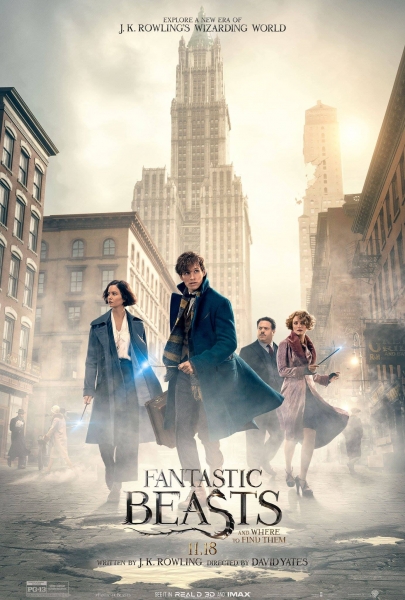
Fantastic Beasts and Where to Find Them (2016)

Cast: Eddie Redmayne, Katherine Waterston, Alison Sudol, Dan Fogler, Colin Farrell, Samantha Morton, Ezra Miller
Director: David Yates
released on blu-ray March 28, 2017
******* 7/10

IMDB: 7.5
Rotten Tomatoes: 73%, Audience Score 80%
The Guardian: ****/*****


David Yates is an English filmmaker who has directed both feature length and short films, as well as a host of television shows, television films, and mini-series. Yates rose to prominence after helming the last four Harry Potter films, and has won quite a few accolades in his time, including six BAFTA awards. Since then, he has gone on to direct the visual stinker known The Legend of Tarzan, and since then… Fantastic Beasts and Where to Find Them.

But was it any good?

I think that we can fairly safely state that Yates has a good record with J.K. Rowling adaptations, but I have to wonder if the hype train and guiding hand of Rowling didn’t have a lot to do with his previous successes. Whereas FBAWTFT draws on Harry Potter mythology without having much true direction of it’s own.

That being said, it IS an interesting film, without ever really standing on it’s own two legs. It’s more entertaining for fans of Harry Potter than the average film goer.

In the mid 1920s British wizard and magizoologist Newt Scamander (Eddie Redmayne) has come to New York en route to Arizona.

He encounters the New Salem Philanthropic Society, run by Mary Lou Barebone (Samantha Morton), which believes magic is real and bad. During the presentation, one of Newts creatures escapes from his briefcase and on his way to recover the Niffler, Newt bumps into another no-maj and aspiring baker, Jacob Kowalski (Dan Fogler). As a consequence, they swap cases.

Demoted Auror Tina Goldstein (Katherine Waterston) watches all of this, and then arrests Newt as an unregistered wizard. She takes him to the Magical Congress of the United States of America (MACUSA) headquarters, they discover the baked goods inside, and Newt is released. At Jacob’s tenement apartment, several creatures escape from Newt’s suitcase.

Tina and Newt track down Jacob and suitcase, wherein Tina introduces them to Queenie (Alison Sudol), her mindreading sister. Queenie and Jacob hit it off instantly but American wizards can’t be with no-majs.

We then learn Newt has an Obscurus, a parasite that develops inside magically gifted children if they suppress their gifts. Newt then persuades Jacob to help search for the missing creatures. MACUSA officials arrest them and give them the death sentence, thinking Newt and compay are responsible for a mystery creature killing in the city. Director of Magical Security Percival Graves (Colin Farrell) accuses Newt of conspiring with dark wizard Grindelwald, but Queenie and Jacob rescue them and they escape.

Graves approaches Credence Barebone (Ezra Miller), Mary Lou’s adopted son, and offers to free him from his abusive mother. Credence needs to find an Obscurus in turn. But Credence is the Obscurus’ host, and a strong one at that, as most hosts die before ten years of age.

Newt finds Credence, but is then attacked by Graves. Each side tries to coerce Credence to them, but aurors arrive and disintegrate the boy. Graves admits to unleashing the Obscurus, as he is Grindelwal in disguise. He wants to expose the magical community to the world. Luckily Newt has a Thunderbird, which can use rainfall over the entire city to erase all no-maj memories. Jacob must participate in this cleanse as well, and Queenie kisses him goodbye.

The movie ends with a secret gift from Newt to Jacob allowing him collateral to open his bakery, Newt leaving for Europe to write his book, and Queenie eventually seeking out Jacob regardless of the law.

As I mentioned already, it’s an interesting film, and definitely a welcome deviation from the Harry Potter franchise, but the plot feels thin in places, and it’s protagonists don’t seem overly invested in the larger problem of wizard prejudice and wizard terrorism. They are happy to collect their creatures until someone tells them otherwise.

Pros: It is an original story with interesting characters and headed by a rising star in Eddie Redmayne. The pace is nice and slow at the start, letting us explore the magic of this universe from a new perspective.

Cons: The action seemingly comes out of nowhere towards the end, and the stakes are raised almost inconsequentially. There are almost too many good things going on, and yet it is frustrating to learn this is not a stand-alone film, but a set up for a new franchise.

Runtime: 2 hours 13 minutes

Points of InterestThe name New Scamander appears on the Maurader’s Map in Harry Potter and the Prisoner of Azkaban. It was originally supposed to be a trilogy of movies, but has now been confirmed as a five part series.

Eddie Redmayne and friends breath fresh new life into a franchise which I can honestly say I thought was finished. And I’m fairly happy with the results. Granted, I’ve seen New York in film far too many times at this point to be excited about a 1920s fantasy version of the city, but all the same, it’s fun to see the wizarding world of Harry Potter expand outside of the United Kingdom.

theories Summarized

This is a movie definitely worth it’s salt, given how difficult it is for prequels to get off the ground these days, but I will do you one better with a my review coming next week. A story for the ages, and my theory on how it attracted both fans and newbies will be a good one.

Tim!