Post-Apocalyptic Triangulation (Z for Zachariah review)

People are sick. They have an odd fascination with the end of the world as we know it. EOTWAWKI for short. But the problem with the EOTWAWKI is that it’s been done so many time in film, music, visual art and literature now, that we don’t really react to it as viscerally as we should.

I blame it on summer blockbusters, but that’s just my theory. Now, where it gets interesting is when we start to explore movies that deal with the subtleties of what could happen both during and post. Today’s review is about the later.


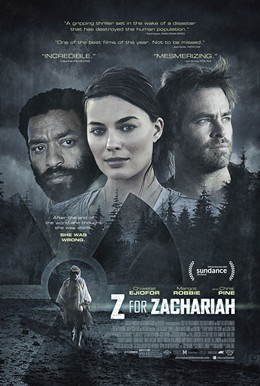
Z For Zachariah (2015)

Cast: Chiwetel Ejiofor, Margot Robbie, Chris Pine
Director: Craig Zobel
released on blu-ray October 20, 2015
******** 8/10
Z_for_Zachariah_poster

IMDB: 6.0
Rotten Tomatoes: 79%, Audience Score 45%
The Guardian: ***/*****

Craig Zobel is an American director, who got his start as a co-founder of the animated web series Homestar Runner. If you don’t know anything about Homestar Runner, you need to go check it out right now. Stop reading this review and watch some episodes of the show. Start with the back catalogue first, especially the Strong Bad Emails. Done? Good.

How weird is it that the guy who made that show is making serious movies now? I find it very unsettling, especially considering how much I enjoyed Z for Zachariah. And the fact that Zobel also directed Compliance, a 2012 movie about the strip search prank call scam that happened in the United States in the early 2000s.

Z for Zachariah is the story of a woman named Ann (Margot Robbie) who has survived nuclear war. She is living on her family farm in the middle of a valley – which has somehow been sheltered from the fallout, with the exception of water that comes over the falls from the mountains. She has a good routine which involves feeding both her and her dog, tending the land, and enjoying music and books.

One day a stranger (Chiwetel Ejiofor) enters the valley in a radiation suit. He was working in a government bunker and avoided the initial attacks, but has definitely been effected by the radiation and loneliness from searching for survivors. When he stumbles upon Ann’s valley, he immediately goes to the falls to clean himself, but Ann jumps out and warns him of the radiation. The man gets sick, and she cares for him until he is well, asking God that he might live. We learn his name is John Loomis, and both Ann and John begin to trust one another.

At one point John suggests that they build a waterwheel to divert the water and generate power, however because it would require a break down of the community church that Ann’s father built, she is reluctant to do so, and John drops the subject. Their chemistry and sexual tension increases over time as well, and just as the relationship is about to blossom another stranger shows up. His name is Caleb (Chris Pine) and he has a different perspective on how events should play out than John.

This is where the story gets interesting, a love triangle forms between the three characters, with conflict between John wanting Ann for himself, wanting her happiness, distrust for Caleb and Ann caught in the middle. We get to witness the full range of emotions that each character has about the other two, without a ton of dialogue. In some ways, it simplifies the plot, but in others it sets the story up for a rather poignant ending, which I won’t ruin because I think it’s worth saving.

Pros: It is a very thoughtful story, albeit somewhat slow in it’s pacing. But with the decision made, it allows the viewer the opportunity to really mull over what has been seen and wonder whether characters are committing deeds out of love or self-love.

Cons: The movie struggles with knowing when to speed up and really make a choice about it’s message. We are left to fill in a few of the gaps ourselves.

Runtime1 hour 38 minutes

Points of Interest: Based upon a book by Robert C. O’Brien, the love triangle is not in the original story, which only featured Ann and John.

This is a nuanced and interesting take on the post-apocalyptic film. Chiwetel Ejiofor gaves a nuanced performance and makes you question his character though he is set up as the sympathetic male lead from the start. Margot Robbie of course delivers with a range of emotions and her obvious naïveté as a young woman who doesn’t know what to do. She pulls it off well. And of course, Chris Pine is always charming and interesting with his devil-may-care attitude. While Z for Zachariah s not quite the same thing as the book, Zobel manages to construct an interesting story all the same.


This post-apocalyptic movie is definitely a slow go, but it does ask the question – what if you had all the time in the world? What would you do? And then what would you do if all of a sudden there was a possibility that you had to suffer as a third wheel in an infinite loop? Zobel manages to expose these shifts in power and opportunity, never revealing what each characters true motivations are. I doubt you’ll catch many Z’s after watching this one, but that’s just a theory.

Tim!
Mind Your Own Business (Your Business Plan)

You ever have someone tell you to mind your own business, dear readers? It’s a fairly common saying in our western culture. It’s supposed to be a direct way of telling others to stop meddling in that which does not concern them.

The expression started out innocently enough.

It came from the Christian bible and in particular from the New Testament. I’ll share the verse with you for reference –

…and to aspire to live quietly, and to mind your own affairs, and to work with your hands, as we instructed you,

1 Thessalonians 4:11

As time passed it slowly entrenched itself into our culture more and more, and even had a place on the first official 1 cent coin of the United States when it was designed in 1787.

By the 1930s a slang version of the phrase came up, which stated “mind your own beeswax.” Author Eric Frank Russell shortened the phrase into Myob!, and various comedians like Kevin Hart and Eddie Murphy have used it in their standup. My personal favourite is, of course, from pop culture.

Will Smith’s Fresh Prince persona has a solid point.You have to stand up for yourself and if it comes to it, tell people to lay off. Now, what does that have to do with today’s Wisdom Wednesday? Well, if you recall there was a time, roughly two months ago, when I wrote about the importance of marketing. And it just so happens that one of the associated points on marketing for a professional was developing a business plan.

Your reason to be, or as they say in french, votre raison d’être.

Writing you business plan may seem stressful at first glance, but it’s not that difficult to do, which is why we will start with the framework of your business plan –

http://www.canadabusiness.ca/eng/page/2753/

Business plans come in all shapes and sizes, but every business plan needs to consider its audience, the business goals, and especially the mode of delivery. I took this layout directly from the Canada Business Network section of the Government of Canada website, so you know that we’re not messing around on timotheories.

Here are some sections that you could POTENTIALLY include in your plan:

  • Executive summary
  • Business strategy
  • Marketing strategy
  • Operational plan
  • Strengths, weaknesses, opportunities and threats analysis
  • Human resources plan
  • Social responsibility strategy
  • E-business strategy
  • Financial forecasts and other information
  • Business exit strategy
  • Additional resources

But now you’re probably wondering how to get started in filling out those sections. Well, I went to another website to dig up some info on example business plans and get you art makers and art shakers some tips.

And here are a few tips to get you started on your own business plan –

  1. Look at other industries that already do what you do, for inspiration. But you need not worry about looking for a duplicate match. The reality is that even if another business functions similarly to yours, every business has a different location, team, and business strategy governing it. Just like individuals.
  2. Emulate their plans at the first draft, and scour other sources with each revision. Good artists copy ideas, and great artists steal them. I think some guy obsessed with apples said that once. You’ll get over your initial fears, learn something about your business, and potentially gain new ideas.
  3. Remember to write your business plan, avoid the copypasta. Professionals like lawyers and accountants can see through this and because your vision isn’t there, you only hurt your businesses chance of success in the long run.
  4. Like art, the real joy and growth comes from the process. You are creating a business plan. And like any creative pursuit, questions arise and insights are gained. You’ll be forced to answer questions you didn’t know you had, and you can then share your vision with stakeholders and anyone you think should know about it.
  5. Build a better business by using your plan every day. Put it on the wall, and keep it there so that any time you have questions about growth, strategy, and costs, you can stay on target and grow your business the right way.

All of it comes down to this, if you mind your business, people will mind their own and you’ll get a innumerable amount of monkeys off of your back. But that’s just a theory.

Tim!

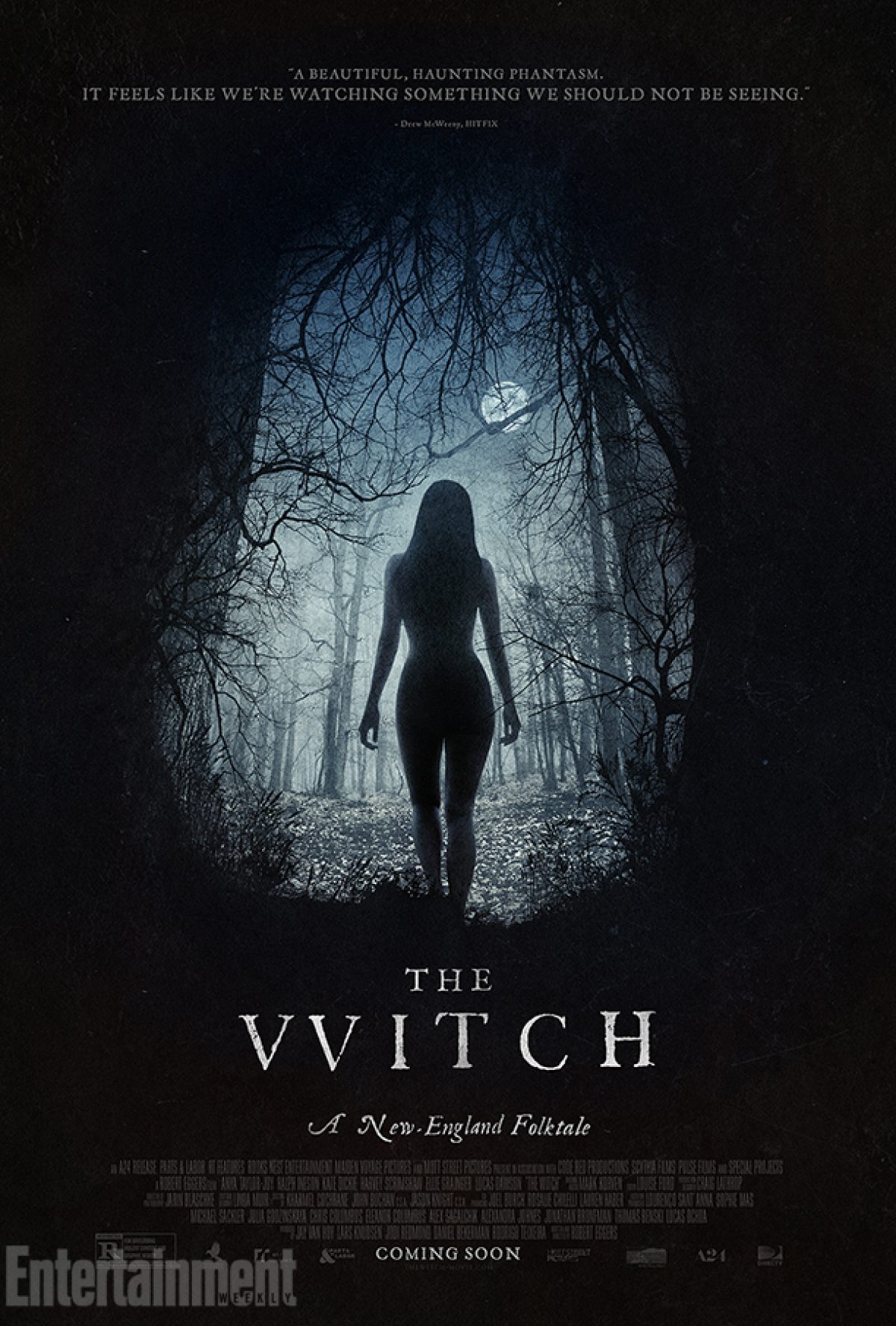
The Creep Show (The VVitch review)


It can be difficult to watch a horror movie even in the daytime. Horror movies are designed to use your natural fears (and sometimes create fears) to get a negative emotional response.

If you feel bad while watching a horror movie, it’s doing its job. This week’s review did that and more. I watched last Tuesday and I am still creeped out.


The VVitch (2015)

Cast: Anya Taylor-Joy, Ralph Ineson, Kate Dickie, Harvey Scrimshaw
Director: Robert Eggers
released on blu-ray May 17, 2016
********** 10/10

The-Witch-Poster-Large_1200_1776_81_s

IMDB: 6.9
Rotten Tomatoes: 91%, Audience Score 55%
The Guardian: ****/*****

Robert Eggers is an American film director and screenwriter, best known for his 2015 film The Witch, originally titled The VVitch: A New-England Folktale.


Did you know that The Witch is Eggers own script? It’s an old concept, that of a ghost story. But we are used to seeing modern tellings of these myths and legends. Eggers decided to direct a story about the beginnings of western culture. Set in New England The Witch is a tale of evil in the woods, plain and simple.

The story is rather chilling too.

In the 17th century a puritan family is banished from their larger plantation community because of the fathers accused pride (Ralph Ineson). We then watch husband and pregnant wife move to a large forest and build a farm there with their four children. Some time passes and Katherine (Kate Dickie) gives birth to their fifth child.

The story slowly unfolds as newborn Samuel goes missing while the oldest girl Thomasin (Anya Taylor-Joy) is babysitting him near the woods. It reminds me very heavily of listening to a camp-fire story except we have the added bonus/cruelty of witnessing the story for ourselves.

As a movie, The Witch functions as something of a slow-burn, carefully building towards the climax but not revealing the source of the kidnapping until the final scenes. This is intentional and helps to cement The Witch as a unique piece of horror cinema.

Playing off elements of both ambiguity and very clear scenes, the fear and paranoia is what sets up the tension but the final scene and the lingering thoughts and feelings after the curtain call are what make this one so haunting.


Pros: Horror has great potential to make you see things you didn’t want to see, when done right. This movie is one of those diamonds which is both scary and intelligent at the same time.

ConsOddly enough, it does such a good job of accomplishing what it sets out to do, that I have a hard time recommending it to others to watch because they may either miss the point or be too heavily affected by it.

Runtime1 hour 32 minutes

Points of InterestEggers based his film on research of New England witch hysteria, several decades before the Salem Witch Trials. Stephen King admitted that he is terrified of this film, also The Satanic Temple has endorsed this film, if that means anything.

While I am not certain if this is a film focused solely on female empowerment, a classic and well-executed horror story, commentary on Christian themes or possibly a combination of the three, The Witch is like nothing I’ve seen in some time.

The Witch has given me some bad dreams, I don’t think I’ll sleep well for a few weeks. Regardless of the terrors presented, this movie manages to walk a fine line between scary and conceptual, and while I wouldn’t recommend it to the impressionable or those with strong religious convictions, it is something to consider and think upon.

Hopefully it doesn’t give you nightmares.

Kill Your Darling Mother Goose (History of Easter Eggs)

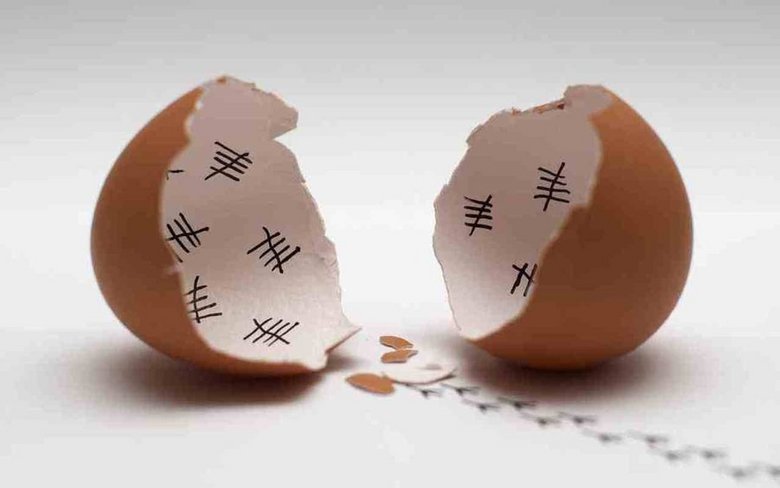
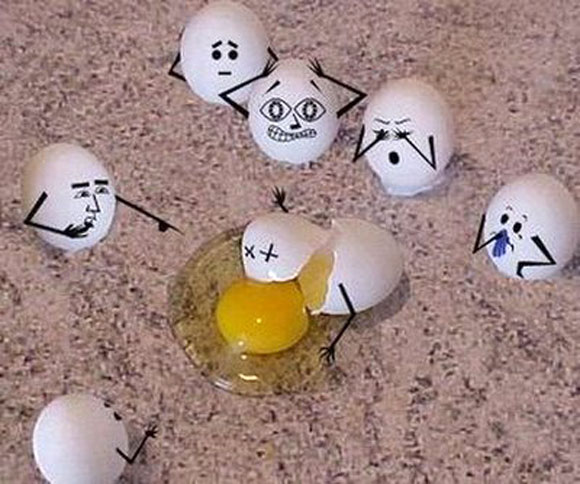
Now that the chocolate withdrawal has begun to rear it’s ugly head, I thought this was a good time to take some time and discuss the Easter tradition, as it relates to art. It is Timely Thursday after all, dear readers.

funny-pictures-auto-egg-birth-480271

Whether you are gung ho for Easter or not, it is a commonplace event in Western culture and is celebrated for a few different reasons. Some do it to celebrate a tradition, others feel obligated to keep their children included and their colleagues in a state of uniformity, still others really really like the ideas espoused in the messages (family, charity, giving, togetherness, etc.) both from a religious or secular viewpoint.

The reality is that there is more than meets the eye to the tradition of Easter, both from a Christian perspective and a secular one.

It has a lot do with notion that whatever the dominant religion is in a culture, most people won’t reference the detailed aspects of the tradition, they just do what their families and friends have always done, and that is how events like this slowly evolve over time.

Look at the history of the Easter egg for example, a lot of people believe that Easter eggs are decorated and given out to symbolize the empty tomb of Jesus (death and rebirth), others believe it is a symbol of spring time, represented by the Easter Bunny. Which makes a lot of sense, but isn’t necessarily realistic.

The reality is kinda a combination of the two beliefs, and they just layer right in there. The tradition of the Easter egg stretches as far back as to ancient Africa, over 60,000 years ago. And we have evidence that eggs were symbols of fertility, death and rebirth, via the Sumerians and Egyptians about 5000 years ago – being placed in graves and decorated with gold and silver.

2

Christians in Mesopotamia started the practice of staining eggs red, as a symbol of the blood of Christ. And this invariably spread throughout the different Christian communities over the centuries. Which is why Russians and Greeks got ahold of this practice, and it eventually made it’s way through different European countries…

Taken from Wikipedia and edited,

In the Orthodox churches, Easter eggs are blessed by the priest at the end of the Paschal Vigil (which is equivalent to Holy Saturday), and distributed to the faithful. The egg is seen by followers of Christianity as a symbol of resurrection: while being dormant it contains a new life sealed within it…

In Greece, women traditionally dye the eggs with onion skins and vinegar on Thursday (also the day of Communion). These ceremonial eggs are known as kokkina avga. They also bake tsoureki for the Easter Sunday feast. Red Easter eggs are sometimes served along the centerline of tsoureki (braided loaf of bread)…

The dying of Easter eggs in different colours is commonplace, with colour being achieved through boiling the egg with either natural colours (such as getting brown by using onion peels, black by using oak or alder bark or the nutshell of walnut, or pink by using beetjuice), or using artificial colourings.

When boiling them with onion skins leaves can be attached prior to dying to create leaf patterns. The leaves are attached to the eggs before they are dyed with a transparent cloth to wrap the eggs with like inexpensive muslin or nylon stockings, leaving patterns once the leaves are removed after the dyeing process...

Pysanky are Ukrainian Easter eggs, decorated using a wax-resist (batik) method. Many other eastern European ethnic groups decorate eggs using wax resistant batik methods for Easter. The word comes from the verb pysaty, “to write”, as the designs are not painted on, but written with beeswax.

As you can see from the excerpt above there is an incredibly storied history to the Easter egg, and a ton of opportunity to contribute to it’s future. But what do you think? Do you decorate eggs every spring and have you ever considered using eggs as symbols in your art? Know any expert egg painters? Please leave some comments and we’ll eggsecute a discussion.

Sorry I had to, I mean I had all this unused internet to write on… Please don’t leave, I can eggsplain, I was recently eggshiled from my family and I make yolks when I’m lonely.

Okay, I’m done. I got all the fun I could get out of that joke. And I’m out of theories for now friends, so please have an eggsellent weekend, and I’ll catch you on Sunday evening for something stimulating!

Tim!

Flower Power (The Cult, Hidden City review)

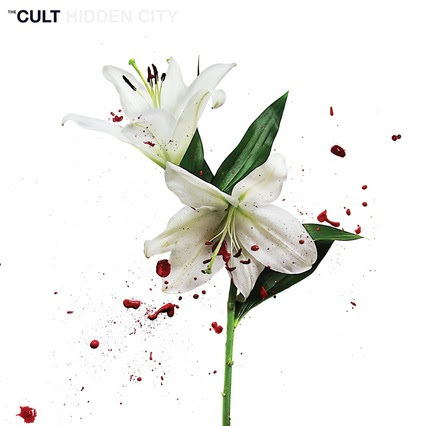
Lilies have a few symbolic purposes in culture. From Greek culture in particular, the lily represents birth and motherhood, and also sexuality. In Christian symbolism, it stands for chastity, innocence, and purity. When we get into the esoteric, we can combine the symbols of purity, innocence and fertility together, and then add in vulnerability and freedom of identity.

This week’s album is made by a musical group known for their love of exploration and consideration of the details, I wonder which symbols their lilies represent?


The Cult – Hidden City
released February 12, 2016
******* 7/10

the-cult-hidden-city

The Cult are a British rock group which have been reunited twice since forming in 1983. Touted as a post-punk and goth-rock band since their inception, they are famous for the singles She Sells Sanctuary and Rain.

The group gained enough traction to enter into North American markets by the end of the 1980’s and kind of did things at their own pace after that point.

Hidden City is the 10th studio album by The Cult, and the third in a “spiritual trilogy” produced by Bob Rock.

I’ve always been a fan of The Cult since I first discovered them in my teenage years. This was well after they had already broken up once and were on their way to another split, but GTA: Vice City introduced a 90’s kid to popular music from the 1980’s, which I’m thankful for. And so  not content to collect the anthology, I eventually decided to buy Best of Rare Cult; a compilation of selected songs from the Rare Cult box set, which had been released in the fall 2000.

Maybe I’m fortunate for this decision or maybe not, but Hidden City features the energy of that compilation album and some of their more experimental artistic decisions.

For instance, Dark Energy is an incredibly appropriate high energy opener, laced with helpings of both mysticism and spirituality, something to get you excited and remind you why The Cult has a cult following, so-to-speak. How convenient for them!

In Blood features soft beats and dreamlike lyrics, while Birds of Paradise takes this further and really heightens the emotional pull.

Hinterland feels like an anthem for spiritual awareness but upon closer inspection I think it’s also an admission of guilt by Ian Astbury to the problems of ignorance and following routine in an age of connectivity and political intrusion.

But that’s the thing about The Cult. The surface and the core aren’t always the same and they play with this idea throughout the record.

Avalanche of Light has a great chorus and reminds me the major reason why this album exists in the first place. The Cult are exploring the intimate and the unknown – Hidden City is a metaphor for us. The tools may be guitars, drums, and microphones, but the result is still the same, a record by The Cult which features goth-rock like tracks Lilies and Deeply Ordered Chaos, which share in the metaphors of life.

You should check out the audio video for Dark Energy and the music videos for Deeply Ordered Chaos and Hinterland to get a taste for the album, but if you like The Cult, goth-rock or are looking for a place to test the waters of hard rock, Hidden City is a good place to go spelunking.


At albums end, I have to admit I’m not perfectly sold on the perfection of these tracks, but this is a damn good record either way. I’m inclined to theorize The Cult is pulling all of those lily symbols in and out of their songs, but I’ll let you be your own judge, after all, you have your own Hidden City to look after.

See you tomorrow for another shadowy review, this time it’ll be a movie.

Tim!