
Make A Name For Yourself (Moonlight review)

I’ve always wondered how much of our identities stem from ourselves, and how much of them come from the world that surrounds us.

Are we peerless souls encased in moonlight, shimmering ever so slightly in shades of indigo as the night wears on? Who is you?


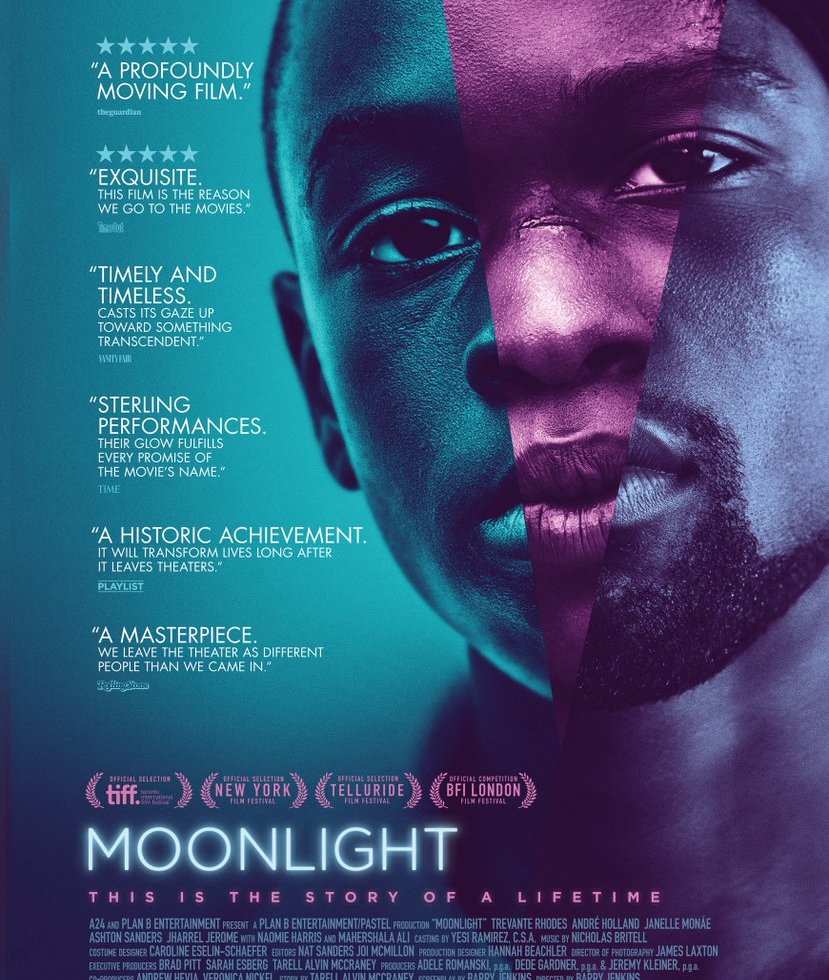
Moonlight (2016)

Cast: Mahershala Ali, Alex R. Hibbert, Janelle Monae, Naomie Harris, Ashton Sanders, Jharrel Jerome, Trevante Rhodes, André Holland
Director: Barry Jenkins
released on blu-ray February 28, 2017
******** 9/10
IMDB: 7.7
Rotten Tomatoes: 97%, Audience Score 83%
The Guardian: *****/*****


Barry Jenkins is a an American film director and writer who has made two films thus far in his career – Medicine for Melancholy and Moonlight. There is an eight year gap between those two films, which I find kind of unsettling, but it managed to get the movie tons of accolades, so who am I to judge on his methods of working?

Moonlight is an interesting film, to say the least.

If we were to be honest with ourselves, would we not all have very different identities at various stages of our lives? Stages which defined us and drove our purpose forward, not matter the personal cost? That’s what Moonlight asks, all through the lenses of vulnerable gay black man, while simultaneously telling a universal story about identity. It’s intelligent, beautiful, difficult to stomach at times, and it is both timely and timeless.

The story is broken up into three parts – Little (Alex R. Hibbert), Chiron (Ashton Sanders), and Black (Trevante Rhodes).

The first part focuses on Little, a little boy named Chiron who is constantly teased by other children, but who receives little help from his drug-addicted mother. One day he is found by Cuban drug dealer Juan (Mahershala Ali), who decides to let Little stay with him and his girlfriend Teresa (Janelle Monae) for the night. Eventually Little tells Juan how to find his mother Paula (Naomie Harris). Juan spends a lot of time with Little, teaching him to swim and to become his own man, but Paula continues to be a bad influence on the boy, calling him a faggot at one point. Juan is ashamed when Little asks him if he ever sells drugs to his mother.

The second part is about teenaged Chiron. Frequently bullied at school, Chiron spends time between his now prostitute and drug-addicted mother and the widow Teresa, as Juan had died previously. Juan is friends with Kevin (Jharrel Jerome), but has a dream in which he sees Kevin having sex with a woman. On a different night the two friends smoke a joint together, discuss the nickname of “Black” that Kevin has given him, and as the conversation heats up, the two kiss. Then Kevin masturbates Chiron. Then at school, the bullies convince Kevin to punch someone, and Chiron is chosen. Kevin punches Chiron several times, and the bullies assault him, but Chiron won’t reveal the identities of who attacked him. The next day, Chiron assaults one of the bullies and is arrested.

Finally the third part of the story is about an adult Chiron who is now a drug dealer and goes by the street name Black. His mother is in drug treatment and wishes to reconcile, but he ignores her. Then one day an adult Kevin (André Holland) contacts him, leaving a message in which he apologizes for what happened in high school. Black decides to visit his mother and they hash out their feelings. Black then travels to see Kevin, who works at a diner, but Kevin can’t seem to get many details out of Chiron. The pair drive back to Kevin’s and Black finally admits he is not happy nor has he had another sexual encounter since high school. Kevin comforts him, and Chiron thinks back on childhood.

Pros: This movie is not full of big speeches or talking heads explaining feelings. It is full of real dialogue and deep silences, the conflicts of masculine identity are very real here. Stories of identity have been told like this before, but not in this way.

Cons: It has such a strong start with the first and second two parts that the harsh drop-off in intimacy and plot in the third act make up for it, but man do those last twenty five minutes feel strained at key points.

Runtime: 1 hour 51 minutes

Points of Interest: The film is based on the unproduced play “In Moonlight Black Boys Look Blue” by MacArthur Fellow Tarell Alvin McCraney. Two firsts in the history of film, Mahershala Ali is the first Muslim person to win an Academy Award for acting AND this is the first LGBT film, and the first film featuring an all black cast, to win the Academy Award for Best Picture.

Jenkins is lucky. Many directors have tried and failed to capture such a wide audience with a powerful story, and this is only his second film ever full realized. Moonlight might represent a win for the LGBT community and another for the black community, but more importantly I think it represents a willingness for change on the part of decision makers within the film community. And as already mentioned over and over again, Moonlight is an excellent story of identity. It asks hard questions about exposure.

theories Summarized

Do I think this is a perfect film? No. But do I think it’s an excellent study in human nature. So often in life we portray versions of ourselves for others, never fully aware of what we look like to the world we live within. Hopefully the soul is what we see at the end of the day, but only moonlight can cast off those shadows that well. At least, that’s my theory.

Tim!

On The Shoulders Of Giants (89th Annual Academy Awards)

Last year the two words whitewashing and oscars seemed to be synonymous with each other. I wrote a rather exhaustive post about it, point of fact. To be fair, I am an artist though, so it’s quite difficult not to be a lens for the big issues I find wrapped around my heart. Sigh.

Now, I have written about this theory before, but let me remind you that there is an idea out there which states that creative professional experience the highs and lows of life even more deeply than an average person. I want to posit something different from that.

We all feel things very deeply, and humans are capable of amazing things when we work together. In fact, I think it’s because we should work together that we achieve greatness.

Children start out with the same basic abilities and aptitudes, as we age, personalities come through and environments shape us into complex individuals.


The Full List of Nominees

I’ve always been a fan of film. Cinema. The movies. Whatever you want to call it, I’ve celebrated motion pictures in my life.

Sitting here at my desk, I’m watching the trailers for the nine films which have been nominated for Best Picture 2017. La La Land, Moonlight, Manchester By The Sea, Arrival, Hacksaw Ridge, Hidden Figures, Hell or High Water, Lion, Fences. I’ve seen more than half of these movies already and I cannot wait to watch the remaining ones I’ve missed. Films make my heart ache with joy, fear, sadness, compassion, anger, excitement, achievement and a number of other emotions.

It’s because so many creative people come together to engage our sense that films mean something. And I think that this year in particular, the academy has done an excellent job listening to the public. 4 of the 9 choices are headed by minority actors, and that’s a big deal.

La La Land has the most votes by far, and while it is an excellent film, it is something of a self-congratulatory piece about Hollywood. So I really hope that this movie doesn’t take it, because we’ve been there, and done that. And Arrival is my new favourite first contact film. On the other side of the coin, Hell or High Water is a classic film on all accounts – I reviewed it late last year and I loved it. It perfectly serves as to what film making is all about. It would be an excellent dark horse entry.

But looking more closely at the nominees, I have to notice something. I’ve only seen the 5 films with white actors headlining them, and that’s an important point.

Award Winning

When you give an award you are truly GIVING something as payment, compensation or as prize. Consider that statement for a second. How many billions of people are there in the world? 30? And how many different ethnicities make up that total?

The challenge we face is that for decades the Academy Awards (like many other institutions) have focused on certain types of people, non necessarily because those people were the most deserving, but because they were singled out for compensation. As the global community expands, it makes sense that we continue to honour those who do the best job, but in instances where many are deserving, it’s those who go over and above should be awarded. By default these means minority groups which need more representation. I haven’t seen Moonlight or Fences, but could easily see them taking it.

I hope they do. Hidden Figures and Lion would be fantastic as well, but based on what I’ve read, Moonlight and Fences are better films. Guess we’ll find out in three days though.

theories Summarized

#OscarsSoWhite was a necessary rebellion against disrespectful authority. I think with it came even more artists working together this year to create films that represent life as it is, and even better, the voters now have an opportunity to choose recipients that better depict humanity. We may be standing on the shoulders of giants, but while every statue has a head of gold, the feet are always made of clay, and liable to crumble towards the end. It’s time to choose a different champion, and that’s my theory.

Tim!

And The Award Goes To… (Spotlight review)

You ever get that feeling? That you know which person, place or thing is going to win an award or accolade? It’s a rare gift to anticipate the results, and most of the time these kinds of decisions are made based on results or conditions, but sometimes it seems like they are totally arbitrary.

Which is why it was so sweet when I predicted that this week’s movie review would win Best Picture at the Academy Awards in my for-fun betting pool with loved ones.


Spotlight (2015)
Cast: Mark Ruffalo, Michael Keaton, Rachel McAdams, Liev Schreiber, John Slattery, Stanley Tucci
Director: Tom McCarthy
released on blu-ray February 23, 2016
********* 9/10

Spotlight-Poster-27X39-Ang-LR

IMDB: 8.2
Rotten Tomatoes: 96%, Audience Score 94%
The Guardian: ****/*****

Tom McCarthy has directed five films now in his film career. Two of them I have seen and can vouch for their emotional punch; The Station Agent and Win Win. But I have not seen The Visitor nor The Cobbler, and the second one for reasons that it has been critically panned. It is currently sitting at 10% on Rotten Tomatoes.

Which is interesting to me because Spotlight is an excellent film and deserves the rating it currently has of 96%. It’s factual and to-the-point, it doesn’t turn it’s cast into cartoons or make them intellectual giants either.

Which is why I’ve decided to change it up this week and give you a much shorter summary of the whole plot, because I want you to know this story, whether you watch it on digital HD, blu-ray or DVD. And I’m willing to bet you’ll skip the plot if you feel you need to.

Taken from Wikipedia and edited,

In 2001, The Boston Globe hires a new editor, Marty Baron(Liev Schrieber). Baron meets Walter “Robby” Robinson(Michael Keaton), editor of the Spotlight team (including Sacha Pfeiffer (Rachel McAdams) and Ben Bradlee Jr.(John Slattery)), a small group of journalists writing articles that take months to research and publish. After Baron reads a Globe column about a lawyer, Mitchell Garabedian(Stanley Tucci), who says that Cardinal Law knew that the priest John Geoghan was sexually abusing children and did nothing, he urges Spotlight to investigate. Journalist Michael Rezendes(Mark Ruffalo) contacts Garabedian, who initially declines interview. Though told not to, Rezendes reveals that he is on Spotlight, persuading Garabedian to talk.

The team begin to uncover a pattern of sexual abuse of children by Catholic priests in Massachusetts, and an ongoing cover-up by the Boston Archdiocese. Through a man who heads a victim’s rights organization, they widen their search to thirteen priests. They learn through an ex-priest who worked at trying to rehabilitate paedophile priests that there should be approximately ninety abusive priests in Boston (six percent of priests). Through their research, they develop a list of eighty-seven names, and begin to find their victims to back up their suspicions.

When the September 11 attacks occur, the team is forced to deprioritize the story. They regain momentum when Rezendes learns from Garabedian that there are publicly available documents that confirm Cardinal Law ignored the problem. Rezendes argues to run the story immediately before more victims suffer and rival newspapers publish, Robinson remains steadfast to research further and expose the whole system. After The Boston Globe wins a case to unseal more legal documents, the Spotlight team finally begins to write the story, and plan to publish in early 2002.

About to print, Robinson confesses to the team that he was sent a list of twenty pedophile priests in 1993 in a story he never followed up on. Baron, nevertheless, tells Robinson and the team that the work they are doing is important. The story goes to print exposing Cardinal Law, and requesting victims of pedophile priests to come forward. The following morning, the Spotlight team is inundated with phone calls from victims coming forward to tell their stories. The film closes with a list of places in the United States and around the world where the Catholic Church has been involved in concealing abuse by priests.

Incredibly powerful stuff.

Pros: The ensemble cast all feel like real reporters out to right wrongs in the most troublesome of settings. It also doesn’t dive into so much detail that you lose interest.

Cons: The story is already 10 years old and for a film released this year, it looks like it at times.

Runtime: 128 minutes

Points of Interest: The Catholic Church has been rather supportive of this film despite the subject matter and likely because of the accuracy of content, not leaning too far into exaggeration. All of the Spotlight cast members spent a considerable amount of time with their real-life counterparts and the real Spotlight team of the period contributed to the office set, among other details.

I’m sure a lot of you have heard of Oscar Bait before, it’s this theory which is used by film enthusiasts to describe movies that look like they’re made mainly to win Academy Awards or at the very least, to get nominations. Movies released later in the calendar year, to stay fresh in the voters minds and also ensure more commercial success.

Think of period pieces which are set up in a dramatic way… Kinda like Spotlight. But the reason why I think Spotlight is an excellent film, even though it may be considered Oscar Bait, is because it is directly addressing a problem apparent in the social landscape, one of pedophilia and rape. And it tastefully addresses the issue as it relates to the Catholic Church, one which has been on our minds for more than a decade now.

So the theory might hold up here, but who gives a shit? It’s a well made movie about an important issue. But you tell me what you think. Please leave some comments or message timotheories@outlook.com if you want to share some private feedback or get involved.

See you dear readers tomorrow with some wisdom.

Tim!