The Creep Show (The VVitch review)


It can be difficult to watch a horror movie even in the daytime. Horror movies are designed to use your natural fears (and sometimes create fears) to get a negative emotional response.

If you feel bad while watching a horror movie, it’s doing its job. This week’s review did that and more. I watched last Tuesday and I am still creeped out.


The VVitch (2015)

Cast: Anya Taylor-Joy, Ralph Ineson, Kate Dickie, Harvey Scrimshaw
Director: Robert Eggers
released on blu-ray May 17, 2016
********** 10/10
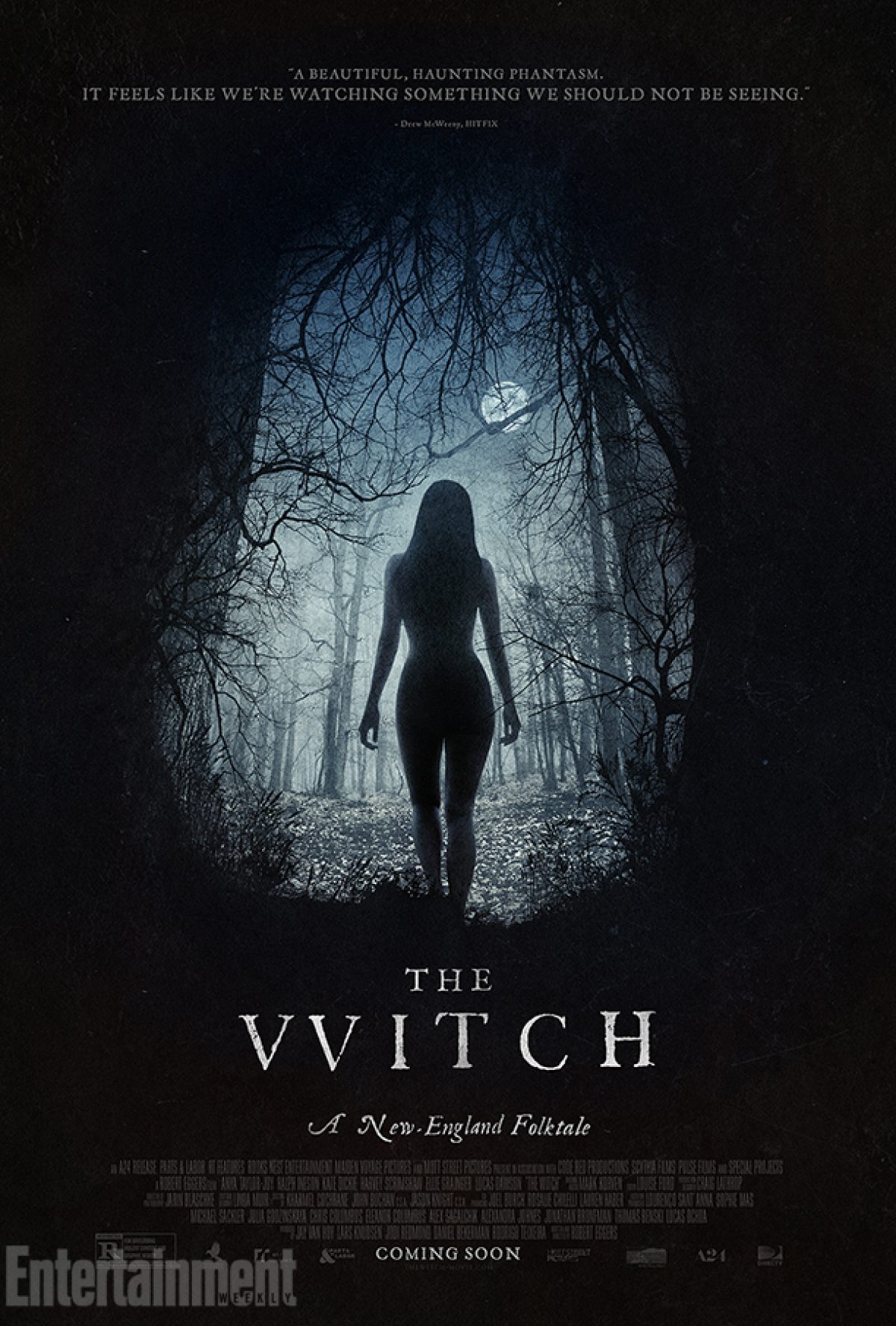
The-Witch-Poster-Large_1200_1776_81_s

IMDB: 6.9
Rotten Tomatoes: 91%, Audience Score 55%
The Guardian: ****/*****

Robert Eggers is an American film director and screenwriter, best known for his 2015 film The Witch, originally titled The VVitch: A New-England Folktale.


Did you know that The Witch is Eggers own script? It’s an old concept, that of a ghost story. But we are used to seeing modern tellings of these myths and legends. Eggers decided to direct a story about the beginnings of western culture. Set in New England The Witch is a tale of evil in the woods, plain and simple.

The story is rather chilling too.

In the 17th century a puritan family is banished from their larger plantation community because of the fathers accused pride (Ralph Ineson). We then watch husband and pregnant wife move to a large forest and build a farm there with their four children. Some time passes and Katherine (Kate Dickie) gives birth to their fifth child.

The story slowly unfolds as newborn Samuel goes missing while the oldest girl Thomasin (Anya Taylor-Joy) is babysitting him near the woods. It reminds me very heavily of listening to a camp-fire story except we have the added bonus/cruelty of witnessing the story for ourselves.

As a movie, The Witch functions as something of a slow-burn, carefully building towards the climax but not revealing the source of the kidnapping until the final scenes. This is intentional and helps to cement The Witch as a unique piece of horror cinema.

Playing off elements of both ambiguity and very clear scenes, the fear and paranoia is what sets up the tension but the final scene and the lingering thoughts and feelings after the curtain call are what make this one so haunting.


Pros: Horror has great potential to make you see things you didn’t want to see, when done right. This movie is one of those diamonds which is both scary and intelligent at the same time.

ConsOddly enough, it does such a good job of accomplishing what it sets out to do, that I have a hard time recommending it to others to watch because they may either miss the point or be too heavily affected by it.

Runtime1 hour 32 minutes

Points of InterestEggers based his film on research of New England witch hysteria, several decades before the Salem Witch Trials. Stephen King admitted that he is terrified of this film, also The Satanic Temple has endorsed this film, if that means anything.

While I am not certain if this is a film focused solely on female empowerment, a classic and well-executed horror story, commentary on Christian themes or possibly a combination of the three, The Witch is like nothing I’ve seen in some time.

The Witch has given me some bad dreams, I don’t think I’ll sleep well for a few weeks. Regardless of the terrors presented, this movie manages to walk a fine line between scary and conceptual, and while I wouldn’t recommend it to the impressionable or those with strong religious convictions, it is something to consider and think upon.

Hopefully it doesn’t give you nightmares.

Sweet Treat (Corinne Bailey Rae, The Heart Speaks in Whispers, review)

Have you ever had a favourite food you loved so much that you were convinced you could eat it over and over again without any consequence to your stomach or feelings toward it? Ice cream was the food that did me in. I loved ice cream so much that I would eat it whenever I could, and one day I decided that I couldn’t stomach it all the time. Today’s album review feels a bit like that.


Corinne Bailey Rae – The Heart Speaks In Whispers
released May 13, 2016
********* 7/10

Corinne-Bailey-Rae-The-Heart-Speaks-In-Whispers-2016-2480x2480

Corinne Bailey Rae is a British singer-songwriter and guitarist. She is the fourth British female artist in history to have a debut album open at no.1 in 2006. Her second album, The Sea, was released almost four years later after a personal tragedy occurred in 2008. Her husband and frequent collaborator Jason Rae died of what has been identified as an overdose. The Sea was nominated for a Mercury Prize for Album of the Year, given it’s somber tone and emotional weight.

It wasn’t until 2012 that Corinne followed The Sea up with The Love EP, and a year later that she married her producer and friend Steve Brown.

The Heart Speaks in Whispers helps us close the gap between that period of heartbreak, newfound love and the cautious optimism of Bailey Rae in her current life.

There is no doubt in my mind that Bailey Rae has a great vocal range and broad versatility to her music & lyrics. It reminds me of a great many female artists whom I have enjoyed previously, like Billy Holiday, Amy Winehouse, Feist, Joni Mitchell, and Emily Haines.

Now I say this with some reservation, but at first I didn’t really care for Bailey Rae as an authentic act.

Her work kind of fits into the larger genre of jazz and soul, and especially the soul revival that is happening, and which I admittedly have been kind of oblivious to until very recently. I will also mention Kendrick Lamar and Leon Bridges as artists who have been part of this movement, also with hesitation, because I hate to compare artists, but in this case, Bailey Rae has been collaborating with Lamar and that is a great indicator of her input into the landscape.

The songs on the album are often rather upbeat and fun – Been To The Moon, Horse Print Dress, and … come to mind. Stop Where You Are has that indie pop sentiment that reminded me of Feist. And if you are looking for anthems to build you up after any manner of letdown Caramel and High will serve that role rather easily. It’s a great ebb and flow of real life experiences without ever telling you explicitly what she gone through.

Push On For The Dawn closes out the album rather beautifully and isn’t ambiguous with Bailey Rae’s future. After all is said and done, The Heart Speaks In Whispers does an excellent job of changing your mind about the commercial production of the entire album, but its not something you can play anywhere and for all occasions.


I think pop music and jazz music are a wonderful form of expression, and that you should listen to them with regularity, but you can definitely over-expose yourself to forms of it. Especially when the music is rich and full of addictive content. The Heart Speaks in Whispers is a great example of this. When consumed in appropriate settings, you will have an awesome time, just don’t over indulge it.

Tim!


Quality Assurance (How To Be Authentic)

Authenticity can be difficult to achieve in the arts, whether you are a painter, a musician, an actor, a writer, a photographer or designer, the list of creative professionals this concept affects and is effected by goes on and on. Authenticity is especially difficult if you are a historian, collector or curator. Questions of who authored the work, when it was made, and its relationship to the culture it’s associated with abound.

And what if the originator isn’t in question at all, but quality of the work against said genius and their oeurve is in question? That’s a tough question too, but believe me I haven’t even addressed one of most difficult questions just yet. The one which I suspect most of you were leaning towards when the word first came to mind – how sincere, thoughtful, and genuine the output of the work is and whether the artist is demonstrating passion in their efforts. That question is one for the ages and something I struggle with too.

Feel like I’m writing a lot of nonsense already dear readers? That I’m going over your heads? That’s because I haven’t even touched the subject proper yet, and we’ve already uncovered a number of definitions and issues with the topic at hand.

This of course is because no matter what level of investment in the arts you ultimately have, the word authenticity itself is difficult to define and important to address in context.

But for the sake of fleshing out an argument, let’s take the definition which I indicated many of you were leaning towards to begin with. Merriam-Webster defines authenticity as follows –

authenticity – true to one’s own personality, spirit, or character

Now as an artist, a lover of language both visual and written, I thought it would be fun to run an exercise to break down the definition and build it back up again, in case there are some outliers in our midst. Here is what Merriam-Webster has to say about the words which make up the basic definition of authenticity, as it relates to the individual, in particular the artist.

true  –being in accordance with the actual state of affairs

personality – the set of emotional qualities, ways of behaving, etc., that makes a person different from other people

spirit – the inner quality or nature of a person

character – the way someone thinks, feels, and behaves

Now let’s add that definition back in, with a little more detail (my highlighted selections above) and see what happens with the results.

authenticity – being in accordance to one’s own emotional qualities, inner quality, or the way someone thinks

If you sit with that explanation for a minute, it gives a true picture of what authenticity means for an artist if they wish to be sincere with their work and marry that with passion proper. In fact, the words that help explain the word authenticity are composed of the same sorts of words themselves in their own definitions.

What that means for us is that there are commonalities and that at the root authenticity is about quality. Without proper quality something or someone no longer has worth.

5souaga

Let’s put it another way.

You see friends, I have this theory that in order to be authentic, you have to know what you are made up of, what your personal experiences have been. Then and only then can you start to address your emotional qualities, your inner quality or nature, and the way that you think about life and then act upon it. What this means for you is that you are fully capable of changing the world and participating in it, but you have to sort out your doorstep first.

You are valuable, but no one is going to sell your worth for you, you have to figure it out first, begin selling yourself and become part of the global marketplace. Sure there are experts who can appreciate potential, but they know just as I do, that the experience of sorting yourself out is invaluable, and has to come from within.

We’ll touch upon the subject more in future posts (in all forms), but for now, I’m out of theories friends. Share this with an artist and join the conversation on Facebook and Twitter. See you tomorrow with something melodic.

Tim!

How To Stay On Topic AND Be Topical (The Reading List)

Reading is cathartic, sharpens your mind, and expands your world. How it manages to do all of this is kind of amazing, but I’ve written about that before (see here, here, and here for recent examples), and it’s not really what this timely Thursday post is really about.

This entry is about another of my lifestyle goals as a cultivator of the arts.

You see friends, I’ve always been a lover of knowledge. Every personality test I’ve taken, every mentor I’ve had, and many of the compliments I have been given by generous humanly have usualy revolved around my intellect. I’ve spent thousands of hours of my life in thought and in the written word, so it kinda makes sense.

It’s a great comfort to me to read and I believe it is where a lot of my natural creativity lies. I’m very thankful for this gift and I intend to continue to use it to great effect. But I’ll be the first to admit, that creativity often comes from places other than self. Sure you can carry a creative idea through to it’s logical conclusion and exhaust it by repetition and personal exploration, but even more new ideas form through experience of the world.

Which is why I need to keep reading regularly, and read new things. As an artist, a curator of art and a practitioner of artist development, it’s my pleasure to share ideas with you dear readers. That means I need to find ideas in order to share them.

Buying a new album and film every week is a start, and participating in social media to build an empire is a good for discipline, but but I’ve always found that reading is the best way to spark ideas. Which is why I’ve decided to start The Reading List. It’s ambitious for sure, but it’s the only way I know how to flesh out a process, by dreaming big and digging in.

My goal for the rest of the year, and then for the rest of my life as I know it, is to read one book a month in a packet of categories. I’m going to start slow though.

To elaborate, I’ve grouped genres and topics, but will slowly expand outward until I am consuming at least 5 kinds of books a month. I already mentioned meta-reading, where I read a book, that I will also be writing about and how it relates to the act of reading, my relationship to the author I’m reading, and how my opinion of them and the work changes over time. I’m following this challenge concurrently with The Reading List to share some insights into the reading process and what I’ve learned from some wonderful authors.

And I’ve started with Ernest Hemingway. So let’s break down my crazy library sized idea for reading, and explore the possibilities and how it will benefit you, the readers of this blog.

I will read one book a month from the 5 groupings below, slowly expanding the number of books read so that I reach the point of 5 books a month. A book for each group:

  1. LIFE – Biographies/Art/Music
  2. LOVE – Classic Fiction/Non-Fiction/Graphic Novels
  3. LEARN – Business/Leadership/Self-Help
  4. LABEL – Philosophy/Sociology/Psychology
  5. LEET -The Internet

If I can get to the point where I read a book from each topic a month, I’ll be flying pretty high. You see, dear readers, if I can embrace the 5 L’s of LANGUAGE (my own idea), then I can contribute proper to your own education and personal growth in the age of the Internet – Hence the LEET grouping.

I think it’s a pretty neat way to keep myself accountable. But what do you think? I’m out of theories for the week, so share the post and leave me some feedback. Facebook and Twitter are most appreciated.

Tim!

One Hit Wonder (Communication Is Key)

Communication is a pain in the butt. Well, that’s what I used to think a long time ago. Being an artist, I was set up to be a recluse, because artists were outcasts. And it was a loneliness I chose.

That was what I told myself anyway.

When you are in your teenage years, and even early 20s, it can be incredibly convenient to look at the world in black and white. If you don’t fit in, it’s because you shouldn’t, so rebel, rebel, rebel. Hell it’s a rebel yell.

hqdefault

You know, I know adults who still do this. Walk around with a very limited view of things and an expectation that you either accept the “truth” they are hawking or they judge you and separate themselves from you. It’s a result of seeing the world the way you want to, and not the way it actually is.

I’m going to share a nugget with you, all you cute and wonderful and dear readers of mine. The truth is that nobody cares what you do with yourself and your time. People aren’t trying to get in your way, they are doing what they can to live their life (exist), escape their life (survive), or fulfill their life (thrive). I like to call it the EST models of life.

You want to thrive, trust me.

This is why it’s so incredibly important to follow the basic principles of communication. Anyone can do it. That’s right, we are reviewing another one of the key 10 skills to invest in. Artists can learn these skills, and everyone really should.

Communication is key.

Let’s recap. In a time when texting, email, and social media are the new favourites, try to use the phone more often. It saves on countless back and forth. And speaking of back and forth, be concise in your emails. Respond to calls and emails as quickly as you can, and when you can’t do that, set up a regular time to respond to your contacts.

But we’ll go over this in more detail because I have at least 200 words left to write. Ever heard of the 7 C’s of Communication? No, well it’s a fantastic way to keep your communication on point.

  1. Clear – it’s important to define you purpose for communication, and keep the number of ideas to a minimum. For example, one idea per sentence. In a three line email, that’s a maximum of 3 ideas, capiche?
  2. Concise – Get rid of all the filler words in your life. And don’t repeat yourself. Ever.
  3. Concrete – You have to explain why people should care, that means using some MF emotion, passion, and keeping focused.
  4. Correct – Oh this one’s a lot of fun. Make sure that you keep your communication error-free. And don’t use big words to make a statement. You can use relevant words, but don’t swim in pomposity.
  5. Coherent – Remember when we were talking about clarity in point no. 1? Well you need to keep all the points in a communication relevant, otherwise people get overwhelmed. One topic per meeting, phone call or email.
  6. Complete – Your message needs a call to action (when required) and details to keep the audience informed.
  7. Courteous – Be friendly in your communication. Tell the truth and be open-minded. The book How To Win Friends and Influence People comes to mind.

And there you have it, I’ve just given communication to an artist who needs it. No greater gift for you fine folks on a wisdom Wednesday. That’s all she wrote though folks. I’m out of theories for the moment. I’ll see you tomorrow with something rather timely.

Tim!