
The Dude (The Disaster Artist review)
To quote from The Big Lebowski, one of my comedy dramas of all-time –
Sometimes there’s a man… I won’t say a hero, ’cause, what’s a hero? But sometimes, there’s a man. And I’m talkin’ about the Dude here. Sometimes, there’s a man, well, he’s the man for his time and place. He fits right in there. And that’s the Dude, in Los Angeles.
In 2003, Tommy Wiseau WAS the dude in Los Angeles. And that’s a true story.
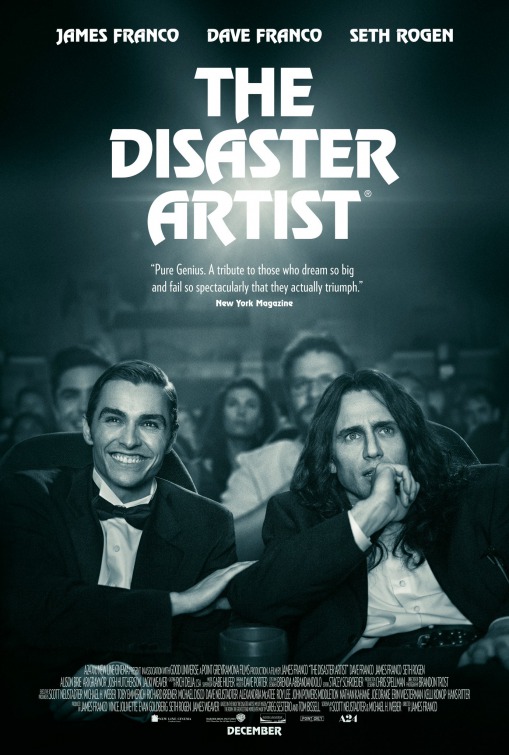
The Disaster Artist (2017)
Cast: Dave Franco, James Franco, Seth Rogen, Ari Graynor, Alison Brie, Jacki Weaver, Zac Efron, Josh Hutcherson
Director: James Franco
released on blu-ray March 13, 2018
********* 9/10
IMDB: 7.6
Rotten Tomatoes: 91%, Audience Score 87%
The Guardian: ****/*****
James Franco is an American actor, filmmaker, and instructor. Comfortable behind the scenes as he is on camera, Franco has been involved in a lot of interesting projects in his career, most notably Milk, The Little Prince, This Is The End, the Sam Raimi Spider-Man trilogy, and 127 Hours.
The Disaster Artist is the first critical and commercial success Franco has achieved in the role of director.
Special thanks to IMDB user Kenneth Chisholm (kchishol@rogers.com for the synopsis.
In the 1990s, Greg Sestero (Dave Franco) is an aspiring actor, who meets the strange Tommy Wiseau (James Franco) in an acting class. Together, Tommy inspires Greg to overcome his nervousness in acting so well that Greg agrees to come to Los Angeles with his odd new friend to pursue their dreams. However, their dreams seem to prove hopeless, especially for Tommy whose mysteriously strange accent and personality repels nearly all around him. Out of an inadvertent suggestion from Greg, Tommy is inspired to instead create his own movie, The Room (2003). What follows is a bizarre struggle to create that film, guided by Tommy, a man who has plenty of money, but not a trace of filmmaking education, experience, talent or even common sense. Along the way, Greg’s friendship with Tommy is put to the test as this project takes shape that would produce a film that ultimately becomes a bizarre accomplishment of a cult classic nature that no one, including Tommy, can see coming.
This is a movie about a movie that was made against all odds… Except for all of the mysterious money that Tommy Wiseau had on hand that allowed him the means to see his shitty movie to the finish line. And no, this movie never answers the questions of Wiseaus heritage, where he got his money from, or how come Greg Sestero was so drawn in by Wiseau and his aspirations.
At a high concept level, it’s pretty easy to see why James Franco aspired to make this film, he relates to the focus of his subject on a personal level, having lived on the edge of art and commercial success for so long. And little brother Dave dotes upon James to gain attention.
Pros: James Franco carries the films strength throughout; his portrayal of Wiseau spot-on. And to top it off, there is clearly a deep appreciation for the story of The Room at the centre of this film, which is emulated through the familial bond of the two Franco brothers.
Cons: While it is clear that there is love for The Room when watching the movie, what is not demonstrated, is true affection for Wiseau, the author that inspired all of this to happen. He is never truly elevated and the stakes are not presented in a way to produce real drama.
Runtime: 1 hour 44 minutes
Points of Interest: Greg Sistero noted in the book, upon which the film is based, that Wiseau would only allow James Franco or Johnny Depp to portray him. This is the first time that James and Dave Franco have appeared on screen together in a feature length film. There was talk of having Dave appear in This Is The End, but he would have died which was too sad, and James was considered for a part in 21 Jump Street, that never came to light.
As is the case in The Room, the comedy of The Disaster Artist comes out of the tragedies of something that is meant to be dramatic. The absurdity of making films, starring in films, and attempting to get a production under control. It’s obvious why so many stars feature in cameos on this film, they see it as an important piece of history and a strong demonstration of what NOT to do when making a film.
It reminds me of Ed Wood, another triumph of will from someone with no desire to earn their stripes.
theories Summarized
Franco was the perfect choice to play Tommy Wiseau, and I’m glad to see him finally share screen-time with his brother. And I also find it fascinating that Sestero and Wiseau do share a resemblance. But while this is an entertaining film, about a so-bad-it’s-good film. It reminds me of an even more important theory, life is too short to eat bad food / drink bad wine / insert appropriate example here.
But on the positive side. We have a video review of Whiplash to share, finally. It’ll make your neck crane, in a good way. Like The Disaster Artist, or like the The Room, I guess. If you liked La La Land, then this movie is for you. If you like drama, then this movie is for you. If you like J.K. Simmons, you know what I was going to type.
So please let me know what you thought of my review, like and share the video, and subscribe to the channel if you haven’t already. I anticipate that our content will continue to grow much like the Marvel cinematic universe. A well considered theory on my part.
Tim!


 timotheories