You Learn From Your Brothers (Last Flag Flying review)

I think you can learn a lot about an institution from how it’s offspring take off into the world and live their adult lives. This week’s movie review addresses that idea with warmth, drama and humour.

And just like real life, is simultaneously messed and unresolved.


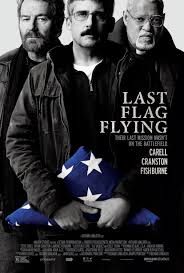
Last Flag Flying (2017)

Cast: Steve Carell, Bryan Cranston, Laurence Fishburne
Director: Richard Linklater
released on blu-ray January 30, 2018
******* 7/10
IMDB: 6.9
Rotten Tomatoes: 75%, Audience Score 70%
The Guardian: ***/*****

Richard Stuart Linklater is my all-time favourite director. And he’s been my favourite ever since I first watched Waking Life back in 2003 (even though the movie released in 2001). I was barely an adult then, so you might have to cut me some slack on the the time it took me to discover him. Point of fact, Chris and I will be sharing a Cross Talk in coming weeks about our favourite directors, so rather then dig into why I think he’s so amazing as I normally preface these posts, I’ll just share a couple of quick anecdotes now. I’ve reviewed two of Richard Linklater’s films before – Boyhood and Everybody Wants Some. And I recorded that upcoming Cross Talk episode before I watched this movie.

I’ve included the distributors synopsis below and modified it slightly to provide some context…

Thirty years after serving together in the Vietnam War, Larry “Doc” Shepherd (Steve Carell), Sal Nealon (Bryan Cranston) and the Rev. Richard Mueller (Laurence Fishburne) reunite for a different type of mission: to bury Doc’s son, a young Marine killed in Iraq. Forgoing burial at Arlington National Cemetery, Doc and his old buddies take the casket on a bittersweet trip up the coast to New Hampshire. Along the way, the three men find themselves reminiscing and coming to terms with the shared memories of a war that continues to shape their lives.

Naturalism is one of the major tools in Linklaters belt. He always manages to bring out the best and brightest of mundane aspects of life. Probably my favourite scene from the whole movie is the experience Carell’s character Doc has upon seeing his dead son when he demands that the military personal open the casket up for him. The camera pans out perfectly and we experience the secondhand emotion a third party would have normally by watching the very real and vulnerable grief someone extremely close to the recently deceased emote. I also enjoyed the interactions between Bryan Cranston’s Sal and the Colonel, that desire to challenge authority is common in many of Linklater’s characters.

And finally, the character of Doc appears very grounded in reality, though we never see him fully open up about his feelings, it is obvious how much he struggles with this unexpected turn of events.

Where the movie becomes a problem for me is in the interactions between the three main characters. They have spent a lot of time apart, and by circumstance are suddenly thrown back into each others lives, but it’s difficult to see why they ever got along or supported each other in the first place. This might be a failing on my part in not fully absorbing the awkward tension these men generate attempting to relate to each other after so much time apart. But I hope with subsequent viewings I can get to the bottom of the tone being explored here.

Pros: Linklater always manages to tell a real story, and stir up a ton of emotions running the gamet of the topic at hand. Never fully committing to one viewpoint or arc, he leaves the viewer with the choice to take something from the film or leave it. It’s difficult to swallow during a film about politics, death, and war.

ConsThat said, It does feel kind of superficial at times, and you don’t really believe the relationships these guys had could endure enough to take the road trip. Yes, they are professional actors, and they are all talented enough to sell their individual roles, but somehow it just doesn’t work thematically at all times.

Linklater has proven he can make any kind of movie, but all the elements of the film manage to conflict in such a negative way, it’s tough to accept this as film with his typical calibre of intent. It never feels especially revelatory, only sad and shallow.

And to sound even more contradictory, while I actually think the themes of patriotism, military service, and political ideologies are dealt with in a mature way, I wish at least one of the protagonists had chosen a side and let the film respond to it.

Runtime: 2 hours 5 minutes

Points of Interest: The film is supposed to be a spiritual sequel to The Last Detail. Laurence Fishburne was Richard Linklater’s only choice for the character of Mueller. Principal photography took only 32 days to complete.

The concept is strong, and I can see what Linklater would have been drawn to it in the first place, but in the end it’s not strong enough in each of it’s parts to overcome the challenges presented and commit to a real anti-war message, instead choosing comedy and drama outbursts to convey the consequences.

theories Summarized

Taken together, each of the three protagonists add their own layer to this film about enduring after war-times. Brotherhood is strong, and I am reminded of the film The Deer Hunter, if only because the challenges of psychology, disruption, and resolution echo throughout both films consistently. Showcasing how two or three men raised in the same household (so to speak) could take different paths. It’s a profound statement to make, and as I mentioned earlier, a lesser director would have definitely missed all of the subtleties and disparate viewpoints within the issue. But ultimately, Last Flag Flying falls short for me, and is only a good film, not a great one. And that’s my theory.

That said, I have a really solid Watch Culture video that directly addresses the effects of war on the soul, and it serves as an excellent metaphor for impotence and decay. Surprise, surprise, a comic book movie was able to get an R rating and tell an engaging story. Can’t you tell how excited Mike and Chris are to discuss Logan? I can!

Logan will likely make you cry, but in a good way. And better still, it resolves so many threads of The Wolverine, while paying tribute to Hugh Jackman’s tenure. Check it out! And remember… Like! Comment! Subscribe!

Tim!
Posh and All That (Cafe Society review)

Cafe Society was a New York city nightclub opened in the late 1930s in the midst of Greenwich Village. It featured mostly African American talent and was intentionally set up to challenge the ideals of the rich club goers of that era.

It was set up as a place for political events, fundraisers and considered to be a staple of liberal ideals. But what about the movie that took it’s name?


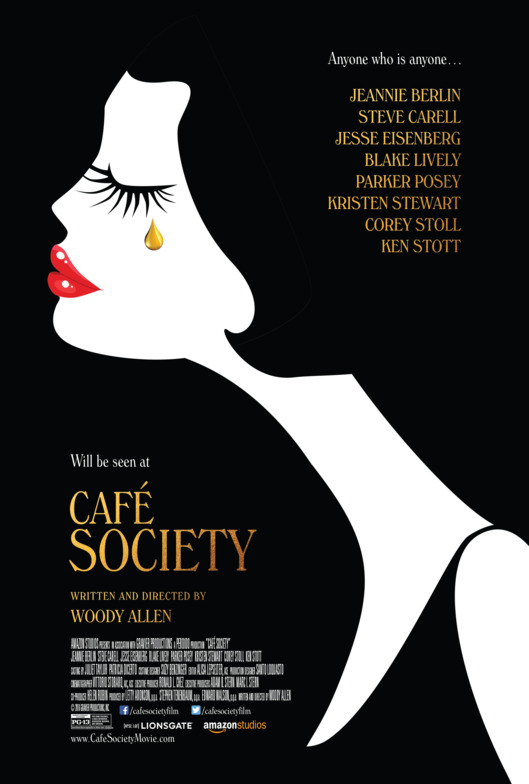
Cafe Society (2016)

Cast: Jesse Eisenberg, Kristen Stewart, Steve Carell, Blake Lively
released on blu-ray October 18, 2016
******* 7/10

21-cafe-society-nocrop-w529-h835

IMDB: 6.8
Rotten Tomatoes: 69%, Audience Score 62%
The Guardian: ***/*****


Ah Woody Allen. An American actor, comedian, film director, and sometimes theatre director. He’s eighty years old and has been making movies for fifty years. Just consider that for a second, fifty years worth of movies and forty-eight turns at directing. And I think I’ve seen somewhere between ten to fifteen of them all by myself.

Cafe Society is his most recent foray into the world of film and ironically or not, it’s a movie about the film industry.

Set in 1930’s Hollywood, we are quickly introduced to Phil Stern (Steve Carell) one of the most prominent agents in the business. At a party he takes a phone call from his sister Rose (Jeannie Berlin), who tells him that her son is moving to LA from New York and that he wants to find a job working with Phil.

Bobby Dorfman (Jesse Eisenberg) lives with his family in town, and is the youngest of his two siblings. His sister Evelyn (Sari Lennick) is a schoolteacher who is married to intellectual Leonard (Stephen Kunken), while brother Ben (Corey Stoll) is a renowned and murderous gangster. The family turns a huge blind eye to Ben’s criminal proclivities.

When Bobby initially arrives in town, he attempts to make an appointment on several occasions but is completely ignored by his uncle for several weeks before Phil finally decides to see him. When they do discuss the possibility of a job, it resolves with Phil deciding to get his nephew in with some pseudo-bullshit type arrangement. He then asks another secretary of his, Vonnie (Kristen Stewart) to show Bobby around town.

Of course Bobby is instantly smitten with Vonnie, but when he asks her out, she tells him she is dating a journalist named Doug. We later learn that Doug is in fact a codename for Phil, and that Vonnie is having an affair with Phil behind his wife’s back. Phil claims to love Vonnie, but is unable to leave his wife, and breaks it off with her at the one year mark, just as Vonnie has given a letter from Rudolph Valentino to him. When Vonnie confides the breakup story to Bobby she leaves out no detail, with the exception of Phil’s false identity.

Bobby and Vonnie slowly begin a romance, and Bobby plans for them to leave to New York and get married.

At this point Phil decides to leave his wife and confides in Bobby that his mistress even gave him a letter from Rudolph Valentino. Once Bobby pieces it all together, he confronts Vonnie, and she decides to leave him and instead marry Phil.

Years later, Bobby is a successful nightclub owner, which is a front for his brother Ben’s criminal activities. Bobby meets and marries Veronica Hayes (Blake Lively). And things continue on positively, until one day Phil and Vonnie come to town.

But that’s all I’ll say about that.

Pros: Kristen Stewart delivers as Vonnie, the set pieces and cinematography are gorgeous, and though the story is somewhat stale and obvious, that’s not to say it isn’t entertaining.

Cons: At many points that film feels like an autobiography of Woody Allen as portrayed by Jesse Eisenberg. The self-indulgence is ever present and the drama can’t seem to find a way to properly raise the stakes

Runtime: 1 hour 36 minutes

Points of Interest: This is the first digitally captured Woody Allen movie ever. And it’s the first time Woody Allen has narrated a movie since 1987’s Radio Days.

It all feels all too familiar, Allen draws on his hometown experiences, referencing the perspective of a New Yorker, covering off the challenges of being Jewish, reflecting on the plight of the neurotic, and even addressing the facade that is Hollywood film culture. Cafe Society appealed to the artist in me, and I’ve said it before, but I’m a sucker for Woody Allen’s introspective nature. Is it for everyone? No. But it is entertaining enough for most.

Cafe Society the movie never quite reaches the same aspirations as the club on which it was based – it asks questions, and considers it’s timeframe, but it is a story driven by emotions and nostalgia for an aesthetic. It never reaches a place of self-awareness, effacement or even acknowledgement. But dammit if it isn’t full of beautiful people and places. This really is an excellent role for Kristen Stewart, and if you like Woody Allen, even when he’s lazy, you’ll drink from this cup.

Tim!

The New Anti-Heroes On The Block (The Big Short review)

The financial crisis of 2007-2008 was no laughing matter. A lot of people lost their jobs, homes, and hope because of the short-sided greed of those in much higher positions of wealth.

It threatened the potential collapse of the largest financial banks, which some feared would send us into a new dark ages, and was eventually prevented by monetary aid of national governments.

In brief, it was fucked up.

The aftermath was that we experienced a global recession for four years, and even now businesses are hesitant to share wealth and distribute resources as readily as they were before. This Theatrical Tuesday entry looks at the “heroes” who saw it coming, and how they dealt with it.


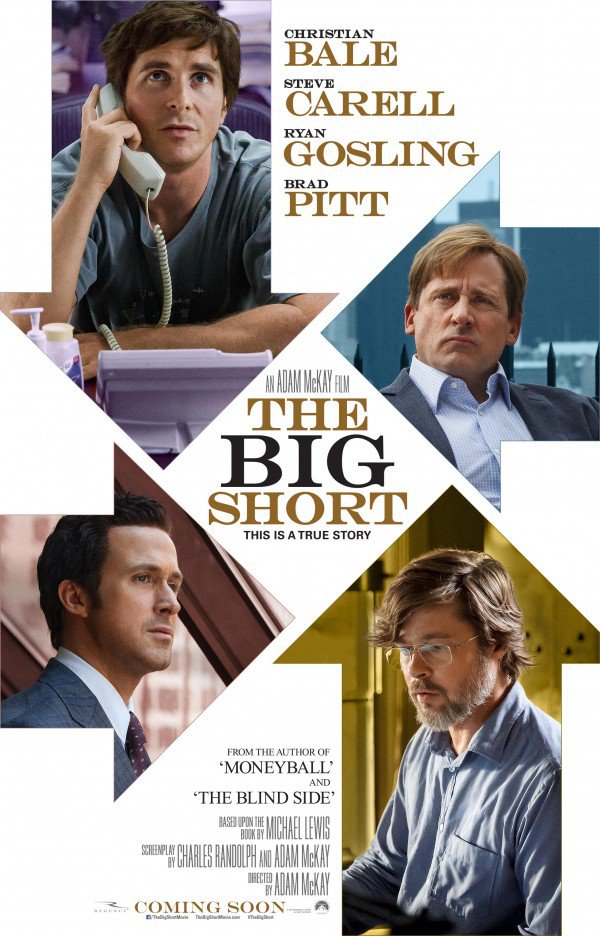
The Big Short (2015)

Cast: Christian Bale, Steve Carell, Ryan Gosling, Brad Pitt
Director: Adam McKay
released on blu-ray March 15, 2016
********* 9/10

The-Big-Short-600x936

IMDB: 7.8
Rotten Tomatoes: 88%, Audience Score 88%
The Guardian: ****/*****

Adam McKay is an American film director, producer, screenwriter, and actor. Known for his comedic chops, he has directed both Anchorman movies, Talladega Nights, Step Brothers, and The Other Guys, which are were all lead by his creative partner, Will Ferrell.

The Big Short is the first film McKay has directed which doesn’t star Will Ferrell, and while it is considered a more dramatic story, it has a lot of his typical satire elements, which fit nicely in the McKay fabric.

Taken from Wikipedia and edited,

In 2005, eccentric hedge fund manager Michael Burry (Christian Bale) discovers that the U.S. housing market is extremely unstable, being based on subprime loans that are high risk and providing fewer and fewer returns. Predicting that the market will collapse sometime in the second quarter of 2007, he realizes that he can profit from this situation by creating a credit default swapmarket, allowing him to bet against the housing market. He visits several major banks and investment dealers with this idea; these firms, believing that the housing market is secure, accept his proposal. This earns the ire of Burry’s clients who believe that he is wasting their money and demand that he stop his activities, but he refuses. As the predicted time of the collapse approaches, his investors lose their confidence and consider pulling their money out, but Burry places limitations on withdrawals, much to his investors’ anger. However, the market collapses just as he predicted and he produces 489% profits from the plan.

Trader Jared Vennett (Ryan Gosling) hears of Burry’s actions from one of the bankers Burry dealt with, and soon realizes that Burry’s predictions are likely true. He decides to put his own stake in the credit default swap market. A misplaced phone call alerts hedge fund manager Mark Baum (Steve Carell) to his plans, and Baum is convinced to join Vennett. The two discover that the impending market collapse is being further perpetuated by the sale of collateralized debt obligations (CDOs), groups of poor loans that are packaged together and given fraudulent AAA ratings due to the conflict of interest and dishonesty of the rating agencies.

When Baum attends the American Securitization Forum in Las Vegas, he interviews CDO manager Mr. Chau (Byron Mann), who has created synthetic CDOs, making what is described as a chain of increasingly large bets on the faulty loans. Baum realizes, much to his horror, that the scale of the fraud will cause a complete collapse of the economy. Baum’s business partners convince him to go through with the credit default swaps, profiting from the situation at the banks’ expense.

Eager young investors Charlie Geller (John Magaro) and Jamie Shipley (Finn Wittrock) accidentally discover a prospect by Vennett and also decide to become involved in the credit default swaps. Since they are below the capital threshold for an ISDA Master Agreement needed to pull off the trades necessary to profit from the situation, they enlist the aid of retired banker Ben Rickert (Brad Pitt). The three visit the Mortgage Securities Forum in Las Vegas, where they manage to successfully make the deals. Shipley and Geller are initially ecstatic, but Rickert is disgusted by their essentially celebrating an impending economic collapse and soon-to-be-lost lives. The two are horrified, and take a much more emotional stake in the collapse by trying to tip off the press and their families about the upcoming disaster. Ultimately, they profit immensely, but are left with their faith in the system broken.

How this movie manages to be both detail oriented and funny, while approaching a still raw subject, is kind of amazing, and what is more impressive is the fact that it does this while featuring an ensemble cast.

Pros: Steve Carell has a fantastic turn as neurotic and disenfranchised hedge fund manager Mark Baum. Christian Bale, Ryan Gosling, and Brad Pitt do okay too. Also the Margot Robbie bit, that kind of pokes fun at The Wolf of Wall Street was hilarious.

Cons: The movie runs a little long, and the slow start featuring fourth-wall breaking pieces feels strange at first, but then the movie tosses that out, speeds up really quick, and crams a lot in towards the end.

Runtime: 130 minutes

Points of Interest: No special effects were used for Michael Burry’s glass eye. That is all Christian Bale, and kinda mesmerizing. The character Mark Baum is based on real-life money manager Steve Eisman. This is the second Michael Lewis book that Brad Pitt has helped produce and acted in. The first was Moneyball.

This is both entertaining and engaging, with the heroes of the story being flawed and real, because they are based on real people and adaptations of real people who were involved in the housing crisis of 2008. The fact that The Other Guys is a McKay movie makes a lot of sense, as that movie features the same types of villains as this one.

The fact that The Big Short depicts it’s leads as heroes is a bit ridiculous if you ask me. It assumes that these men actually did something for the greater good. Yes, they dealt with danger, adversity, and their personal reputations to expose and react to the impending housing crisis, but most of them profited from it.

Michael Burry and Mark Baum “kind of” walked away, but they made a lot of money in the process. And even Brad Pitt’s financial guru pariah got something out of it.

I read a review that said you’ll leave the movie feeling angry, and that is true, but I get a sick feeling in my stomach when I think that we get excited about people making money in a situation when so many lost out. Something to chew on.

No more theories today, friends. Come back on Wednesday for some Wisdom.

Tim!