Why The 1970s Are Inspiring Films Today (Cross Talk Ep. 30)

There are definite echoes and recurrences of the 1970s cropping up in film.

It was a time of very serious filmmaking, when grit and resourcefulness were championed, emotions were raw and characters had very simple motivations. You killed my partner? I’m coming after you. We can’t make our marriage work? Let’s get divorced. Our crew needs to get home from the edge of the universe? There’s time to investigate an alien spacecraft.

Tensions were high, politics was laden with so many revolutions – sexuality, gender equality, television, nationalism, race relations. But at the core of it all were stories about characters, and the depth of field pushed backdrops to the edge of our attention.

For the sake of argument, I’m just going to quickly list off a bunch of famous films from that timeframe to demonstrate my point. Ready? Here we go. Star Wars, Jaws, The Exorcist, Alien, The French Connection, The Godfather, Taxi Driver, All The President’s Men, Close Encounters of the Third Kind, MASH, Apocalypse Now, Annie Hall, Rocky, A Clockwork Orange, Halloween, The Deer Hunter, Willy Wonka & the Chocolate Factory, Carrie, Serpico, Chinatown, the Rocky Horror Picture Show.

Sure I didn’t select comedies like The Muppet Movie and Bedknobs and Broomsticks, but even those movies featured Nazis and a frog legs merchant. And were weird as shit. I’ll let you figure out which villain was for which film. Yes, there were complex films like Airport, but on that note, disaster films, exploitation and “B movies” were prominent in a decade of civil unrest. Any of this sounding familiar yet?

As we start to look back on the 2010s, I can see that there is a definite correlation in critical filmmaking and so we have some spiritual successors to 1970s classics. Movies like A Ghost Story mimic the epistemological 2001: A Space Odyssey, while Logan channels Badlands, The Man with No Name trilogy and so many other flicks like Five Easy Pieces. But maybe Baby Driver was more your speed, creative cuties? What about The Driver, The Italian Job (technically the 1960s, but just barely), and Smokey and the Bandit?

You know what, just watch the latest episode and decide for yourself if we are entering into a second renaissance of 1970s minimalism in film. AKA the return of the 1970s.

Cool right? Yeah, its a great idea to explore how themes repeat themselves over time, and yes there still plenty of examples of films inspired by the 1980s, but I have to wonder if anybody else is noticing this connection?

I hope you enjoyed watching this episode as much as Chris and I enjoyed recording it. But you know what we love more? Comments! Shares! And new subscribers! Check back in a day for an album review and a theory on why metal music gets better as you age.

Tim!

The Truth Is Out There (Neil Strauss)

So how many of you remember when I wrote that post a couple of months back about one of my personal goals for the year? Nope, not the one about my movie watching goals (The Watch List), and also not the one about my music reacquiring goals (The Back Catalogue). Want a hint?

It has something to do with reading. Reading via that dying form of book learning.

It’s a tough one to accomplish for sure, in a world where working 40+ hours a week is the norm, exercise, food, and sleep are required, and social relationships must exist in order to be a contributing member of society proper, where does an artist fit in time for absorbing artistic endeavours in tactile paper and ink objects AND find time to produce his own work? Well, obvs you have to have a schedule and a game plan.

Which is what I came up with. I wonder if you know what I’m eluding to just yet.

I’ll share a snippet from the post I have in mind to give you a reference point –

Buying a new album and film every week is a start, and participating in social media to build an empire is a good for discipline, but I’ve always found that reading is the best way to spark ideas. Which is why I’ve decided to start The Reading List. It’s ambitious for sure, but it’s the only way I know how to flesh out a process, by dreaming big and digging in.

My goal for the rest of the year, and then for the rest of my life as I know it, is to read one book a month in a packet of categories. I’m going to start slow though.

I will read one book a month from the 5 groupings below, slowly expanding the number of books read so that I reach the point of 5 books a month. A book for each group:

  1. LIFE – Biographies/Art/Music
  2. LOVE – Classic Fiction/Non-Fiction/Graphic Novels
  3. LEARN – Business/Leadership/Self-Help
  4. LABEL – Philosophy/Sociology/Psychology
  5. LEET -The Internet

If I can get to the point where I read a book from each topic a month, I’ll be flying pretty high. You see, dear readers, if I can embrace the 5 L’s of LANGUAGE (my own idea), then I can contribute proper to your own education and personal growth in the age of the Internet – Hence the LEET grouping.

The great thing about having a reading list is that it continuously reminds me that I should be consuming books, not because they make me smarter, but because I should be participating in culture and sharing what I learn back with you, my dear sweet readers.

The Truth About Neil Strauss

This month I decided to reach out into the LEARN section of my 5 L’s of Language and look at a book by one Neil Strauss. The book I decided to read is called The Truth, An Uncomfortable Book About Relationships. If you have been around for the past ten years, you’ll probably recognize his breakout bestseller The Game: Penetrating The Secret Society of Pickup Artists.

Now before I receive a bunch of boo/hiss comments, because as much as I don’t want to get into apologetics for pick-up artists, I’d rather do that defending thing and say that Neil Strauss is something of a pioneer in my opinion, then have you shut er down “just because”.

Bold talk timotheories, but go on.

He saw how social cues and dating etiquette was evolving in the early 2000s and because he had never had a serious relationship, he was sick of living in a victim mentality, and he went out and learned some skills to better himself and gain confidence.

We’d all be incredibly naive if we didn’t think that sex, attraction, dating and relationships didn’t have something to do with skillfulness and ability. Just like literally everything else in life.

So many of us expect romance and love to just happen for us, but we have to gain emotional intelligence and sexual prowess if we want to find that person (or persons) that compliment us appropriately and with who we also compliment.

The Truth is a book about Strauss’ realization that while he had learned how to seduce women and how to better understand what women wanted from a sexual partner, what he didn’t learn was that in order to have romance, and then healthy commitment, we have to understand our upbringing and the challenges we carried with us into adulthood. Otherwise we have half the necessary skill-set to be a functioning sexual being. Yes, the book explores themes that demonstrate how some people can live a single life, others can get polyamorous, and most of us go monogamous, but it’s our individual responsibility to figure out for ourselves what defines our intimate nature and then mature into a healthy adult.

This book taught me, that no matter what kind of sexual identity I take on, my personal happiness is still my responsibility. Whatever physical or mental imperfections I am faced with, I choose to be defined by them OR to work with and through them, especially at a pace that is manageable.

And that’s a heavy topic for an artist to tackle, whether you’re a writer like Strauss, a musician, an actor or a visual artist.

I highly recommend this one. Give it a shot, you’ll likely learn something about yourself.

Tim!

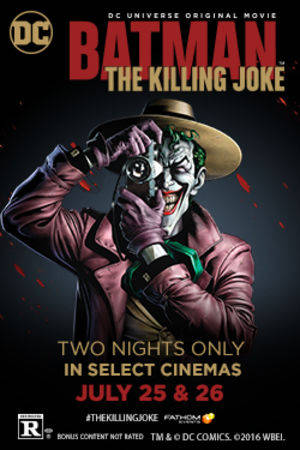
A Non-Comical Book, Err Film (Batman: The Killing Joke, review)

Sexuality is a complicated thing, dear readers. People of all sexual orientations exist in this world – heterosexual, homosexual, bisexual, asexual, polysexual, pansexual, and transexual. And those are just the baseline, it gets more intricate then that. Which is a difficult thing to address because we have so much cultural material out there that mostly address heterosexuals, and to a lesser extent, homosexuals.

Every other persuasion gets considerably less attention.

Now, I’m writing about this challenge as a straight white male, so I realize my opinion is pretty limited, and that I am quite privileged in my perspective, but I will mention this, I have no idea how the actual percentages shake out on this sexuality matter.

Regardless, when we are reduced to our sexual motivations, that sucks. And not in a good way. Especially when it comes to art.


Batman: The Killing Joke (2014)

Cast: Kevin Conroy, Mark Hamill, Tara Strong, Ray Wise
released on blu-ray August 2, 2016
***** 5/10
batman_250x375_r5

IMDB: 6.8
Rotten Tomatoes: 48%, Audience Score 56%
The Guardian: N/A

Sam Liu is a Chinese American animation director, artist, and designer. He has directed several animated superhero films at both Marvel Entertainment and Warner Bros. Animation. I could list the heavy CV of films he has had a hand in, but it’s rather exhausting to look at, so let’s just take my word for it, okay?

As Bob Dylan once sang, the times, they are a changin’.

And this story probably didn’t need to be retold, especially the way it did, but before I tell you about the story, I’ll give you a bit of background first.

Batman: The Killing Joke is an adaptation of a rather slim graphic novel of the same name, which was originally created by Alan Moore and Brian Bolland in 1988, and which was itself also an adaptation of another story from the 1950s called The Man Behind the Red Hood which originally served as an origin story for Batman’s greatest foe, The Joker.

It has been widely lauded as one of the greatest Batman stories of all time, and has been critically reviewed as the definitive Joker story. It is a story describing both how The Joker came to be and for him to prove that anyone can sink into madness.

The flashbacks show a failed comedian and his very pregnant wife, and the comedian eventually decides to work with criminals to steal from a playing card company. It’s adjacent to his former work, which is a chemical plant. But his wife dies in a household accident, and he is forced to help the criminals anyway. The criminals dress him up as The Red Hood to implicate him if cops arrive. Cops do arrive, and then Batman. The comedian escapes from Batman, but is flushed out the chemical was pound lock – this turns his skin white, his lips red, and his hair green. He loses his sanity.

In the current timeline, The Joker invades the Gordon’s home, shoots Barbara (Batgirl), and kidnaps Commissioner Gordon. He then subjects him to sexualized images of his naked and bloody daughter, ridiculing him, and parading him through an abandoned amusement park. His hope is that Gordon will go insane just as he did, but this does not happen. Then Batman arrives, fights The Joker and proves to The Joker that he is the only insane one. The comic closes with Batman attempting to rehabilitate his foe, and The Joker responding with a joke that insights laughter from both parties, then the comic ends with an empty panel. Leaving the question of what happened to the reader.

It was a powerful story for the time, and still an interesting read, but Alan Moore has admitted that it lead superheroes down a dark road, and that while he wanted to show that comic books could be anything, all it did was darken the industry, and it hasn’t really recovered since. He regrets having written the story.

Now, let’s get to the update. Without diving too much into it, the new animated movie adds a prologue to help introduce us to Batgirl, even showcasing her challenges with a villain of her own, and a strained relationship with her mentor. The villain is sexually attracted to her, and of course gets in her head, which has Batman take Batgirl off the case. The story eventually shifts to a sexual tryst between Batman and Batgirl. Then Batgirl intervenes in the case anyway, and she ultimately resigns from crimefighting. Thus setting up the rest of the movie, which is a beat for beat repeat of the original story.

And so the story shifts the motivations of Batman and Batgirl, while removeing the weight of both The Joker and Gordon’s role in it’s outcome.

Pros: When the story sticks to the source material, it is engaging and an interesting account of both The Joker and his role with Batman.

Cons: We didn’t need to see a sexualized Batgirl. And we definitely didn’t need to see a 30 minute prologue story, when Batgirl should have gotten her own feature length animated film. Also, the animation is quite bad in many places.

Runtime1 hour 16 minutes

Points of Interest: Mark Hamill had retired from voicing The Joker, and would only come back if this story was adapted for film. The movie received a limited theatre release a week before it dropped in stores and online; the last time this happened was with the 1993 Batman: Mask of the Phantasm.

The fact that Alan Moore didn’t want his name on this adaptation might have been considered a sign that DC shouldn’t have green-lit this story, but that’s the perpetual struggle with comic book publishers, it’s a constantly dying industry, and they have to do something to inject life back into their business. And so an adaptation of an almost 30 year old Batman story was made into a movie. You can watch it, but I’m not sure that it’s worth it.


I really wish this movie didn’t turn out the way it did. I mean, the original story is interesting and noteworthy for a morality tale and cross-examination of Batman and The Joker as they relate to each other. And yes, Batgirl does plays a victim role in the original story, so it’s not like it’s the most brilliant piece of writing ever, but man did they screw up the adaptation with that prologue. It went from being an interesting story to something completely different. It just doesn’t mean the same thing with those changes. A story reduced to sexual motivations, and unnecessary sexualization of a female character.

Tim!

Heartbreaker, I’m Addicated To You (Ex_Machina review)

She’s not your typical girlfriend. Recognize those lyrics dear readers?

It’s from a Simple Plan song called My Alien. It’s probably one of my favourite tracks on that album. Incidentally, I was listening to their breakout album No Pads, No Helmets… Just Balls, right before I started today’s film review.

And conveniently enough this song ties in very nicely with it as a transitional point. I’m gonna share a few more lyrics from the song with you dear readers before I jump in.

She knows when something is wrong, when something doesn’t belong
She can read in my mind
And she can be assured that with me, there is no conspiracy
Shes not wasting her time

She’s not wasting her time. That’s for damn sure.


Ex_Machina (2014)

Cast: Alicia Vikander, Domhnall Gleeson, Oscar Isaac
Director: Alex Garland
released on blu-ray July 14, 2015
********* 9/10

4O2OUnbVYOm11E2GIfqrJ6GEvo2

IMDB: 7.7
Rotten Tomatoes: 93%, Audience Score 86%
The Guardian: ****/*****

Alexander Medawar Garland, also known as Alex, is first and foremost a novelist, then a screenwriter, followed by producer and now director. Garland has been involved with the scripts for 28 Days Later, Sunshine, Never Let Me Go, and Dredd. Which if you know anything about science fiction, should get you super excited. But his breakout fame came with his first novel, The Beach. This of course was later made into the film The Beach.

Ex_Machina is Garlands directorial debut. And given his record of previous projects, I just had to check out this film. Now I realize it’s a little bit late, but my policy at timotheories is always digital curating at heart, and so we curate that which is necessary. Especially since there was nothing new released last week that seemed worth the attention. And so here we are.

Already released on blu-ray and digital HD a year ago, Ex_Machina is a story about a surprisingly difficult to assess turing test. This is because the detail to which the newly minted android Ava (Alicia Vikander) is capable of convincing programmer Caleb (Domhnall Gleeson) to play into her game of cat and mouse with her creator, and his employer, Nathan (Oscar Isaac). And this ultimately surprises both men.

Throughout the test, Ava is confined to her apartment, within the compound of Nathan’s hidden mountainside home. Caleb is locked in as well, to protect company secrets, but Ava slowly wins Caleb over during his questioning with her flirtations and expressed attraction towards him. Her ability to cause power surges cuts the security cameras at key moments and allows her and Caleb to have frank exchanges. This leads Caleb to believe that Nathan is abusive and cruel towards Ava.

Caleb eventually learns that Ava will be upgraded to a new model after the test is over, which will destroy her consciousness and memories. Caleb and Ava plot to overthrow Nathan and escape the facility together.

It is only in the final moments of Caleb’s stay before the helicopter will arrive to take him back home, when Nathan reveals that he already knew all of the androids were intelligent and had consciousness, but that he wanted to know how easily a human could be manipulated by one and how far the android was willing to take it to escape. Caleb then tells Nathan he has already engineered the escape, and Nathan knocks him out.

Ava is now out and works with the only other android to kill Nathan. Ava goes into Nathan’s room to repair herself using old android body parts and skin, becoming indistinguishable from a woman. She then leaves Caleb locked in the facility, now conscious himself and watching the scene unfold, taking the helicopter meant for him.

Pros: With such a small cast, we are really given the time to digest the unfolding story and enjoy the clean and concise results. Amazingly it is a film of ideas, dressed beautifully with carefully and sparing CGI.

ConsThe voyeuristic elements which are useful in demonstrating the flaws of both Nathan and Caleb kick into full gear right at the gut punch, and make it a little less thrilling.

Runtime1 hour 48 minutes

Points of InterestOscar Isaac based his character on intellectuals with dark sides, namely Bobby Fischer and Stanley Kubrick. Throughout the film the colours red, blue and green are used very obviously in each area of the house, a nod to RGB colours which are used for computers.

Ex_Machina just might be the scariest science fiction movie I’ve seen in some time. Throughout the film I was never clear on the true intentions of each character, and that in itself was an excellent turing test. At the end of it all, I have to wonder if Ava had planned to use Caleb all along or if he eventually offended her in some way or another. And that my friends, is why this is an excellent film.

And if you want further evidence, please check out the video review below!

theories Summarized

Swedish actor Alicia Vikander has an incredible range, and just the right mix of emotions portrayed to demonstrate the naïveté of an AI not yet realized. That surface tension is what draws us in, and makes us question the morality of the human characters, and maybe even sympathize with Ava. She’s not your typical girlfriend indeed.

Tim!

Let’s Make a Jazz Record (David Bowie, Blackstar review)

I wish I knew more about jazz, other than that I like it of course. It’s one of those musical formats that permeates music culture but which is so open ended that I find it overwhelming to participate in discussion about it – Most of the time.

Today’s album review is one of those times when I feel comfortable talking about the subject matter. I think mostly because the artist handles the infusion of it rather well and because he has a solid track record of dealing with musical avenues that call for experimentation.


David Bowie – Blackstar
released January 8, 2015
********** 10/10

david-bowie-blackstar-2016-billboard-1000

If you don’t know who David Bowie is, I’m afraid to tell you you’ve missed out, and never again will you see his like. David Robert Jones, also known as David Bowie, was an English musician who played a variety of instruments, sang, wrote songs, produced records, painted, and acted in big screen releases occasionally.

My first experience with him that I can remember was the movie Labyrinth, though that was not how he got his start. With a musical career spanning back to the early 1960’s, Bowie had a top 5 hit in the UK by 1969 with Space Oddity.

If you haven’t seen the original music video you should go take a look at it right now.

Then he developed the Ziggy Stardust persona, and showed the world that he would be constantly innovating and reinventing himself for the rest of his career. Like that time he made a song with Queen called Under Pressure, and it was awesome!

Honestly, I could go on about his accomplishments and my thoughts on his legacy for another few posts, but that is not what today’s review is about, dear readers. No.

Today we are looking at Blackstar, Bowie’s curtain call and last hurrah. And before I get too sentimental and forget why we are here again, I’ll admit that this is difficult to listen to without thinking about the fact that David Bowie won’t be making any more art of the world for the world.

So with as much objectivity as I could muster I’ll say this about the album, yes it is filled with references to death, but I don’t think that it’s as obvious as all of that. This record is profound because of the talent backing the tracks and the effort put forth to create something with a unique vision.

It was his 25th studio album, and that has to mean something after all, right?

Well, I think we are seeing David Bowie at his best. The title track Blackstar is incredible, experimental, and covers some dark ground. There are jazz elements throughout the whole record, and the electronic progressions certainly aid the sombre mood of songs like Lazarus. The saxophone was Bowie’s first instrument and it makes sense to me that he use something which is associated with freedom and exploration to give us some more innovations and remind us of what he has done in the past, simultaneously.

One review I read made a very valid point that while this music will make some of us incredibly happy, others will find it frustrating and difficult to stomach. But I would argue that the inaccessibility is an indicator of just how well done this album is. Bowie’s music is strongest when there is mystery attached to it. No different than the man who made us wonder about his sexuality, spirituality, political motivations, and project choices.

For example, he played Thomas Jerome Newton (The Man Who Fell to Earth), Jareth the Goblin King (Labyrinth), Andy Warhol (Basquiat), himself (Zoolander), and Nikola Tesla (Prestige), among a weird slew of other roles.

If you think it’s all jazz, brooding, and electronic injections, think again. Girl Loves Me is a strange rap about a day that has disappeared. It is both aggressive and apathetic in each lyric.

Truthfully, if you are hoping for a clear narrative theme or explanation of what you’ve just listened to, you’re not going to find it here or anywhere else. That was not David Bowie’s intent, and he has never been one for revealing his secrets. Otherwise he wouldn’t be having fun, and we wouldn’t have gotten anything out of him while he was with us.

I’ll leave his final music videos, Blackstar and Lazarus for you, because there isn’t much that can say it better.


That level of experimentation in art is incredibly undervalued in my experience, but I think we can argue fairly easily that David Bowie handled jazz music with the respect and understanding it deserves – improvisation, syncopation and polyrhythms. Bowie took this love of innovation into other arenas and managed to be a pop artist that was whatever he needed to be.

That quality is rarely recognized and I hope as time goes one we will celebrate him properly and encourage others to take up his mantle.

See you tomorrow for a Theatrical Tuesday review my friends.

Tim!