I Have No Words (The Killing of a Sacred Deer review)
… I have no words. That’s what I said after I watched this movie.
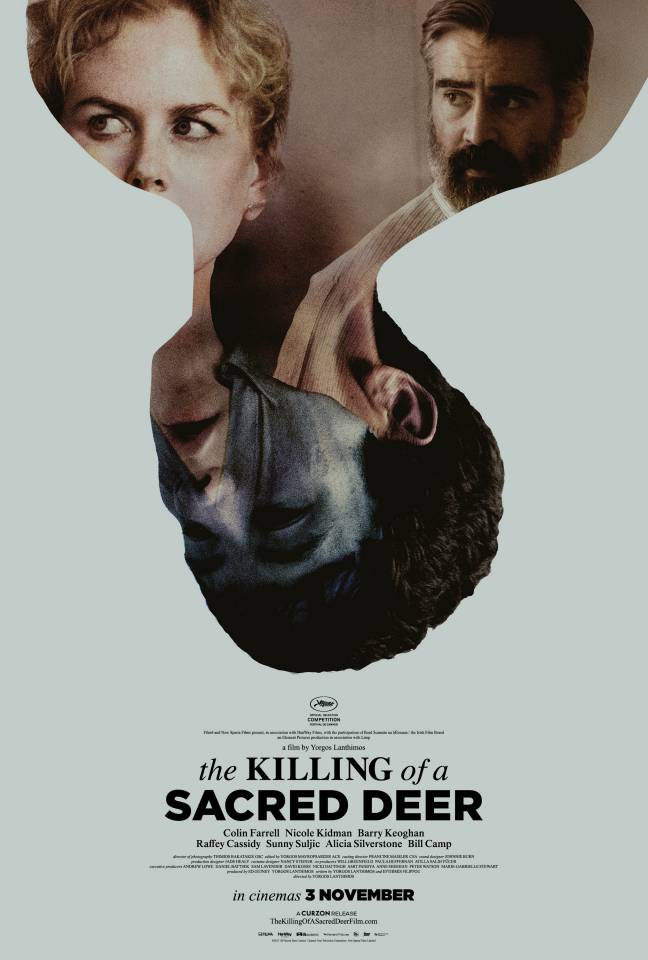
The Killing of a Sacred Deer (2017)
Cast: Colin Farrell, Nicole Kidman, Barry Keoghan, Raffey Cassidy, Sunny Suljic, Alicia Silverstone
Director: Yorgos Lanthimos
released on blu-ray January 23, 2018
******** 8/10
IMDB: 7.2
Rotten Tomatoes: 78%, Audience Score 64%
The Guardian: ****/*****
Yorgos Lanthimos is a Greek film and theater director, producer and screenwriter. I’ve written about a film of his before, but I want you to consider his background today. While Lanthimos may have made his first feature length film back in 2001, he was making experimental plays as far back as 1995, and that’s likely how this film came about.
Taken from Wikipedia and modified…
Steven Murphy, a skilled cardiothoracic surgeon, finishes an open heart surgery, and later goes to a diner where he meets a teenage boy named Martin. The precise nature of their relationship is unexplained. Afterward, Steven returns home to his wife, Anna, and their children, Kim and Bob. The next day, Steven reveals his connection to Martin, claiming he is a schoolmate of Kim’s, when Martin unexpectedly comes to speak with Steven at the hospital. Steven later privately tells Anna that Martin’s father died in a car accident ten years earlier, and that he has taken an interest in the boy to help him grieve. At Steven’s suggestion, Martin comes to the Murphy household for dinner; Kim seems particularly taken with him.
Martin returns the favor by inviting Steven to his mother’s home for dinner. After the meal, Steven attempts to leave, but Martin insists he stay and watch a movie with them. Martin leaves halfway through the film, and his mother makes a sexual advance on Steven, who quickly rebuffs her and goes home. Over the next few days, Martin’s demands on Steven’s time grow increasingly frequent and desperate, but Steven does not reply. One morning Bob awakens and finds he cannot feel his legs—he has become paralyzed. Steven and Anna rush him to the hospital, where a full neurological examination reveals that nothing is physically wrong. Though he briefly recovers, Bob remains unable to walk. While the elder Murphys tend to Bob, Kim meets with Martin for a date.
The next morning, Martin visits Bob in the hospital and demands that Steven speak to him in private. The two retreat to the cafeteria, where Martin reveals the truth: his father did not die immediately, as Steven told his wife, but during surgery that Steven himself performed after the crash. Steven failed to save Martin’s father, and the boy bluntly tells Steven that he blames the cardiologist for the death. He further explains that, to “balance” the act of destroying a family, Steven must kill one of the members of his own. Martin goes on to explain that he has placed a curse upon the Murphys that will gradually kill them through a series of stages unless Steven makes his choice and murders one of them; the paralysis is the first of these four stages. Steven attempts to dismiss these seemingly wild claims, but later finds that Bob is refusing food—this is the second stage of Martin’s curse. Kim later loses the use of her legs during a choir practice and also will not eat.
Kim receives a phone call from Martin at the hospital. During the conversation, Kim abruptly regains the use of her legs, only to lose mobility again when the connection is broken. This seems to convince Anna of Martin’s power, and she travels to his home to directly ask why she and her children must suffer for Steven’s mistakes. The unrepentant Martin cannot answer, simply remarking that “it’s the only thing I can think of that’s close to justice”. Anna, further suspecting that her formerly alcoholic husband may have imbibed on the day of the operation, speaks to Steven’s anesthesiologist, who reveals that Steven did in fact have a few drinks that morning, with Anna sexually gratifying him as payment for the information. At Anna’s insistence, the children are transported to their home, where they are continually fed though an NG tube. Anna and Steven fight over the situation, with Steven refusing to believe that anything supernatural is happening. That night, he kidnaps Martin and binds him to a chair in the basement, brutally beating him and demanding that he undo his hold on the children. Martin remains unflappable, warning Steven that time is running out.
Martin’s presence only exacerbates the tension in the household: Kim and Bob argue with each other over who their father will choose; Steven tries to gather information to make the decision; and Anna claims that killing one of the children is clearly the only option, as they can have another. Kim attempts to save herself by traveling to the basement to see Martin, demanding that he free her again so that they may run away together. Her strategy fails and she tries to escape herself by crawling through the neighborhood. Steven and Anna save her. The next morning, Anna releases Martin while Steven sleeps, pointing out that holding him captive was of no use. Later that day, Bob begins bleeding from the eyes—the final stage of the curse before death. Rather than choose, Steven binds Kim, Bob, and Anna to chairs in the living room, covers their heads, and pulls a black woolen mask over his own face. He next loads a rifle, spins uncontrollably, and fires. The first two shots miss, but the third pierces Bob’s heart and kills him.
Some time later, the family visits the same diner where Steven previously met with Martin. As they sit in silence, Martin enters and stares at them; he and the family briefly lock eyes and Kim begins eating before they stand and leave. Martin gazes after them as they walk through the door.
I’ll say this as objectively as I can, while this movie is incredibly fascinating to me, I don’t think it’s very accessible to the average film goer. Which is very sad, because I think it has a lot of interesting ideas about revenge. And for that reason alone, it’s difficult to give it a high rating. Because I think the director made conscious decisions to veil the meaning of the story, when they could have made it less beautiful and theatrical, and more cinematic.
With all that said, this movie absolutely effected me. It shifts from dark comedy, to a dense drama, weaving in elements of the myth of Iphigenia – a tale about the sacrifice of the titular princess by her father King Agemmnon after he unwittingly offended Artemis, and brought ruin upon his household.
It should be obvious that The Killing of a Sacred Deer is a tale of revenge, but the poetic choice to remove most present day vernacular in favour of emotional resonance turns this into an arthouse film. And as I mentioned, makes it immediately less accessible. But that never prevents the themes from coming through. Alicia Silverstone does an excellent cameo as Martin’s mother, and the superficial nature of the Murphy family dynamic is perfectly painful to watch.
But the best of all is Barry Keoghan as the increasingly terrifying and awkward Martin.
Pros: Lanthimos is fully capable of making his audience uncomfortable, looking at issues of guilt, compliance, and morality. No one is free of sin, but best of all, we never know if Martin is an angel of death or merely the messenger.
Cons: As I mentioned before, the film doesn’t address the scene of the crime in a direct way, nor does it identify the body immediately, but as the aftermath unfolds, we are asked to endure increasingly more shocking events, which all pale in comparison to what could have been a series of suggestions.
Runtime: 2 hours 1 minute
Points of Interest: The heart surgery scenes were of real people. A shot panning towards Bob when he starts to get sick, blurs an image of a deer behind his head, subtly foreshadowing the ending of the movie. Colin Farrell admitted to nausea after reading the first draft of the film.
All-in, the cinematography is beautiful and while it is reminiscent of 2015’s The Lobster, Lanthimos truly does have a handle on the hard emotions of life. I can almost guarantee your own reaction to this film will be different then mine, my fiancee refused to watch the ending of the film, getting all the way up until the final twenty minutes. Such is the nature of true art, it effects us.
theories Summarized
I think this movie is bizarre, disruptive and well planned. It’s likely not going to be for everyone, but if you want a gut punch and are prepared to feel unsettled, then I have a theory that The Killing of a Sacred Deer will leave you wondering deep things.
That said, Mike has a really cool solo Watch Culture video run prepared for you. What We Do In The Shadows is a film about a group of vampires that live together and are documented by a film crew. It’s a horror comedy, and in a completely different vein from any vampire movie you’ve ever seen. And I’m not sorry for the bad pun. Check it out! And remember… Like! Comment! Subscribe!
Tim!




 timotheories