Meditate On This (Vinson Lim interview preview)

There is a lot to be said about the importance of discipline, meditation and reflecting on your creative projects upon completion… Whether you shoot video, take photos, design logos or any of the other convention commercial arts, timelines and making the work count is a necessary evil of the job. People pay for expertise, and so you have to look at your art as a business in order to satisfy client needs, but what about the importance of inspiration?

Vinson Lim has come to accept that you need a healthy dose of both in order to achieve greatness as an artist. Truly talented individuals can live in the moment all they way, and produce high volumes of work too, but it’s even more important to take care of your health, and develop intelligent practices to maintain the workflow for years to come.

And so I asked Vinse the question – how often do you find yourself in a state of meditation when you work?

I wanted to see if he actively reflects on life or if there is simply rituals in place that fuel the fire and keep things going even when the spark of youth has left us. This is just a taste of our broader discussion on spiritual alignment, but I promise you’ll get a lot out of hearing what Vinse has done over more then a decade of shooting fashion photography, commercial product photos, living the weekend warrior life of wedding photography, and make artistic work too.

It’s an amazing introduction to the topic of spiritual alignment, and while this might be considered a heavy topic, Vinse has a great ability to present his thoughts in a meaningful way. But enough from me, it’s time for you to watch the video and see for yourself.

theories Summarized

Fun fact, I’ve known Vinse for quite a few years now, but it has been a while since we’ve been in touch. I’m truly impressed with how much he has matured in half a decade, taking on husband duties and now a father as well. But I’d rather not go into those details just yet, better to save them for the official interview, which I will be releasing next week!

That said, if you’ve enjoyed this introductory question and answer on the importance of meditation, please like and share the video, and of course leave some comments if anything really stood out or if you’ve got a good example of balancing inspiration and ritual in your own artistic practice.

More theories on the way, especially with this Our Lady Peace review coming out tomorrow! Check back soon!

Tim!

Reflection Injection (Positive Affirmations & Happiness)

Our days our filled with observations and analysis.

Whether it’s dealing with social hoops of family and friends, the inherent differences between the opposite sex or the tedium of the work week, we have to take in a ton of information and process it rather rapidly, so that we can then move onto the next thing.

As someone who is always thinking about things critically, this can be especially frustrating for me to personally deal with, and I know that we are all victims of our own over-analysis. What we really should be doing, is separating ourselves from our problems and reflecting on the week, REGULARLY, so that we can apply the critical model to ourselves.

But in order to get there, we have to be receptive to the process.

6FUl7

That means looking into healing practices so that you can properly begin the process of self-reflection, and I just so happen to have a couple of tricks up my sleeve to make that happen for you without too much effort, and right out of the gate to boot!

Positive Affirmations and Mindful Meditations

Introspection is an amazing thing dear readers, but you don’t know what you don’t know, as they say. Who are they anyway? Well, let’s not get sidetracked, the word they is just a generalization to avoid citing sources.

So you want to be more introspective folks, because as you examine those negative thoughts, feelings, and insights, you’ll start to feel overwhelmed. And listening to pre-recored audio affirmations that you voice yourself will train your brain to listen to yourself in a different way. As you do this each day, when you wake up and then before you go to bed, your brain sub-consciously takes in these ideas and shifts away from negative self-talk to more positive self-talk.

This next part is important – You need to make declarations, especially ones that you don’t believe at the moment.

The reason for this is that these statements will slowly become things that you believe about yourself over time, and because it is as simple as listening to the statements, you aren’t working to accomplish anything. But they need to be statements that without an end or a goal. Statements of being, identity and purpose.

It’s kind of difficult to explain so rather than dwell on it, I’ll show you. For example, this is my list and it’ll help contextualize the purpose of the exercise.

I am a child of God with infinite worth.
I am always taken care of.
God loves me and accepts me.
I am always more than enough.
The worth of my soul is great.
I now fully accept myself.
My body is now in perfect balance.
I am always healthy and strong.
Everything I touch prospers.
Other people experience their worth when they are in my presence.
Everything works together for my good.

Now I don’t think you need any of the points around a spiritual purpose, but it is important to be balanced in terms of mental, emotional, physical, and spiritual needs. So if you have a belief system or you have no belief system, you can replace “God” with whatever works for you. If you are an atheist for instance turn “I am a child of God with infinite worth” into “I am child of humanity with infinite worth”, and “God loves me and accepts me” into “I am loved and accepted.”

Another key component to consider is that when you are recording these statements, you should replace I with you where appropriate so that you are saying these messages back to yourself, and it has been shown that classical music elevates the mind, so why not put some Mozart, Bach, or Beethoven as a backing track?

Next, loop the audio track so that it comes in at about 15 minutes, and export the mp3. You have the basis for your positivity. If you can commit to this process over a month, you’ll be shocked at how much of a difference it makes in your mood, and then see how you feel after three months.

Yes, I know that this wasn’t entirely a “timely” post friends, but this is routine something that I recently got back into myself, and coming off the heels of a break-up, I’ve felt significantly better following this protocol than I would’ve if I had just kept my thoughts to myself.

The results are truly staggering, but that’s just a theory.

Tim!


The Best Laid Plants (Plan To Make Plans)

Remember a week ago when I said we were done with the preliminary series of Life Hacks AKA Skills To Invest In?

Well while that was true, I wasn’t telling you that we were done altogether, only that we were done with the basic concepts.  This is because we did touch on each concept in one way or another dear readers, but we didn’t spend dedicated time on 2 topics in particular, and I want to get to them this month.

Which is why today we’re going to focus the first topic – Planning To Make Plans. Before we dig into it, let’s take a peek at the skill summary:

Plan regularly! Build routines to start your day AND end your day. You are going to have to organize throughout the day too, so make an outline to insure you aren’t starting from scratch over and over. Please also set deadlines for major projects by planning ahead. You’ll benefit from organizing your desk/workspace, minutes save hours, believe me.

We will definitely hit all four of those highlighted points dear readers, but if you’re patient with me, you just might foresee the great plan being laid out.

1. I don’t care who you are or what stage of life you are at, it’s important to have a daily routine and to schedule your days in a way so that they always start & end the same. How do you accomplish this you ask? Try theming your days

Monday – production and creating
Tuesday – management, company identity, and running your business
Wednesday – production and creating
Thursday – marketing, communications, and partnerships
Friday – production and creating
Saturday – FUN, aka relaxation
Sunday – reflection, feedback, strategy for the upcoming week

2. Organizing throughout the day can be daunting, especially with all the various forms of distraction we have so handy in our lives. But if focus on what exactly you want to accomplish that day, or to put it another way, what positive influence do you need to make on the world and that follows your passions for life, you can then set up an outline that will cover your needs. Especially with so many internal or external distractions, model your days (on Sunday) so that you hit four or five points throughout the day each day of the week

WORK – 2-3 tasks you need accomplished that day
PLAY – dedicated time for fun and recharging activities
FOOD – both prep and eating should be identified
HEALTH – to slot in exercise and self-care
MIND – for reading, learning, and simple reflections

3. Deadlines always seem scary, but guess what? You’ve already started to lay the groundwork to fit them into your routine. By coming up with a weekly and daily schedule, you can very easily develop a monthly schedule too. This is where deadlines can be helpful – You should never set deadlines for the non-creative work, as a creative professional, but you should set deadlines for projects, within reason. Where the reason comes in is somewhat subjective, but essentially you don’t want the deadline to be so far out that it loses meaning, or so close that it overwhelms, you need to find that 2-4 week sweet spot.

4. Organizing your desk and/or work space: Or how to keep your creative space inspirational. No matter what kind of creative person you are, you must know that your environment effects your creativity. But the question remains, how do you make your space both visually interesting & comfortable to work in?

– Have beautiful objects around you and music that motivates
– Organize based on your personal aesthetic and make it functional, -with stocked supplies
– You need to control the light – have access to daylight, but be able to to dim for abstract thought
– Comfort is crucial – your seat, your clothes, your shoes, the temperature… all important
– Remove distractions (phone, social media, TV, children) and troublesome clutter

This might seem like news to you, common sense or somewhere in between, but no matter what stage of planning your life is in, we all benefit from these types of theories because our current technologies are incredibly efficient at depriving us from focus – Dangerously so. But that’s just a theory after all.

I’m out of theories for now, but be sure to check back tomorrow when I examine something timely and lay out the monthly schedule.

Tim!

Licensed To Steal (Artist As Collector)

I’ve been thinking about what I should write for today pretty much all of my waking hours this past week.

Sometimes I chew on a theory for months (anticipating the date to share it with you), other times the theory appears in a flash of light. And sometimes theories just work themselves out naturally in the moment and I kind of surprise myself with the results.

It’s a similar experience that many artists have when they create work. Nothing happens perfectly, but relying on moments of inspiration is incredibly draining and risky in terms of output. That is why it is so incredibly important to set up a routine and a space that works for the individual, so that bursts of creativity can happen naturally and “seemingly” spontaneously and the disciplined efforts can cover of those moments of creative silence.

It really is amazing that our unconscious minds are working in our favour though when you stop to think about it.

We organize information, experience, and our interests to produce something special, and if we do it correctly, we create a work of art which looks and feels unique, whatever the source of inspiration.

The reason why I’ve been thinking about this process today is because I have this theory that all good artists steal ideas (not an original idea either), but the best ones steal from everyone and everything in their lives. They do this because of an honest appreciation for life and an attachment for what already exists in the world.

To put it simply, every artist is a collector. On the surface it could appear that they store objects, but the reality is that they have enduring love for the object(s) which house much more than the literal contents we observe in passing.

This TED Talk by Austin Kleon details the point quite well.

Nothing is original. All art, from the bad to the great, references what came before it.

So why do critics sometimes comment as if we should operate in a vacuum? I’m not entirely sure. I think it is likely that nuanced truths are harder to swallow than obvious ones, if I am being perfectly honest. Which can be a full blown topic for another Stimulating Sunday.

But that is not what today is about.

Today is about the theory of artist as collector. And the inspiration for today’s post is from a very talented artist who I am sure you have heard of at one point or another, whether you like their work or not.

Here is a sample of my favourite song from the record.

Walking through a crowd
The village is aglow
Kaleidoscope of loud heartbeats
Under coats
Everybody here wanted something more
Searching for a sound we hadn’t heard before
And it said

Welcome to New York
It’s been waiting for you
Welcome to New York
Welcome to New York
Welcome to New York
It’s been waiting for you
Welcome to New York
Welcome to New York

It’s a new soundtrack I could dance to this beat, beat
Forevermore
The lights are so bright
But they never blind me, me
Welcome to New York
It’s been waiting for you
Welcome to New York
Welcome to New York

I’ve highlighted particular lines because I think they are especially relevant for the topic at hand.

This song is from the album 1989 by Taylor Swift. Yes, that’s right.

But that’s not what I was listening to on the drive home to Edmonton from my girlfriend’s parents home in Lacombe today. I was listening to Ryan Adam’s cover album, also titled 1989, with the exact same number of tracks, with almost identical lyrics, in the same song order.

Let’s break this thing down for a minute.

3F70F73E42A17886E4E31E44764B96FB201410916283289

Taylor Swift, who is incredibly talented, let Ryan Adams, who is also incredibly talented, “steal” her work and create his own version of it.

In fact, she gave her instant approval, when he asked. She is a genius.

If you think about it for a second, there have been reviews claiming he did a better version of her work, and that he made it more meaningful.

I call bullshit on that. But not for the reasons that lots of people are.

He was a vehicle that proved how powerful her lyrics really are to everyone, whether people choose to see it or not, is a completely different matter.

This is especially important to note for those who don’t listen to her music and pass if off for cookie cutter pop. Taylor Swift is an incredibly talented songwriter. Period.

And, she gracefully pointed that out with her title track, without being a jerk about it.  Let me illustrate – while we might all be “searching for a sound we hadn’t heard before,” 99% of the time, the sound already exists. It’s because someone loved it, and made art about it, that we can appreciate it the new art. 1989 by Ryan Adams is a great album, but it wouldn’t exist without 1989 by Taylor Swift, and Taylor’s is definitely the better album because she made something “original” without making it obvious what she “stole” from to get inspiration.

And she understands that sharing is caring.

My girlfriend, who is a super fan of Taylor Swift, realized this brilliance of TSwift years ago, I’m finally starting to see it myself. I hope that other creative types make that leap sooner than later, and I also hope that everything I just stole from makes this post worthwhile. And that’s all of the theories I’ve got for tonight.

What do you think? Leave comments!

Tim!

 

The Power Of… Discipline (Build Discipline)

Dear readers, I’ve been thinking about the power of love a lot this past week!

If you’ve ever been witness to the wonder that is the Back To The Future trilogy at any point in your life, you’ll know the song I’m thinking of and the incredibly strong association it has with the original Back To The Future soundtrack, but also with the whole franchise as well.

If you haven’t seen the movies, I’ll just leave this here for your convenience.

If you have seen the movies before, now the song is stuck in your head too! Ha.

Man, I must have have some sort of strange fascination with movie franchises if I keep bringing them up? I think it probably has to do with the fact that the story arc in a film is often fleshed out a little better then in a TV episode. That and it is usually self-contained and more consideration goes into the writing.

JK. Or am I?

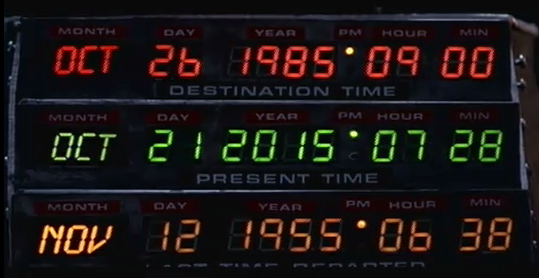
But I have not JUST been thinking about the power of love. That song/concept was not the only part of the movies that came to mind for me when I kept hearing over and over again from friends and media content that the future was now here – that the October 21, 2015 date which Doc Brown and Marty were headed to in Back To The Future Part II, was finally on our doorstep.

back-to-the-future-ii-1

No, I had been thinking about a lot of the principles that the Back To The Future movies rely on to tell it’s story. Concepts of destiny, free will and the time-space continuum. And yes, also the power of love.

One of the major themes from the films interestingly enough is about society and how it changes over time.

This is best embodied in the relationship of Vice Principal Stickland and his family tree, versus the changing landscape of Hill Valley as the characters time hop through it. There are a ton of themes in the movies, but the Stricklands specifically are archetypes of morality and discipline. The Strickland of 1985 even has a favourite word to describe those who don’t uphold his version of etiquette. Slacker!

Admittedly this post is not about the movie Back To The Future, it’s just a device I’m using to get to the topic at hand. Discipline.

It’s funny to me how subjective a disciplined lifestyle can be from one individual to the next, but what I’ve always noticed about someone who is disciplined is that regardless of how they achieve their goals, they work out some sort of routine for themselves in order to accomplish their goals. Much like how fiction writers come to use techniques over and over again in order to create their stories.

I kind of hinted at this concept of discipline this past Wednesday, so if you don’t know what I am getting at, maybe do a rewind to a couple of posts ago and rejoin me when you are ready.

52b577721cb279f307df3206ef80b13d

Glad everyone is going the same direction now…

Why am I writing about the concept of discipline and such? Well, I think Marty McFly has some issues with discipline in those movies, fears of rejection regarding his music in particular, and yeah he definitely grows up towards the end, but we are all in various states of disorganization at one time or another in our lives, but we don’t necessarily need to experience a traumatic event to shift positively.

So how do we work on this?

Well, a lot of people much smarter than I, have suggested that when we form good habits and have schedules, we can spend our brain power on increasingly interesting ideas and actions that propel us forward, rather than rebuilding the wheel, so to speak, every time we engage in an activity.

Let me give you a more concrete example to put it into perspective.

If you decide you want to get better at public speaking, you attend a public speaking course, get involved with toastmasters, start reading book, play brain training exercises, try your hand at improv, etc, etc. But in order to actually improve at those attributes, you do them regularly and allow the habits to form naturally as you commit to the practice of showing up.

Achieving results with creative endeavours is no different – if there are things you need to do in order to create works of fiction, illustrate comic books or piece together your next dress design, and those recurring tasks constantly come up, then you have to generate the brain power to remember to do those tasks.

But if you build a routine for yourself, you will eventually “know” what you need to do intuitively, and can focus your energy on experimenting, playing, and enjoying your talents.

Without building a routine for you, I’m going to share a link here to another article I enjoyed that’s done some of the legwork already and which also has citations.

What do you think of this theory? Are routines important? Do you like it better when you let your brain run on auto pilot and move you into the studio or at your desk where you can focus on the fun parts? Leave me some comments!

Tim!