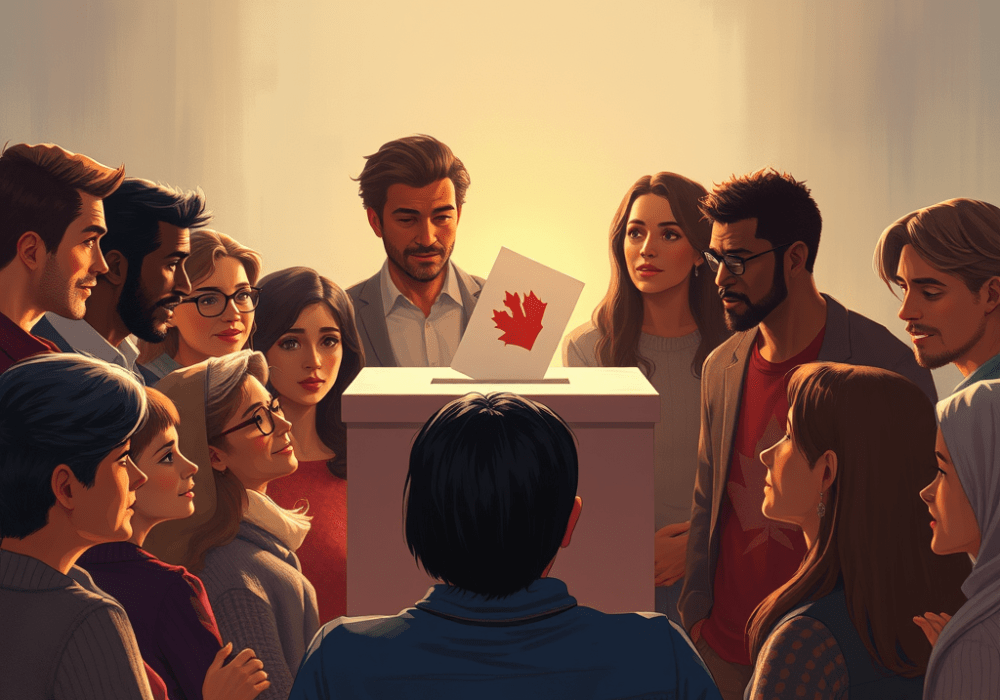
On Monday night (April 28, 2025), Canadians didn’t just cast votes—they told a story. About who we are, what we value, and where we believe we’re going.
As the results of the 2025 Federal Election rolled in, I found myself thinking less about seats and more about symbols. Less about the politics, and more about the narrative we’re crafting together as a nation. Because at its core, an election is just another kind of storytelling—one that plays out across platforms, debates, doorsteps, and digital comment sections. And like all stories, it reveals something deep about the people who choose to tell it.
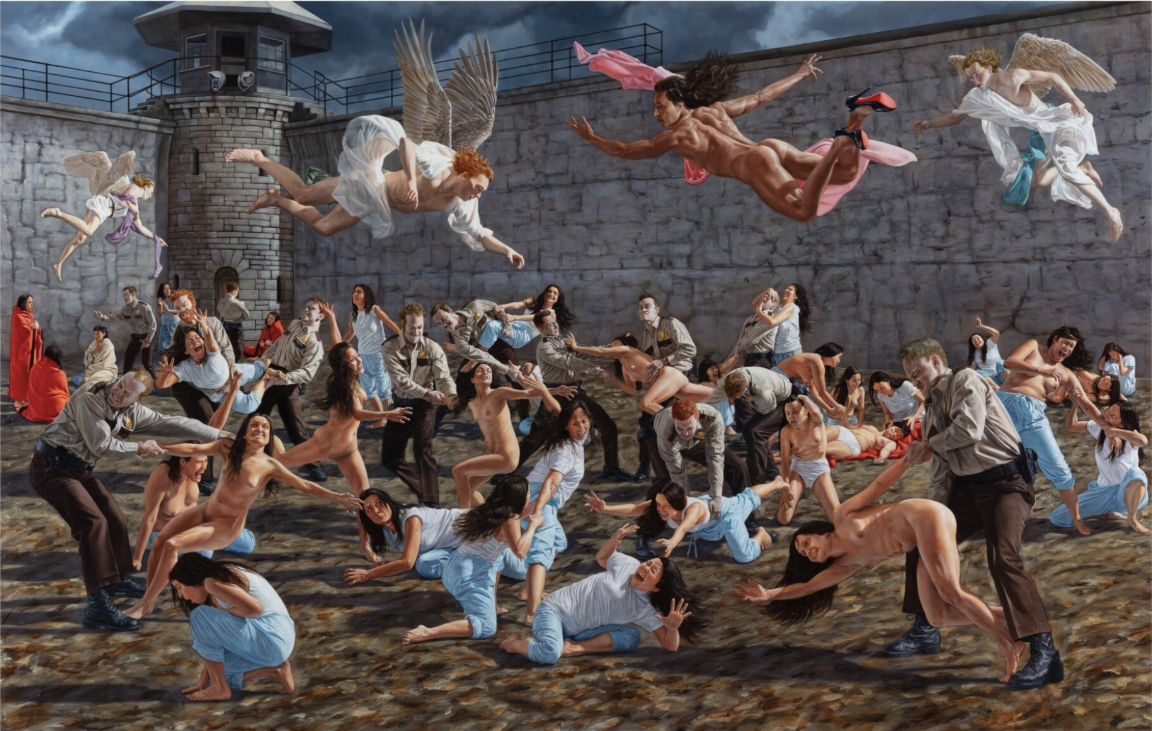
Moments like this have long inspired Canadian artists to interrogate identity, power, and place. Whether it’s Kent Monkman subverting colonial narratives or filmmakers capturing quiet rebellion, the work that emerges from cultural tension often becomes timeless.
Kent Monkman, “The Madhouse” (2020). Image via Sotheby’s.
The Election as a Mirror
This year’s election was historic— a shift in leadership that saw all major parties change at the top, a resurgence of voter engagement and the emergence of new voices on the political stage.
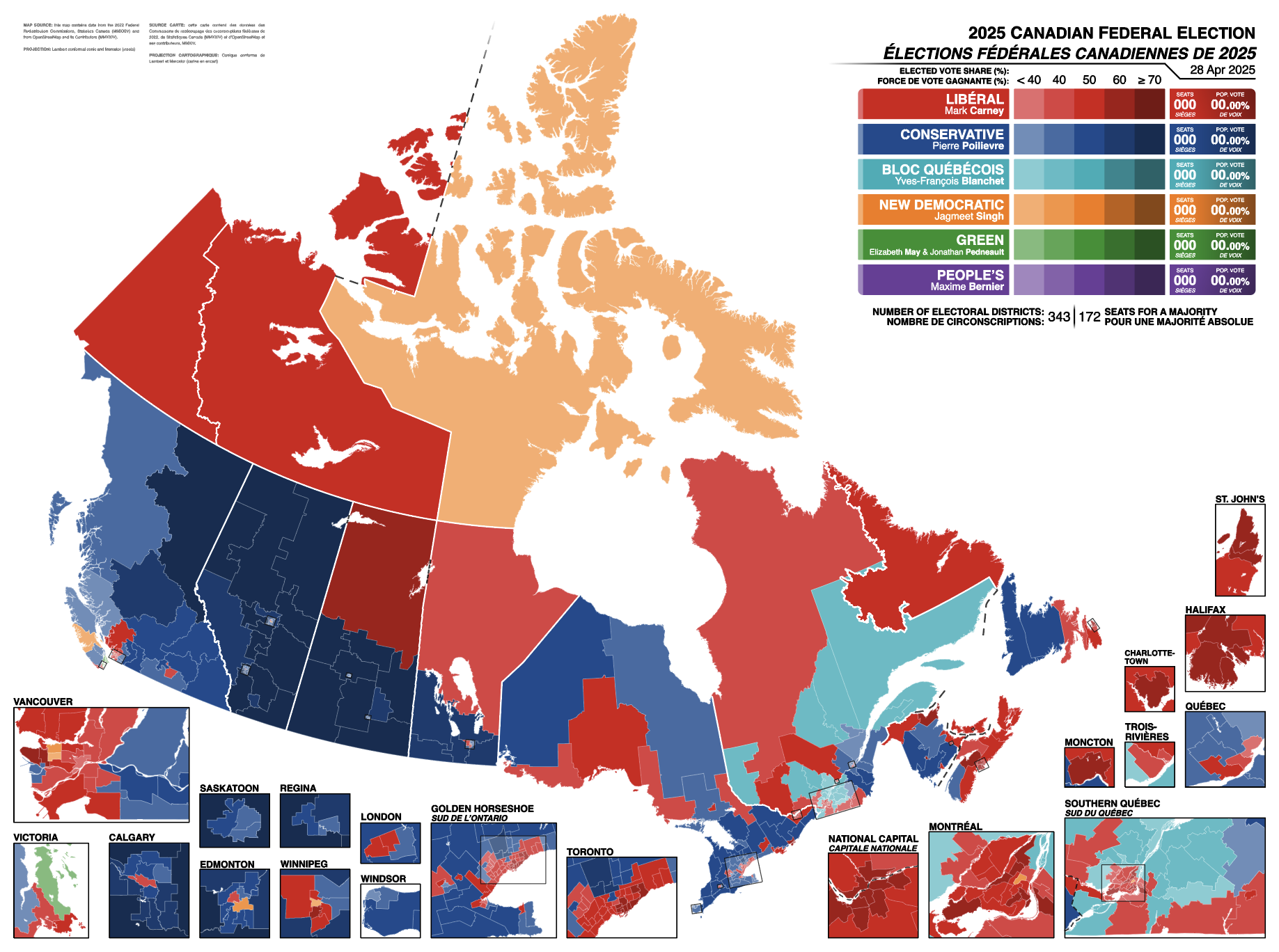
Justin Trudeau stepped down as Prime Minister, making way for Mark Carney to step into the Liberal leadership – Carney led the party to a minority government win. Meanwhile, Pierre Poilievre gained ground for the Conservatives, solidifying their dominance in Alberta and Saskatchewan—but lost his own seat in Carleton. The Bloc Québécois saw a drop in seats but retained just enough influence to affect the balance of power. The NDP, facing its own steep decline, lost official party status, prompting Jagmeet Singh’s resignation as leader.
2025 Canadian Federal Election Results. Image via Wikimedia Commons.
The Liberal Party hold a minority government victory, securing 169 seats—just shy of the 172 needed for a majority. What’s more surprising is that this actually came to fruition; many political sources and publications have stated that the Conservatives (or Tories as they love to be called 😉 ), under Poilievre, should have won the election but Carney’s leadership played a pivotal role in reshaping the Liberal’s fortunes. In the end, the Conservatives won 144 seats, with Poilievre notably losing his own seat in Carleton. The NDP faced significant losses, securing only 7 seats and as mentioned, Singh’s resignation as party leader.
But beyond all the numbers and headlines, what resonated with me was the underlying tone.
The election served as a cultural mirror. The language of the campaigns, the concerns raised at town halls, and the platforms that gained traction told us that Canadians are wrestling with identity, equity, safety, and hope.
In film, we’d call this a turning point. The moment where the protagonist must decide whether to change, resist, or retreat. And I’d argue that Canada—like a character in a compelling drama—is right in the middle of that scene.
Among the many reflections I’ve come across, some of the most thoughtful have captured the nuance of this moment through unity and empathy. They point out that this election wasn’t just a division of geography, but of generations, values, and rhetoric—and that the real path forward lies in unity and empathy.
Everyone is entitled to their belief and their vote, but regardless of how they voted, they are our neighbor.
Creativity in the Shadow of Politics
Elections don’t happen in a vacuum. They shape how we create, fund, and distribute art. They influence the stories that get amplified—and those that get buried.
As someone who built a platform rooted in cultural critique and creative expression, I’ve always believed that artists have a responsibility to pay attention. Not necessarily to be political in the traditional sense, but to be attuned. To reflect, to question, to push. What we create in response to the world matters—and this election may mark a shift in tone for many Canadian creators.
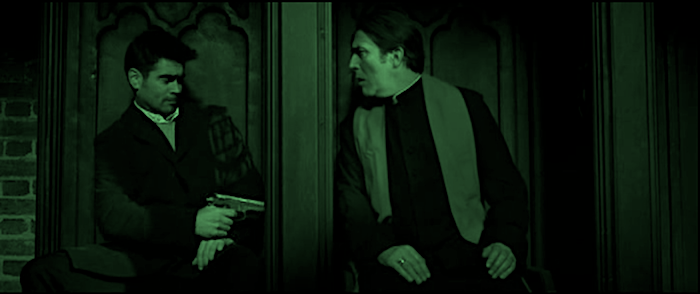
Whether you’re a filmmaker, a writer, a painter, or simply someone who consumes art with intention, you’ve probably felt this undercurrent before: that moment when politics start to bleed into the palette. For me, I think back to films that captured national identity in flux—like Gangs of New York, Incendies, Waltz with Bashir or District 9. Granted, District 9 is a sci-fi set in South Africa, but it does a fantastic job exposing the legacy of apartheid.
A country’s soul is often best understood through its art.
What Artists and Thinkers Can Do Next
So what now?
We make things. We stay present.
We interpret this moment and give it texture. Whether we agree with the outcome or feel disappointed, we don’t go quiet. Creativity is resistance, but it’s also restoration.
timotheories ethos has always been about uncovering truths through culture—digging into film, art, and ideas not just for entertainment, but for connection. And this is one of those times when connection is crucial. We need the dreamers and the realists, the critics and the community-builders, the hopeful and the heartbroken. Because storytelling doesn’t end at the polls. It starts again the next day.
Films That Speak to Our Political Soul
Confession time: I haven’t seen most of these films coming up.
But in reflecting on this election, I found myself wondering—how has Canadian cinema captured moments like this? What stories of resistance, quiet rebellion, or cultural reckoning have we already told?
So I did what any artist would do: I dug in.
The list below isn’t a list of films I’ve mastered—yet. It’s a set of culturally significant Canadian works that I’m adding to my own Watch List. Stories that speak to identity, resilience, and the subtle ways people push back against systems, silence, or expectations.
If you’re curious too, maybe this is your invitation to watch with me:
Antigone (2019, dir. Sophie Deraspe) – A bold reimagining of the Greek classic, rooted in a teenage girl’s fight for justice in Quebec’s immigration system.
Sleeping Giant (2015, dir. Andrew Cividino) – A quiet but potent exploration of masculinity, grief, and adolescent rebellion in Northern Ontario.
Meditation Park (2017, dir. Mina Shum) – A Vancouver grandmother begins quietly reclaiming her autonomy after decades of self-sacrifice.
The Body Remembers When the World Broke Open (2019, dirs. Tailfeathers & Hepburn) – A real-time portrait of Indigenous womanhood, class divides, and unexpected compassion.
Firecrackers (2018, dir. Jasmin Mozaffari) – Two teenage girls on the edge of adulthood push against the limits of control and small-town life.
These aren’t loud stories—but they’re full of power. And maybe, like this election, they remind us that the undercurrents matter just as much as the headlines.
theories Summarized
The 2025 Federal Election is now part of Canada’s cultural archive. A chapter closed, but far from the end. What comes next—how we respond, create, and relate—matters just as much. Maybe even more.
So I’ll keep watching, writing, and wondering. And I hope you will too. Let’s continue to make sense of the world together—one story at a time.
What did the 2025 election mean to you? What story do you see unfolding in your community, your creativity, or your own life? Let’s talk in the comments.
In a world where creativity is often seen as the result of an original spark, the truth is much more nuanced.
Artists, in their various forms, are not lone geniuses creating something from nothing; we are collectors. We gather fragments from the world around us—ideas, sounds, visuals, stories—and blend them into something new.
You may or may not recall a previous post of mine, Licensed To Steal (Artist As Collector), another of my very early blog post entries and one which I absolutely can look back on with cringeworthy facial expressions and heartfelt nostalgia. Simultaneously.
In case you don’t want to take a walk down memory lane with me, and I wouldn’t blame you, I’ll sum up the concept of that previous entry for you..
I discussed the fine art of borrowing from others and making it your own. It was inspired by Austin Kleon’s TED Talk on how “nothing is original,” and we, as creators, are all influenced by the work we consume. I referenced Ryan Adams’ cover of Taylor Swift’s 1989 as an example of how an artist can transform something familiar into something uniquely their own.
Fun fact: I also gave a shoutout to my girlfriend at the time, but funnier still is that we parted ways in the summer of 2016 and then after some time apart, she made an attempt at “a reconnect” the same night Trump was elected that fall, but thankfully I was riding off the high of my first date with Mysticque from earlier that same night… so bullet dodged.
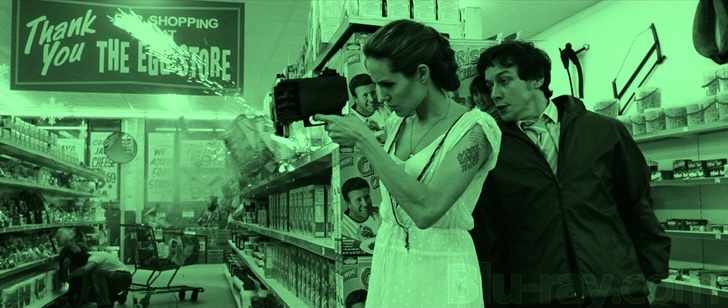
Thanks, corner gun.
Since then, I’ve realized a few things. I still really and truly think Wanted is a terrible movie, and I don’t know how James McAvoy dodged his own bullet with that one, (read: paradox) but more importantly, that the act of borrowing, or “stealing,” goes beyond just creative reinterpretation. It’s about re-contextualizing ideas to give them new meaning in our lives.
The line between “stealing” and “creating” is often blurry.
Every time I pick up a camera, paintbrush, or microphone, I’m gathering from the world around me. Insert my obligatory cliche.
Good artists borrow, great artists steal. Attributed to Picasso, but he could have stolen that from someone else for all we know.
Each movie, album, or conversation has become part of my collection of influences. But the real magic happens when I take these influences, mix them with my personal experiences, and make them my own. It’s a cycle of reinterpretation, where nothing is purely mine, but nothing is purely someone else’s, either.
What It Means to Be a Curator
The title of “creator” often comes with a sense of awe, as though we’re expected to manifest something out of thin air—pure, original genius. But the truth, as I’ve come to learn, is far more intricate and grounded. Being a creator is not about inventing something from nothing; it’s about finding meaning, context, and connection in the things we already have, in the influences we’ve absorbed, and in the raw materials life provides.
So, by that account, to be a curator should really mean a guardian of a collection. To be a custodian, keeper or critic of those things can have its place, for sure, but by my own definitions, a curator ideally protects and organizes things that they love, and hopefully, like a well made mixtape or a playlist for my Zennials, they pay it forward by sharing that collection with others.
For many, collecting can be an intellectual pursuit, driven by a desire to learn, to gain insight, and to preserve knowledge, but it can also be deeply personal. In fact, Chris and I talked about this in great depth on a Confer Culture episode back in 2020, titled Collecting vs. Hoarding. We explored the psychological nuances of these two acts—how collecting is intentional, meaningful, and deeply tied to who we are as individuals, while hoarding, conversely, can reflect a compulsive, often chaotic desire to accumulate without purpose.
We discussed how, as creators, we constantly gather influences—from art, from our own experiences, from history—and how this curated collection shapes our identities and informs our creative work. What differentiates collecting from hoarding is the intent: the creator’s purpose is to transform and share, while the hoarder might simply amass without truly engaging with or curating their collection.
A Philosophy of Collecting
At its core, collecting is deeply psychological. It speaks to our innate desire for connection— they represent memories, emotions, and stories that ground us. Collecting is also about identity: the way we define ourselves by what we choose to keep, what we value, and how we express that value to the world.
While accumulating objects might be an instinctual act, curation involves a mindful selection process. A true collector doesn’t just gather things indiscriminately; they curate—carefully selecting what enters their collection based on a set of personal criteria. This act of curation transforms a simple collection into something intentional, purposeful, and meaningful.
Our collections, in many ways, act as living journals that, when viewed as a whole, paint a portrait of our personal growth. Collecting shouldn’t be about what we accumulate; it’s about seeing how our collections evolve, reflecting the changes in ourselves as we navigate life’s chapters.
The Curator’s Process: Gathering with Purpose
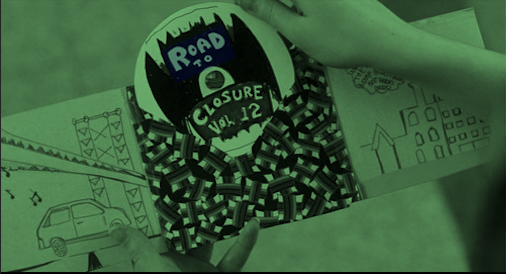
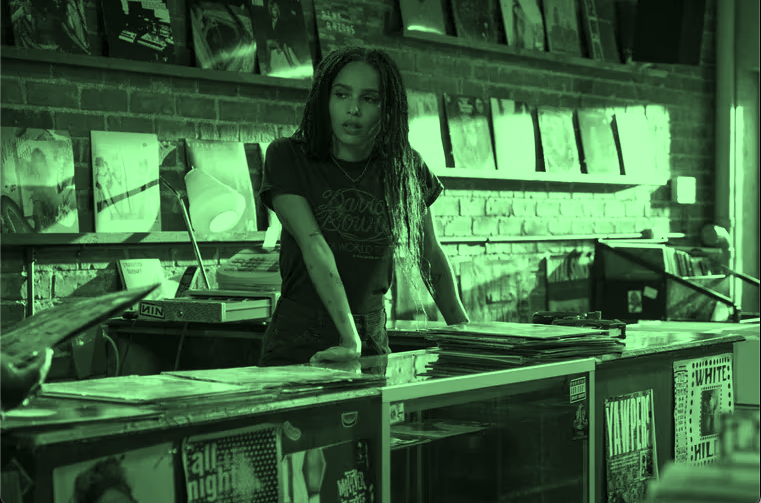
My process of curating is always deliberate. Take my Watch List project, for instance. I approach each film with a purpose—whether it’s to engage with a specific genre, explore cultural significance, or revisit films that have shaped my creative journey. Each film I watch is like adding another thread to a larger tapestry of understanding. With vinyl records, it’s more tactile. The act of going out, finding a record, and holding it in my hands feels like a sensory engagement with the past. It’s a ritual that connects me to the music, the artist, and the moment in time when the album was released.
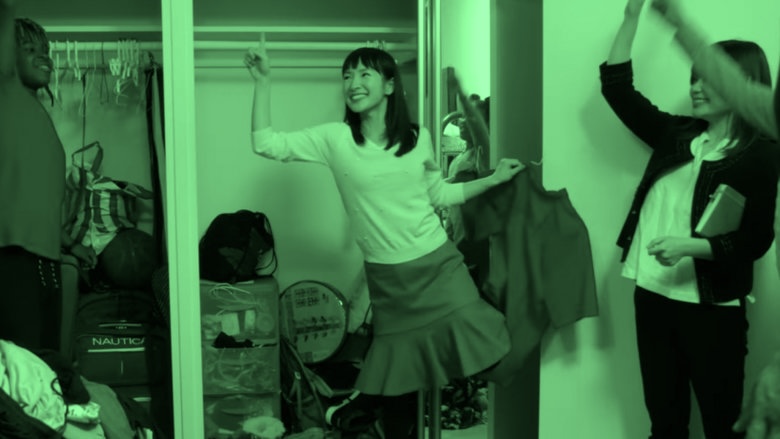
To avoid the trap of hoarding, it’s essential to ask yourself: Does this item enhance my life or creative process in some way? I love Marie Kondo’s philosophy on de-cluttering because I think it works here too. Does it spark joy? If it doesn’t serve you, don’t keep it and definitely be more mindful of adding additional pieces. A collection becomes overwhelming when it’s driven by impulse or nostalgia rather than intention.
Intentional collecting can act as the catalyst for new creative projects. For example, when curating and exploring The Watch List, I don’t just watch films for entertainment; each movie becomes an opportunity for reflection or exploration. A particular film sparks an idea for a blog post, a podcast episode, or even an art piece. This cyclical nature of collecting fuels my creative work, offering new angles and fresh inspiration.
Collections as Cultural Windows
Collections are not just personal; they also serve as cultural artifacts. The items we choose to collect speak to the values, aesthetics, and trends of particular moments in time. Take my movie collection, for example: Each film represents not only my personal taste but also a broader cultural context—whether it’s a reflection of social movements, technological advancements, or shifts in cultural norms. Similarly, music collections can reflect the sounds and styles of specific eras. By looking at the art we collect, we can trace the evolution of culture, taste, and human expression.
In my movie collection, the films I gravitate toward range from classics like Citizen Kane to contemporary works that explore societal issues like Short Term 12 or Eye in the Sky. I often joke that the movies I watch have to mean something or do something interesting, but what I really mean is that these selections tell a story about my interests—how I appreciate timeless storytelling, but also how I’m drawn to exploring the present-day world through the lens of film. My music collection does the same – each album revealing a bit about my shifting tastes, the eras I admire, and the ways I see the world and want to be shown it too.
As a collector, I’m not just holding onto things; I’m preserving pieces of cultural history.
Every item in my collection is a piece of a larger narrative—whether it’s a film that shaped the cinematic landscape or an album that became the soundtrack to a generation’s coming-of-age. By sharing these pieces through my blog, podcast, and other creative outlets, I’m inviting others to explore these stories, to question, reflect, and connect with the past. Collecting, then, becomes a way to engage with culture and to share that culture with others.
Borrowing From Life
My collections are a rich source of creative inspiration for me, if that’s not obvious yet.
For example, a film may spark an idea for a podcast topic, a song might influence the tone of a new blog post, or a board game might inspire, ironically, a board game design. The influence of these collected pieces is subtle but constant—shaping my ideas, fueling my projects, and driving my creative process forward.
There’s a certain alchemy that happens when you start to borrow not just from other art, but from life itself. I’ve found that some of my most recent work has been shaped by personal struggles and growth, elements that didn’t come from external sources, but from within. These are the pieces I draw upon when creating, often without realizing it. Whether it’s the challenges I’ve faced in blending families or navigating career hurdles, these experiences often find their way into my projects.
In fact, I think the best artists do this all the time.
One of the things I both loved and hated about doing a bachelors of fine arts degree was the spectacle surrounding famous artists throughout history, those winners whose art gets to adorn curated mausoleums, or museums if you prefer the politically correct definition of them. But if you go looking closely enough, you can start to see that like anything, all of those artists were inspired by those who came before, and the world around them.
In an upcoming Confer Culture podcast on Character Actors, for example, Chris and I explore the way certain performers transform roles by borrowing from their own life experiences. The magic of these actors is their commitment to their roles. And I think in their ability to borrow from their lived experiences, bringing a depth to their roles that resonates with audiences.
And when I share those works with you, whether they come from me or from creators I admire, I’m still sharing fragments of my life along with those external influences.
Just as a home can become a canvas for the expression of self, so too can a career, a relationship, or even a community. In this way, the “stealing” or borrowing I do is not confined to traditional sources. Life itself has become a part of my collection.
theories Summarized
As I continue to push forward with timotheories, I’m reminded that creativity is a continual act of collecting, rearranging, and transforming. Each piece informs the next, with influences overlapping and intermingling.
The future of timotheories is about more than just gathering ideas; it’s about cultivating a community where others can share in the process of borrowing and creating together. Whether it’s through mentorship, collaborations, or engaging in deeper discussions about art, the journey ahead is one of growth, connection, and transformation that you get to benefit from.
So, as I continue to collect and create, I encourage you to do the same. As artists, we all have the privilege of borrowing from the world around us. It’s in the way we take what we’re given and turn it into something new and exciting. After all, art isn’t about inventing something from scratch; it’s about discovering new ways to connect, transform, and share the world with others.
Your Turn
What are you collecting these days? What influences are shaping your work? How do you see the act of borrowing and reinterpreting playing out in your creative process? I’d love to hear your thoughts and see what you’re working on. Please like, comment, and subscribe to the blog. Share it where it makes sense and hug an artist after you read this.
Welcome back to the final installment of my comeback series, From Renovation Chaos to Creative Clarity: My Comeback Story.
Over the past four posts, I’ve shared my journey from creative burnout to reigniting my passion. In Part 1, The Hiatus (Or More Affectionately, I Hate This), I took you through the long stretch of challenges that began in 2017, including an extended home renovation project and professional stagnation, which left my creative pursuits sidelined. Part 2, Finding Purpose: Overcoming Creative Blockages, delved into the mental and emotional blocks I faced, and how building new routines, embracing growth, and relying on my support system helped me reconnect with my art.
Then, in Part 3, Finding Strength in a Storm: My Story of Growth, I shared how life’s unexpected twists—like adjusting to new relationships, becoming part of a blended family, and managing my mental health—became catalysts for growth. I also reflected on how creative outlets and a strong community, even in the form of surprising allies, helped me navigate these storms. Finally, in Part 4, Rekindling Creative Passion: My Journey Back, I revealed how this process of self-discovery and resilience led me to reignite my creative flame, with timotheories becoming my sound piece for exploring and sharing this renewed energy.
Now, in this final post, Building a New Path, it’s time to look ahead.
With lessons learned, it’s not just about returning to form—it’s about evolving. I’ll walk you through my new vision for timotheories, outlining how the platform will grow beyond its original scope to incorporate new formats, deeper community engagement, and an even stronger focus on creativity and collaboration. This journey isn’t simply about recovery from burnout; it’s about creating a sustainable, fulfilling future for myself as an artist, an educator, and a leader in creative communities.
Together, we’ll explore the steps I’ve taken to align my creative and professional goals, and how I plan to keep growing—both personally and within the timotheories ecosystem.
And.
And I’m going to explain how this builds a foundation for me to help you better. Here we go.
Creating a New Vision
Reflecting on my journey, building a new path really has been a profound and transformative experience, crystalline in fact. Almost 10 years later, what began as a blog outlet to express my thoughts on art has evolved into something much bigger.
Through careful planning, strategic action, and resilience in the face of challenges, I’ve set the stage for a sustainable and inspiring future.
The evolution of timotheories is simple.
The platform is no longer just about creating content; it’s about fostering a community, encouraging creativity, and sharing meaningful insights that help others in their artistic journeys, whether they’re creators or patrons of the arts.
In navigating my creative hiatus and the challenges that came with it, I’ve come to realize that my journey with timotheories is far from finished. If anything, the difficulties I faced provided me with a much clearer vision for the platform’s future, because I had to reconnect with myself at the source. I firmly believe that the best is yet to come.
William S. Burroughs once said, if you’re not growing, you’re dying. Which I think is why sometimes it feels like we go through similar problems until we learn from them. Through life’s challenges, I was forced to either renew my sense of purpose or abandon it, and fortunately art won out.
As I reconnected with my creative self, I’ve grown more confident in the belief that timotheories can serve as a bridge for other creators and art enthusiasts looking to share, learn and thrive.
And this next statement is less about you and how I can serve you, but it really does need to be said. The most important realization I’ve had was in the logistics of it all. My goals don’t need to change drastically – they need to expand.
So what exactly is this new vision you ask? I’m going to outline my plans and aspirations in three parts. Focusing on the content I want to produce, my personal growth as an artist, and my goals for community engagement,.
Initially, this blog was a platform to share my thoughts about art, which slowly evolved into a digital persona. I reviewed films, interviewed creative professionals, and shared resources with the goal of helping artists. These were very specific types of posts, but how did they connect back to the act of creating, collecting art or even building your skills up to take on business? That was where I struggled. Then I got further enmeshed in the social media, video production, writing, of just making content, rather than being the content. Which sounds super zen, but will make sense as we keep going.
I’ll be the first to admit that my new goal doesn’t sounds drastically different from the old one, I still want a multi-faceted business that covers a wide range of creative disciplines, provides insights on creative process, life skills, curating collections, consuming media, etc. But here’s the new thing – I want to expand the business and bring timotheories into new formats. Instead of slowly picking away at ideas over time, I plan to broaden my scope and spread specific content across multiple channels all at once. Everything everywhere all at once, but like with art ideas.
My goal covers a wide range of creative disciplines—from traditional arts to contemporary digital mediums, but all of the content is talking to each other at any given time and it feels more intentional. Because it is.
More importantly, I want to build a vibrant community where creatives can share, learn, and grow together, fostering genuine connections and mutual support. So let me walk you through the specific steps I’ll take to achieve this, touching on three key areas.
Content Evolution
The evolution of content is the heart of my vision for timotheories. While I’ve always focused on creativity and storytelling, I now see an opportunity to push the boundaries and be more thoughtful with both the type of content I create and the ways I share it.
Expanding Video Interviews: One of the first steps in this new content strategy is to incorporate more video interviews, branching out into podcasts and live streams. These formats offer flexibility and immediacy, making it easier to connect with my audience in real-time. This shift will also allow me to bring in guests more often, facilitating richer discussions and deeper dives into creative processes.
Introducing Themed Seasons: For open discussion content (like the YouTube Cross Talk or Confer Culture podcast), I’m introducing themed seasons to create a more cohesive storytelling experience. This change will allow me to focus on specific topics or genres over a set period, ensuring that the content remains high-quality, structured, and impactful, while also giving me room to innovate within each season.
Focusing on Positive Reviews: As a creator, I want my platform to radiate positivity. I’ll be shifting away from negative reviews and focusing instead on celebrating content I love—whether that’s a board game, an album, or a film. By spotlighting creative works that inspire me, I’ll keep a positive and supportive space for both creators and their audiences.
Diversifying Content Channels: To keep my content organized and aligned with my core values, I’m introducing three key pillars: Digitally Curate Your Heart, School of Thoughts, and Kuality Talks. These pillars will act as the foundation for every piece of content I create, from in-depth interviews to opinion pieces, allowing me to categorize and show ideas in a way that resonates with my audience.
Broadening the Scope: Moving beyond film, music and gaming, I’ll explore aspects like literature, culinary arts, travel, and wellness. This more holistic approach reflects the diverse interests I hold and allows me to dive deeper into the creative process. Expect case studies of influential artists, deep dives of art intersecting life, and continued critical analysis.
Telling Personal Stories: I’ve also realized the importance of weaving personal stories into my work. I’ll be sharing more about my own creative process, focusing on the “why” behind my artistic choices. By offering a more intimate connection with my audience, I hope to inspire others to think about their creative motivations and make their own stories more visible.
Professional Development
Reimagining timotheories has also led to significant personal and professional growth. Through this process, I’ve identified new career paths, expanded my network, and found more ways to improve my skills as both an artist and educator:
Content Creator: As I continue to produce reviews, interviews, and discussions on creative work, I aim to solidify my role as a content creator who not only critiques art but offers practical, actionable advice. I’ll share insights into time management, the art-making process, and how to keep a balance between creativity and life’s obligations.
Continued Education: To stay on top of industry trends and deepen my knowledge, I’m committing to ongoing education. This means enrolling in workshops, courses, and seminars that can enrich my skills and keep me sharp.
Networking: Building relationships within the creative industry is essential. By continuing to network with other creators, industry professionals, and thought leaders, I’ll make sure that I stay inspired and connected to new opportunities. This will also open doors for potential collaborations that can elevate theplatform.
Launching a Podcast: One of the most exciting developments on the horizon is the launch of another timotheories adjacent podcast. This podcast will offer a more personal touch, allowing for direct conversations with the audience and in-depth explorations of creative topics. It’s a space where I can share candid art thoughts, bringing the audience into my creative process.
Collaborations: Collaboration has always been an important part of timotheories, but I’m looking to expand these opportunities even further. By teaming up with other creators and professionals, I can enrich the content I produce and share a wider variety of perspectives with my audience.
Mentorship Programs: I’m also working on establishing a mentorship program. Through this, experienced creators can guide and support newcomers, helping them navigate their creative journeys while building a supportive and collaborative community.
Long-Term Plans
Looking ahead, my long-term vision for timotheories is ambitious, but it’s grounded in the values I’ve cultivated through this journey. Here’s what’s on the horizon:
High-Quality Content: Consistency and quality are at the core of my content strategy moving forward. Whether it’s through blogs, videos, or podcasts, I’m committed to producing content that engages, educates, and inspires..
Educational Resources: I plan to develop educational resources that can help other artists. These resources will range from practical guides on technical skills to deeper reflections on creative strategies, allowing budding artists to access valuable information at any stage in their journey.
Public Speaking and Workshops: I’m eager to engage in public speaking and workshops to share my experiences with a wider audience, providing practical insights to those who want to support artists through business and community-building relationships.
Community-Led Events: I want to take the platform offline and into real-world spaces, organizing events like art shows, film screenings, and creative meetups. These events will help foster a deeper sense of community, allowing like-minded people to come together and share their passion for the arts.
Financial Sustainability: As I expand timotheories, financial sustainability becomes crucial. I’m working on establishing revenue streams through merchandise, publishing, and other ventures that will allow the brand to thrive in the long term without compromising its core mission.
Continuous Innovation: Finally, my goal is to keep timotheories relevant by consistently innovating. Whether it’s exploring new content formats, embracing cutting-edge technology, or responding to cultural shifts, I’m committed to keeping the platform dynamic, adaptable, and progressive-thinking.
Implementation and Action
Building this new path has been both a challenging and rewarding process.
Reflecting on my journey, I’ve come to appreciate the importance of resilience, adaptability, and the power of community in not only surviving challenges but thriving in the face of them. Over the past few years, I’ve realized that my creative work, family life, day job, and other interests aren’t isolated parts of my life—they’re interconnected and can actually reinforce one another.
This mindset shift has empowered me to embrace my creativity fully, without feeling the need to compartmentalize my life. timotheories is becoming more than just a creative outlet—it’s a representation of my journey and my belief that creativity and life’s practicalities can work together harmoniously to make me the best version of myself.
However, recognizing this was just the first step. The real work came in translating my reflections into clear actions and laying out a plan to turn my vision into reality.
Planning and Strategy
This transformation didn’t happen overnight. It took careful planning, patience, and a lot of honest reflection on what I want to achieve. Here are some of the key elements that went into creating this new path for timotheories:
Content Analysis: I spent a great deal of time analyzing my past work to figure out what resonated most with my audience and what felt most meaningful to me. I took stock of the types of content I enjoyed making and those that aligned best with my vision. This analysis provided me with a foundation for future content, helping me see which areas to double down on and which to evolve or let go.
Competitor Review: I evaluated other creators and platforms in the same space, assessing how they engage with their audiences and what kind of content they produce. This helped me pinpoint opportunities to differentiate timotheories and set more realistic, yet ambitious, goals.
Honest Self-Assessment: I had to be honest about my own capabilities, passion, and available time. What would it take to keep this momentum going in the long run? I confronted my weaknesses, acknowledged my strengths, and charted a course based on my realistic capacity to stay consistent and motivated.
Goal Setting: Once I’d laid the groundwork, I began setting clear and actionable goals. These goals were divided into short-term and long-term objectives, with checkpoints along the way to measure my progress and stay on track.
Detailed Roadmap: My next step was to take these goals and create a detailed roadmap for execution. This roadmap included timelines, content formats, and strategies to build out my different content pillars (Digitally Curate Your Heart, School of Thoughts, and Kuality Talks).
Content Calendar: I’ve always been an advocate of to-do lists, but now I’ve created a dedicated content calendar to plan and manage the production and release of content across all channels. This ensures I keep consistency while allowing space for flexibility and creativity.
Execution
Turning these plans into action has required consistent effort and a lot of juggling. But I’ve learned the key to success isn’t perfection—it’s persistence.
Finding a balance between personal and professional responsibilities has been one of the biggest challenges. Establishing a realistic schedule was essential to guarantee that I could manage my creative commitments while also attending to other aspects of my life.
Financial constraints were another hurdle, which I addressed by creating a loose budget and making more thoughtful purchasing decisions, cutting down on impulse buys that could disrupt my plans. Additionally, technical issues arose along the way, but I leaned on my community for help—seeking advice from knowledgeable peers and using online resources to troubleshoot problems.
Through it all, maintaining mental health has been a priority. I realized that to keep producing high-quality work, I needed to care for myself first. I turned to my support system when needed, prioritizing self-care to make sure I didn’t burn out again. Adopting a positive mindset has been crucial, especially when setbacks threatened to derail my progress. Practicing gratitude, staying flexible, and using affirmations have all helped me keep focus on the long-term goals of timotheories. Despite the challenges, the journey has been incredibly rewarding, and I’ve learned that resilience and adaptability are key to moving ahead.
theories Summarized
As I bring this final post of my comeback story to a close, I’m reminded of the long and winding journey that brought me here.
In this post, I’ve outlined the vision for the future of timotheories—a platform no longer just about creating content, but fostering a vibrant community, nurturing creative passions, and offering meaningful insights to guide others on their artistic journeys.
With a renewed focus on content evolution, professional development, and community engagement, I’ve set the stage for this thing I love to grow into a more intentional and impactful space, serving creators and art enthusiasts alike.
It’s no longer just about overcoming burnout; it’s about building a sustainable future, expanding my creative horizons, and ensuring that this platform becomes a dynamic hub for both personal expression and collaboration.
Reflecting on the series as a whole, we’ve covered a lot of ground.
In the first part, I shared the deep struggles that began in 2017—stagnation in both my creative and professional life, coupled with a long and challenging home renovation, which all led to a total pause in my artistic pursuits. In the second, I discussed how I finally began to break through mental and emotional barriers by developing new routines, leaning on my support system, and rediscovering the reasons why I was drawn to art in the first place.
Then we got to the third part where I really got vulnerable and came to terms with some major life changes – a blended family, mental health struggles, and discovering unexpected communities that helped me weather those storms. I also realized that growth comes from these moments of challenge, and creativity can be a lifeline. Then came part four, where I shared how these experiences fueled my artistic rebirth, leading me back to timotheories with fresh energy and a deeper sense of purpose.
Now, in this final chapter, it’s all about building the future. I’m not just reviving a blog; I’m expanding its scope, bringing in new formats, creating deeper community connections, and setting long-term goals to guarantee the platform thrives – I aim to offer programming and engage with the creative world in more meaningful ways, with a focus on inclusive content, professional development, and community-led initiatives.
But this series isn’t the end of my journey. In fact, it’s just the beginning.
As I’ve hinted throughout, there are exciting developments on the horizon—new content formats, more collaborative efforts, and a broader exploration of art, life, and creativity. I’m working to launch more podcasts, organize live events, and build a program that brings creators together to learn and grow as a community. The road ahead is full of possibility, and I’m eager to keep sharing it with you.
Thank you for tracking along, supporting me, and engaging with these stories of transformation. Together, we’re building something bigger than any one post, any one idea—timotheories is evolving into a living, breathing space for creative exploration. Stay tuned for what comes next, like and share this post if you got something out of it. And better yet, subscribe and leave a comment on your favourite part.
And let’s continue to create, inspire, and grow together.
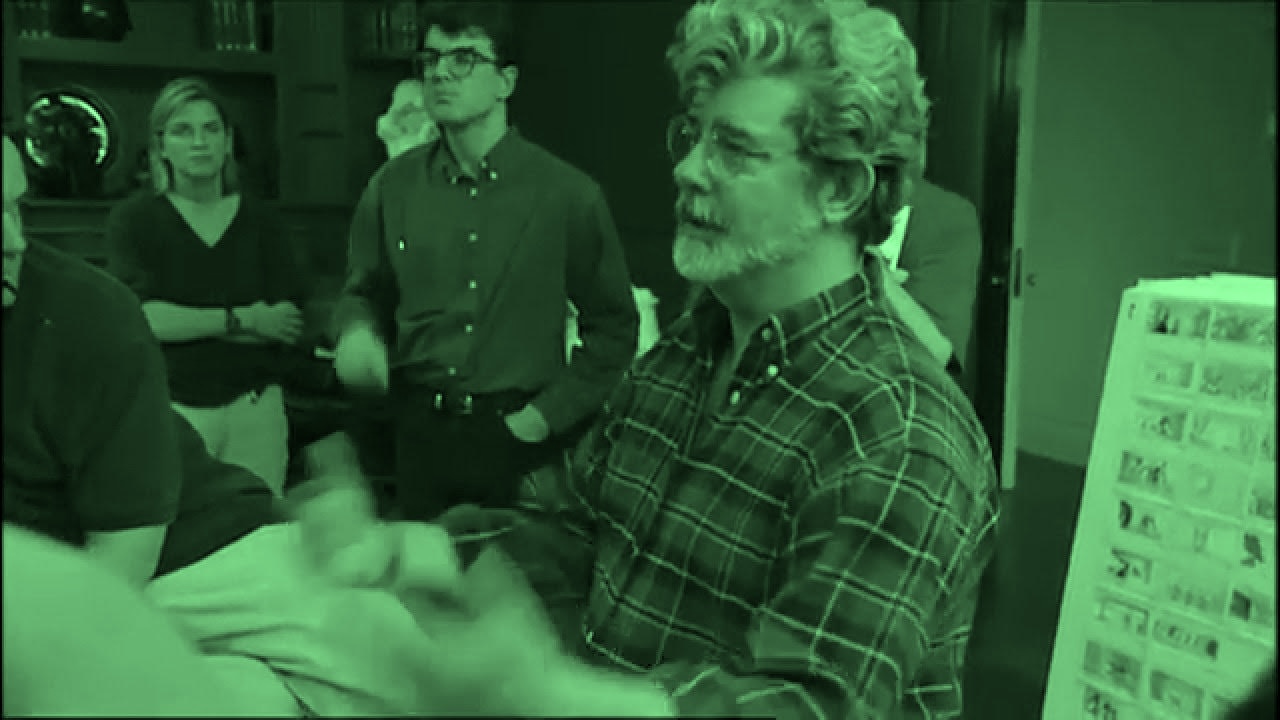
Also, if you listen to Confer Culture every once in a while, you might get a kick out of this George Lucas image I just posted because it fits with the latest and greatest podcast episode – Grumpy Old Men. Chris and I have a running joke about Star Wars and poetry, but you’ll have to listen to learn more.
 timotheories
