A Tale On Repeat (Beauty and the Beast review)

Rehashing a story that rehashes another story doesn’t create more hash? Sheesh, y’all. What a wonderful thing is this reimagining that it can invigorate previous fans, and draw in troves of new ones too.


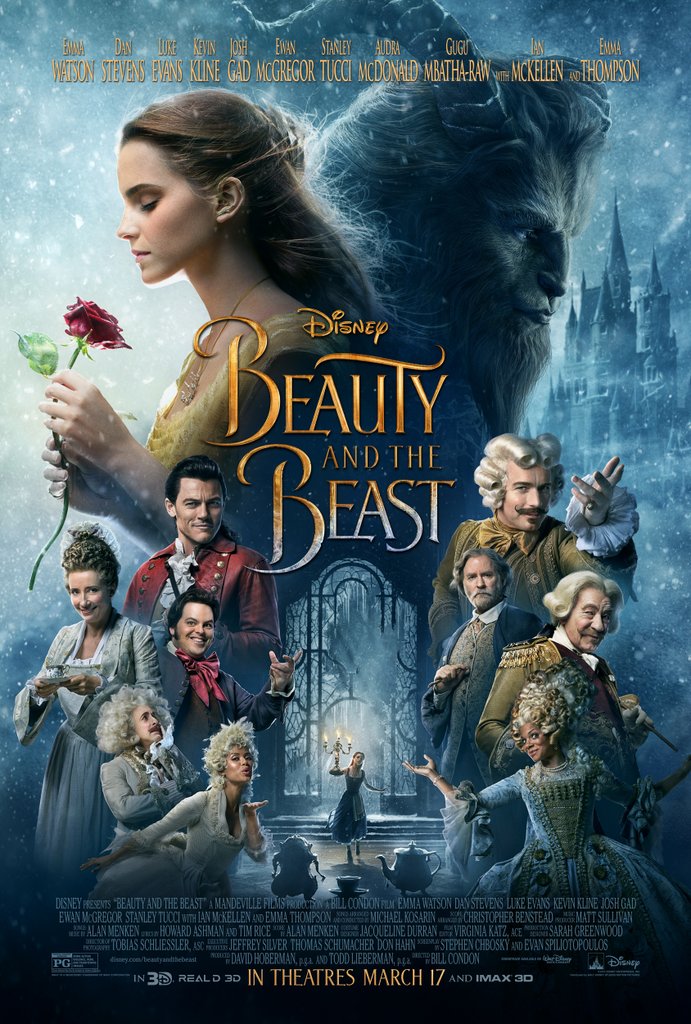
Beauty and the Beast (2017)

Cast: Emma Watson, Dan Stevens, Luke Evans, Josh Gad, Kevin Kline, Ewan McGregor, Ian McKellan, Emma Thompson
Director: Bill Condon
re-released on blu-ray June 6, 2017
******** 8/10
IMDB: 7.5
Rotten Tomatoes: 71%, Audience Score 83%
The Guardian: ***/*****

Bill Condon is an American screenwriter and director, best known for his dual roles in Gods and Monsters as well as with Dreamgirls. He also had success directing Kinsey, Mr. Holmes, and very recently the 2017 version of Disney’s Beauty and the Beast.

And that is the topic I shall choose to write about. Mostly because I bought a copy and watched it last week.

Taken from Wikipedia and edited –

In pre Revolution era-France, an enchantress disguised as a beggar (Hattie Morahan) arrives at a ball and offers the prince (Dan Stevens), a rose for shelter. When he refuses, she transforms him into a monstrous beast and his servants into household objects, and erases the castle from the memories of their loved ones. She casts a spell on the rose and warns the prince that, unless he learns to love another and earn their love in return before the last petal falls, he and his servants will lose their humanity forever.

Years later, in the village of Villeneuve, Belle (Emma Watson) dreams of adventure and brushes off advances from Gaston (Luke Evans), an arrogant former soldier. Lost in the forest, Belle’s father Maurice (Kevin Kline) seeks refuge in the Beast’s castle, but the Beast imprisons him for stealing a rose. Belle ventures out in search for him and finds him locked in the castle dungeon. The Beast agrees to let her take Maurice’s place, despite her father’s objections.

Belle befriends the castle’s servants, who treat her to a spectacular dinner. When she wanders into the forbidden west wing and finds the rose, the Beast, enraged, scares her into the woods. She is cornered by a pack of wolves, but the Beast rescues her and is injured in the process. A friendship develops as Belle nurses his wounds. The Beast shows Belle a gift from the enchantress, a book that transports readers wherever they want. Belle uses it to visit her childhood home in Paris, where she discovers a plague doctor mask. Belle realizes that she and her father were forced to leave her mother’s deathbed as her mother succumbed to the plague.

In Villeneuve, Gaston sees rescuing Belle as an opportunity to win her hand in marriage and agrees to help Maurice. When Maurice learns of his ulterior motive and rejects him, Gaston abandons him to the wolves. Maurice is rescued by a hermit, Agathe, but when he tells the townsfolk of Gaston’s crime, Gaston convinces them to send him to an insane asylum.

After sharing a romantic dance with the Beast, Belle discovers her father’s predicament using a magic mirror. The Beast releases her to save Maurice, giving her the mirror to remember him with. At Villeneuve, Belle proves Maurice’s sanity by revealing the Beast in the mirror to the townsfolk. Realizing that Belle loves the Beast, Gaston has her thrown into the asylum carriage with her father and rallies the villagers to follow him to the castle to kill the Beast. Maurice and Belle escape and Belle rushes back to the castle.

During the battle, Gaston abandons his companion LeFou (Josh Gad), who sides with the servants to fend off the villagers. Gaston attacks the Beast in his tower, who is too depressed to fight back, but regains his will upon seeing Belle return. He spares Gaston’s life before reuniting with Belle. However, Gaston fatally shoots the Beast from a bridge, but it collapses when the castle crumbles and he falls to his death. The Beast dies as the last petal falls and the servants become inanimate. When Belle tearfully professes her love to him, Agathe reveals herself as the enchantress and undoes the curse, repairing the crumbling castle and restoring the Beast’s and servants’ human forms and the villagers’ memories. The Prince and Belle host a ball for the kingdom, where they dance happily.

This version of the film does well to increase the mythos of this fairy tale, all while adding in additional songs, but never losing the main story nor the music which made it so memorable in the first place, but it does fairy fail in other ways. Learning more of the princes backstory, why the servants became objects, and the reason Belle has no mother are interesting, but add a lot of time to the story.

In some ways it makes it a far more beautiful telling of the story, though it doesn’t significantly improve the stock of it’s Disney characters. Except for Gaston and Lefou… Their performances are noteworthy and feel very fresh throughout.

Pros: Luke Evans and Josh Gad provide a far more nuanced and complex relationship for their characters, and Lefou is a scene stealer to be clear. Emma Watson does well in revitalizing and addressing the persona of Belle. Heck, even the new song the Beast sings is pretty swell.

Cons: Kevin Kline just doesn’t quite cut the mustard as Maurice nor does Emma Thompson as  Mrs. Potts. Their performances seem a little phoned in and do a lot to slow the story down in addition to 45 minutes worth of new songs and the aforementioned backstory updates.

Runtime: 2 hours 9 minutes

Points of Interest: During the Be Our Guest sequence, a model of Aladdin’s Agrabah castle appears. Belle takes on the role of inventor in this film over Maurice because Emma Watson wanted Belle to have more of a back story, and a better reason for being treated differently by the villagers. And in case you didn’t already know, Le Fou is Disney’s first official gay character.

A story rehashed from a story already rehashed, 2017’s Beauty and the Beast works to window dress a film which is already well love by many, but guilty of the falling into the same philosophical challenges of its predecessor – love is the answer. The realist in me knows that love is hard work and to expect that love alone will cure sickness (read: mental health) and prejudice (read: sexism, violence and hate) is a silly aspiration, but the underpinning message of Beauty and the Beast can’t seem to shake it.

theories Summarized

I’m happy that movies are being made like Goat, Moonlight and Nocturnal Animals. They address issues of toxic masculinity and other not-so-fun global problems, so I’ll say good on Emma Watson for injecting a stronger voice and presence in to Belle, and good on Bill Condon for keeping this movie a musical, and good on Disney for updating this story, but please can we stop making the same tales as old as time?

Tim!
Holy Cross, Adam West (The Ongoing History of New Music)

I live by a set of immalleable valuables

– Adam West, Batman: Return of the Caped Crusaders

When you decide once and for all that you’re gonna be what you want to, and not let anybody stop you, the next step is pretty simple: have a little understanding, dig in and fully commit to it.

maxresdefault-1

Take for instance, the 1960s Batman live action television series, which is incredibly campy, has some pretty silly moralistic themes, and an ever present sense of humour. Over the course of three seasons and one film, Adam West and Burt Ward managed to seep their way into the lives of countless North Americans. They owned their terminology with the constant string of “holy …, Batman,” referring to every piece of tech as “bat (insert equipment name),” placing graphics over sound effects during fist fights, and the never-ending flirtations between Batman and Catwoman. There were other constistent tropes of the series, but Batman never broke ranks.

Except for last year, when DC finally decided to revisit those characters and create an animated film voiced by Adam West and Burt Ward. In the film, we see many of the characters playing off of the tropes which made the show ever-so popular and memorable.

Playing off what we loved about that TV show was a smart move on the part of DC, and as I finish off this introduction, I’ll tell you why. We know the stories are tongue-in-cheek, but that doesn’t stop them from being entertaining and expected. As audiences have evolved and humour has changed over the decades, it was necessary for DC to acknowledge that in their story, breaking some walls along the way but never knocking the foundation.

Syndicated For Your Listening Pleasure

And Adam West has owned his persona ever since – by always willing to demonstrate this campy quality which has made him much beloved.

Which brings me to another hero for the ages.

Someone who had humble beginnings as a radio disc jockey, but a personality much greater than the sum of his core job responsibilities. One of my personal heroes and someone who I can only hope to emulate in my much broader tastes of all art forms, fellow Canadian and downright cool guy, Alan Cross.

Alan Cross is the originator of The Ongoing History of New Music (TOHONM), Canada’s longest running radio show documentary.

The purpose of the show is to explore the alternative rock world, which is a vast thing, believe me. Cross profiles artists, explores genre changes, looks at themes of culture and politics, and always always provides a well researched show.

Over the course of it’s hundreds of shows some of my favourites have been about the definition of indie rock, the evolution of punk, and the history of Red Hot Chili Peppers, a band I never cared much for, at least until Alan Cross taught me different.

It all started with Cross hosting an afternoon show on CFNY-FM, better known as 102.1 the Edge, then a morning show, and eventually moving back to an afternoon show in 1993. This is when he took on the additional project of TOHONM. As his career evolved, Cross took on different roles and moved around, but he never quit the show, not until he officially left Corus Entertainment in 2011, TOHONM was cancelled as Corus owned the show.

A Different Tune

After that happened, Cross started another program called The Secret History of Rock, which was produced by Astral Media. It lasted for about 100 episodes and was pretty cool. Then in 2014 Cross decided to go back to Corus and TOHONM was revived once more. Unfortunately neither TOHONM nor The Secret History of Rock are widely available for download, the first because of music licensing issues and the second because Cross is looking for global syndication.

But that shouldn’t matter, because you can listen to recent episodes of TOHONM on the Edge’s website and Cross has a series of audio books on The History of Alternative Rock, which are pretty cool.

This guy seriously knows a ton about music. I’m recommending him to you because if you know nothing about music, he’s a fountain of knowledge, and if you know tons about music, I can assure you that you know nothing compared to Alan Cross.

04f

Just saying.

theories Summarized

Will listening to Alan Cross change your musical life? Maybe.

But I will commit this to you, if you listen to him, and I mean really listen to what he says, you’ll realize that he is a lot like Batman. A geek at heart, with an immalleable set of values when it comes to work ethic, and keen sense for information. Plus he’s pretty funny too. I think he could teach you a thing or two about the arts, for sure – and I’ll commit that theory to vinyl.

Tim!

I Wanna Be Like You (The Jungle Book review)

In computing language, source code is meant to be instructions for computers, often in an executable format. But sometimes a programmer will include the source code so that other users and programmers might benefit from the information – to study it and hopefully modify the results.

Where technology intersects with human biology, that’s when it gets interesting. And conveniently, that’s what today’s film review is all about.


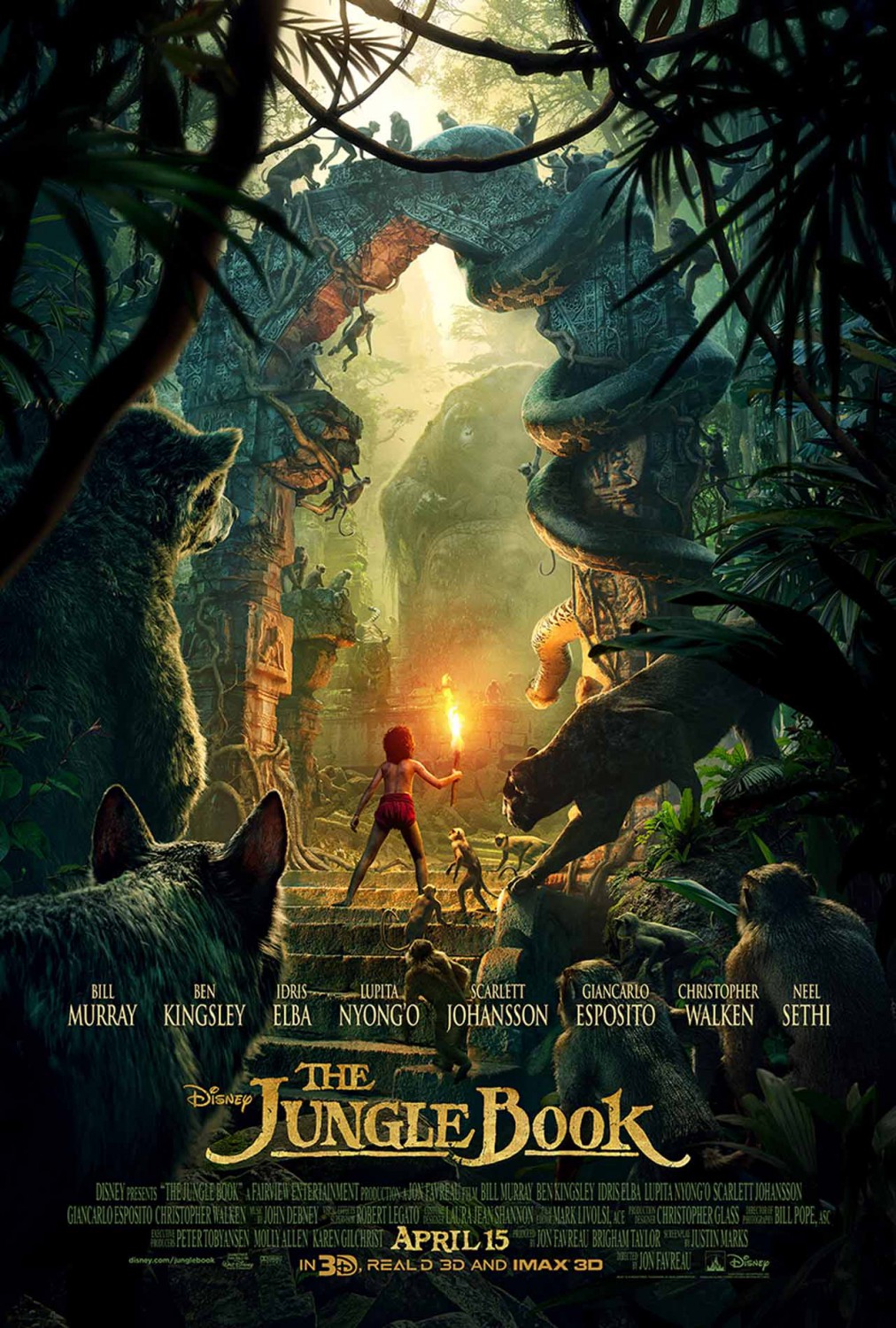
The Jungle Book (2016)

Cast: Neel Sethi, Ben Kingsley, Lupita Nyong’o, Idris Elba, Bill Murray, Scarlett Johansson, Christopher Walken, Giancarlo Esposito
Director: Jon Favreau
released on blu-ray August 30, 2016
********* 9/10

jungle_book_ver6_xlg

IMDB: 7.7
Rotten Tomatoes: 95%, Audience Score 88%
The Guardian: ****/*****

Jonathan (Jon) Kolia Favreau is an American actor, director and comedian. He’s acted in many of the films he has directed, with the exceptions of Zathura and Cowboys & Aliens. Favreau has also directed Chef, Elf, Iron Man 1 & 2, and most recently The Jungle Book remake – If you haven’t seen him acting in any of those movies you might also recognize him as Monica Geller’s boyfriend Pete from TV’s Friends. Favreau also produces movies under the banner Fairview Entertainment.

He’s been in the film industry since the early 1990s, but it wasn’t until his first financial success directing Elf that Favreau really became a big name. Which is why it’s not that surprising that he was able to land the directing role for Disney’s live-action/CGI reboot of The Jungle Book. Especially after having a hand in launching the MCU.

Filmed mostly with digital animation, and featuring a real-life Neel Sethi roaming around the jungle as Mowgli, this movie takes some cues from the book, but quite a number from the original animated adaptation from the 1960s.

I’m not going to spend a bunch of time hashing out the story as you’ve likely already seen the original movie. I mean who hasn’t? One of the major differences is that the animations are stronger and more tied into real depictions of animals – with the exception of King Louie who is much larger than life and definitely took me out of the story, even if Christopher Walken did an excellent job voicing him. On the positive side of things, the danger is made more real and the movements of Mowgli inside this world are so fluid, that you sometimes forget it’s all made up.

Pros: It manages to retain it’s humanity, while having almost no elements that exist in the real world. Exploring nature and the laws of the jungle haven’t seemed this fun in a long time.

Cons: There are some moments where the story feels mechanical, and I suspect that has something to do with the absence of ties to real environments, and when you see a 30ft ape, it’s a little disappointing.

Runtime1 hour 46 minutes

Points of Interest: Kaa the snake is portrayed as a female, rather than a male, which is a first and intentional as Jon Favreau felt there were too many male characters in The Jungle Book. Reference shots of remote jungle locations in India were used to help construct the settings for the movie.

I went into this movie somewhat sceptical that it could recapture the entertainment value of the original film, and when I heard “The Bare Necessities”, “Trust In Me” and “I Wanna Be Like You” I was quickly comforted, though it could have easily been the opposite. These riffs off of the original Disney movie were important to take, because the nostalgia factor remained high throughout, evening knowing how the story was going to end. This is an example of a movie where the remake is both excellent and respectful, allowing us to revisit the original or perhaps even expose new viewers to the source.


This technology driven re-imagining of The Jungle Book is amazingly faithful and yet it is a distinct property which can be consumed and shared with all of it’s strengths intact. As a case study of where animation is come from and where it’s headed. Much like how life cycles through and changes with each new generation, never changing so much that it is unrecognisable, but that it is distinct and authentic. You should definitely watch this movie, it gives I Wanna Be Like You a new meaning.

Tim!