Court of Cowls (Scott Snyder)

I like comic books – Always have. Always will.

The surface reason is pretty straight forward. I really appreciate a good narrative, and because I’m fascinated by visuals, comic books can’t be beat when it comes to pulling off a spectacle of visuals and for providing that sense of satisfaction. Correction, I probably shouldn’t call it satisfying, instead I should call it gratification, because the nature of the comic book is a continuing story. Gratification is something we are thankful for, while satisfaction is a feeling of enough.

You see, dear readers, the comic book by its very nature never finishes, so you cannot experience the fullness of pleasure, you’re left wanting.

This is great for sales, when a book has a strong story and great visuals. Less so when the book isn’t picked up. After all, the comic book industry is perpetually dying.

The Batman Writer We Deserve

If you haven’t seen Christopher Nolan’s The Dark Knight yet, I’m sorry to hear that. It came out almosta decade ago and it’s probably one of the best comic book based movies of all time, if not the best… possibly sharing the limelight with Iron Man no.1 and the first The Avengers movie for my top picks.

6300929807_fb32d68411_b

Anyways, there is this great scene at the end of the movie wherein the newly appointed Commissioner Gordon gives a speech at Harvey Dent’s funeral. He describes Batman as a dark knight, a watchful protector, what the city of Gotham deserves, but not what it needs. The city needs a white knight in shining armour, flawless and serving as a beacon of hope. The city doesn’t deserve a flawless hero, but Batman is willing to become the villain in order to help his community rise up out of the darkness. In fact, Batman is flawless in that he is a true hero, he loses his parents and the love of his life, but he continues forward as a warrior for justice. But Harvey Dent is very flawed, and when the chips are down, he reveals that he is capable and willing to go to The Joker’s level, becoming Two-Face.

Now, let’s talk about Scott Snyder.

Scott Snyder is known for his comic book writing skills, having worked with DC and Vertigo on various books – American Vampire, Detective Comics (part of The New 52 relaunch), Batman, and Swamp Thing.

A lot of people have said that Snyder’s work on Batman has been exemplary, and I would tend to agree. I recently read the hard cover volume of The Court of Owls, and was pleasantly surprised at how well he was able to combine new storytelling with flourishes of what came before.

batsignal_at_highmark_building

Scott Snyder is the Batman writer we deserve, because he spent five years working with artist Greg Capullo to give a new perspective to Batman, respectful of what preceded, but willing to explore. This is something that all comic fans really want to see, and it’s a difficult line to walk.


I think he was able to accomplish this by building upon key moments and seeing the story through to whatever direction it took. Kind of amazing when you stop to think about it. Even his twists and turns on The Joker is one to remember.

Disney and Stephen King VERSUS Detective Comics

Scott Snyder attributes a lot of his writing to an early exposure to horror writer giant Stephen King and later when he was able to work for Walt Disney World after he graduated from university.  He describes it as such 

All the things I ended up writing about, those things that are deeply frightening to me—fear of commitment and growing up, fear of losing loved ones, the wonder and terror of falling in love—all of it was constantly being played out all around me in this weird, cartoonish, magnified way at Disney.

Which tells me that he deserved to write for Batman, and we deserved to have him. Not to sound like a broken record, but yeah – a labour of LOVE is what it comes down to friends. And this is why Scott Snyder is this month’s featured author for my 5 L’s of Language post. His massive love for the subject material he writes about comes through no matter what. And this is something you too should take to heart.

No matter what the occasion or the reason, always be headed towards you purpose and be authentic in your feedback, if you can do this, you’ll be like Batman. But that’s just a theory.

Tim!
This Click-bait Will Change Your Blog For The Better (Buzzfeed)

Click-bait. We all hate it, and we hate it because of what it makes us feel inside. We click that link hoping that the headline will deliver on what it says or that picture will open up a gallery of wonders. But it never does… It just fulfills instant gratification, without any kind of growth. In case you have absolutely no idea what I am referring to dear readers, I’ve set up some examples, which will follow below.

He thought he was safe. What happened next changed his world.

Number 9 is the most shocking one!

Marketing companies hate her.

What they learned was terrifying.

We already knew it, but she perfected the delivery.

This idea will make you a better reader.

Click-bait is without a doubt, the perfect example of a pejorative word. With sneering and everything.

We’ve all been there, surfing the internet from the safety of our homes while rocking our PJs with a litre of red wine, while scrolling through our preferred media of consumption (insert Facebook, Reddit, Twitter, Google Reader or YouTube for starters) when we see it. A headline that just screams INSTANT GRATIFICATION. All you problems solved in one click. Knowledge, sex, fun, tears, power, miracles, etc.

9f882617-54f1-4860-add0-8067b8107967

But fuck that.

Click-bait doesn’t really solve any problems. In fact, it’s been designed by marketers to help generate revenue; quality and accuracy be damned. The goal is close the sale and get your curiosity past the point of intrigue but not sated enough that you can ignore the headline. And so you click. Because the thumbnail picture is conjuring feelings or the headline has a supposed spoiler in it. As I already mentioned, go anywhere on the internet and you are sure to find examples of click-bait in use.

It’s what made the website BuzzFeed so popular in the first place way back in 2006. It was originally founded as a hub for viral content, and it did a good job of bringing in users so that they would see content on its way up the social ladder, at the peak of its popularity, or content that was now overexposed and burning out fast.

With this traction the company was able to grow over the past decade and slowly become a source for internet media of all kinds, with a focus on digital media and tech. They’ve made great efforts to curate old content, deleting over four thousand articles at one point as they changed the face of their brand.

Now a website that once used click-bait of every kind to draw in traffic, instead produces their own daily content which consists of both articles and video, and has a staff of reporters, artists, and part-time contributors. Did I mention they also let their community contribute to the conversation?

Which means that they are more interested in traditional methods of publication now that they have traffic and want to have a good reputation too. Though they still click-bait. Man oh man do they still click-bait.

oh-god-why-meme-4812

So why did you decide to write about Buzzfeed then timotheories?

Because I have this theory.

How convenient for me. And for you! You see dear readers, I think that click-bait is our generations version of hot topic marketing. It’s not that much of a stretch when you think about it, but have you thought about it?

That’s the real question.

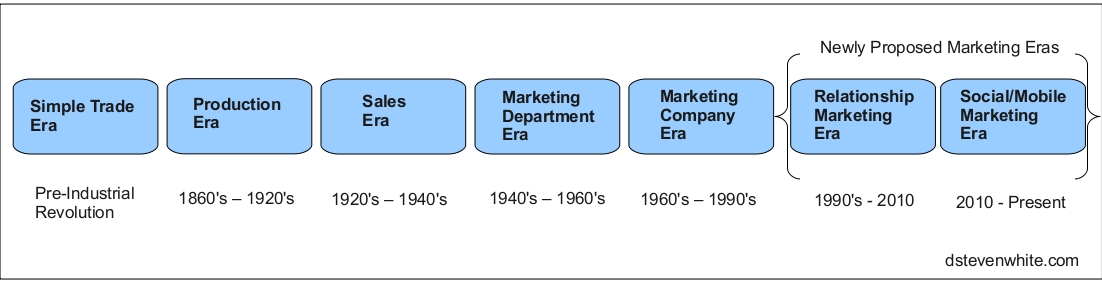
You see, over the past couple of centuries in the western world, marketing as evolved just as much. We’ve gone from eras of trade, to production, to sales, to having marketing departments, to having marketing companies, to “relationship” marketing, and now we are in the middle of social/mobile marketing. This article goes into detail on it, but for our purposes I’ve included a handy little chart that D. Steven White put together.

marketing-eras

As you can see, none of those marketing previous forms have died by any means, however, as they lost focus and became normative behaviours, creativity moved in new directions (as it always does) and communication had to go right along with it. Is click-bait the end-all-be-all answer in an era of social/mobile marketing? God no. But it is something to consider in the scheme of things, and it does have value.

So your task as an art maker, art shaker, and art breaker is to figure out all of the tools available, become an expert at marketing and move forward. But that’s something we can go into more detail on in a future post.

But what do you think? Am I missing notches on the marketing tool belt? Is click-bait not worth the time it took me to craft this sentence? Please leave some comments, subscribe to the blog, and share with your friends (artists, art enthusiasts, and humans apply)… I’m out of theories for today friends, I’ll catch you tomorrow with something timely.

Tim!