The Great Digitization (Lucien X. Polastron)

Labels are a double-edged sword, if you ask me. They can provide you with valuable information about products, people, and places. But sometimes they are too simple and limiting with their direction.

Specifically when it comes to imposed labels we make for other people and ideas. What many call common sense, I call limiting perception. When we think on these labels of society, we might gain better perspective into our own assumptions and the world around us. Which is why I chose to read a book in the LABEL category this month. I wanted to think on something we are definitely taking for granted.

As always I’m going to offer up some information to remind of this ongoing process of mine, also known as the The 5 L’s of Language –

I will read one book a month from the 5 groupings below, slowly expanding the number of books read so that I reach the point of 5 books a month. A book for each group

  1. LIFE – Biographies/Art/Music
  2. LOVE – Classic Fiction/Non-Fiction/Graphic Novels
  3. LEARN – Business/Leadership/Self-Help
  4. LABEL – Philosophy/Sociology/Psychology
  5. LEET– The Internet

My goal with this of course is to share information with you that might help you avoid mistakes, stimulate your mind, and encourage you to think outside of your typical modus operandi.

Lucien X. Polastron, The Man Who Read Too Much?

Lucien X. Polastron is a French writer and historian who has focused his attentions on paper, books, the process of writing, and the history of libraries. When the National Library of Sarajevo was destroyed in 1992, it triggered his research into the history of libraries and the many examples of libraries which have been destroyed. This is something he had previously observed while working on research of history of paper.

His two most famous books are Books on Fire: The Destruction of Libraries throughout History, a historical survey of the destruction of books from Babylonia through to modern society, and The Great Digitization and the Quest to Know Everything, which examines the consequences (both good and bad) of the digitization of books.

Polastron posits that while the digitization of books is an excellent way to move forward the exchange and breakdown of knowledge, it can very easily creates parallels between book burning by restricting access to books and destroying their autonomy. Effectively removing the idea of free books altogether. For instance, if internet service providers charge for their services and publishers hold the rights to books, who polices the quality and authenticity of the information being shared.

After all, if libraries become obsolete, that means that local governments will have to fund services which they cannot control or leave very easily. It is up to us to not only move forward with technology but to also be conscious of and protective of the accuracy of these words.

It’s books that feature intelligent content and do not dumb down their theories for the reader which allow for proper mental exercise. And while this book is now a decade old, and we still have access to free information, the thoughts which echo throughout are still cautionary and relevant for a globalized marketplace.

Let’s close out this post without resorting to simple labels. Of course digitization has great many benefits. It opens up the world and creates a level playing field of information for many who don’t have access to money. Our education levels are increasing all over the world as this technology flattens and creates transparencies. With that said, I’m going to leave you with this thought.

If knowledge is power, then who is holding all of the cards?

I’m out of theories for today friends, but check back tomorrow when write something timely about Halloween. Should be spooky.

Tim!

Heartbreaker, I’m Addicated To You (Ex_Machina review)

She’s not your typical girlfriend. Recognize those lyrics dear readers?

It’s from a Simple Plan song called My Alien. It’s probably one of my favourite tracks on that album. Incidentally, I was listening to their breakout album No Pads, No Helmets… Just Balls, right before I started today’s film review.

And conveniently enough this song ties in very nicely with it as a transitional point. I’m gonna share a few more lyrics from the song with you dear readers before I jump in.

She knows when something is wrong, when something doesn’t belong
She can read in my mind
And she can be assured that with me, there is no conspiracy
Shes not wasting her time

She’s not wasting her time. That’s for damn sure.


Ex_Machina (2014)

Cast: Alicia Vikander, Domhnall Gleeson, Oscar Isaac
Director: Alex Garland
released on blu-ray July 14, 2015
********* 9/10

4O2OUnbVYOm11E2GIfqrJ6GEvo2

IMDB: 7.7
Rotten Tomatoes: 93%, Audience Score 86%
The Guardian: ****/*****

Alexander Medawar Garland, also known as Alex, is first and foremost a novelist, then a screenwriter, followed by producer and now director. Garland has been involved with the scripts for 28 Days Later, Sunshine, Never Let Me Go, and Dredd. Which if you know anything about science fiction, should get you super excited. But his breakout fame came with his first novel, The Beach. This of course was later made into the film The Beach.

Ex_Machina is Garlands directorial debut. And given his record of previous projects, I just had to check out this film. Now I realize it’s a little bit late, but my policy at timotheories is always digital curating at heart, and so we curate that which is necessary. Especially since there was nothing new released last week that seemed worth the attention. And so here we are.

Already released on blu-ray and digital HD a year ago, Ex_Machina is a story about a surprisingly difficult to assess turing test. This is because the detail to which the newly minted android Ava (Alicia Vikander) is capable of convincing programmer Caleb (Domhnall Gleeson) to play into her game of cat and mouse with her creator, and his employer, Nathan (Oscar Isaac). And this ultimately surprises both men.

Throughout the test, Ava is confined to her apartment, within the compound of Nathan’s hidden mountainside home. Caleb is locked in as well, to protect company secrets, but Ava slowly wins Caleb over during his questioning with her flirtations and expressed attraction towards him. Her ability to cause power surges cuts the security cameras at key moments and allows her and Caleb to have frank exchanges. This leads Caleb to believe that Nathan is abusive and cruel towards Ava.

Caleb eventually learns that Ava will be upgraded to a new model after the test is over, which will destroy her consciousness and memories. Caleb and Ava plot to overthrow Nathan and escape the facility together.

It is only in the final moments of Caleb’s stay before the helicopter will arrive to take him back home, when Nathan reveals that he already knew all of the androids were intelligent and had consciousness, but that he wanted to know how easily a human could be manipulated by one and how far the android was willing to take it to escape. Caleb then tells Nathan he has already engineered the escape, and Nathan knocks him out.

Ava is now out and works with the only other android to kill Nathan. Ava goes into Nathan’s room to repair herself using old android body parts and skin, becoming indistinguishable from a woman. She then leaves Caleb locked in the facility, now conscious himself and watching the scene unfold, taking the helicopter meant for him.

Pros: With such a small cast, we are really given the time to digest the unfolding story and enjoy the clean and concise results. Amazingly it is a film of ideas, dressed beautifully with carefully and sparing CGI.

ConsThe voyeuristic elements which are useful in demonstrating the flaws of both Nathan and Caleb kick into full gear right at the gut punch, and make it a little less thrilling.

Runtime1 hour 48 minutes

Points of InterestOscar Isaac based his character on intellectuals with dark sides, namely Bobby Fischer and Stanley Kubrick. Throughout the film the colours red, blue and green are used very obviously in each area of the house, a nod to RGB colours which are used for computers.

Ex_Machina just might be the scariest science fiction movie I’ve seen in some time. Throughout the film I was never clear on the true intentions of each character, and that in itself was an excellent turing test. At the end of it all, I have to wonder if Ava had planned to use Caleb all along or if he eventually offended her in some way or another. And that my friends, is why this is an excellent film.

And if you want further evidence, please check out the video review below!

theories Summarized

Swedish actor Alicia Vikander has an incredible range, and just the right mix of emotions portrayed to demonstrate the naïveté of an AI not yet realized. That surface tension is what draws us in, and makes us question the morality of the human characters, and maybe even sympathize with Ava. She’s not your typical girlfriend indeed.

Tim!

The Cult of Apple (Steve Jobs review)

Great men and women are always to fascinating to the world. It’s almost as if people expect that by analyzing them, they’ll get insight into how to achieve their level of success and become them, without doing any real work.

Almost cult-like behaviour.

How fitting, given this week’s movie review topic.


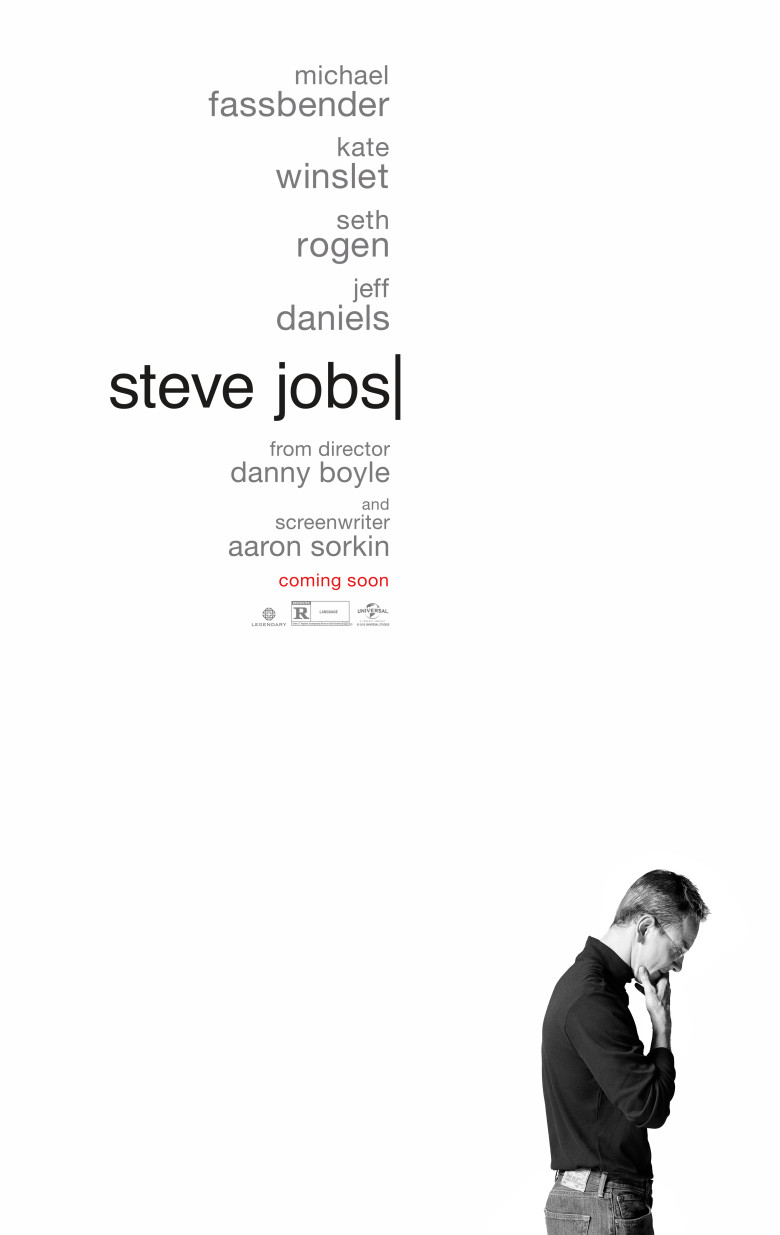
Steve Jobs (2015)
Cast: Michael Fassbender, Kate Winslet, Seth Rogen
Director: Danny Boyle
released on blu-ray February 16, 2016
******** 8/10

SJB_Tsr1Sht5_RGB_0818_1-780x1235

IMDB: 7.3
Rotten Tomatoes: 85%, Audience Score 76%
The Guardian: ****/*****

Danny Boyle is an English stage and film director, producer, and screenwriter, with a spiritual atheist belief system. Raised in an Irish-Catholic home and in line for the priesthood until he was 14, Boyle was persuaded by a priest to consider a different path.

He decided to enter into drama and I think we are the better for it.

Boyle has directed Trainspotting, The Beach, 28 Days Later, Slumdog Millionaire, 127 Hours, among others. His belief in the connection between theatre and spiritual expression has likely influenced his project choices, but let’s dig into the plot a bit to see what I mean.

The movie starts in 1984 California with a young Steve Jobs (Michael Fassbender) and his marketing executive Joanna Hoffman (Kate Winslet), discussing the failure the Macintosh computer demo is currently facing. Andy Hertzfeld (Michael Stuhlbarg) is also there and tells them it cannot say hello because they need special tools to open up the computer.

Joanna wants Steve to stay calm and lower his voice because a GQ journalist is present and could get them bad press. Steve not only wants the computer to say hello, he wants total darkness in the theatre to focus the audience attention, which is not allowed due to safety reasons with the exit signs. Joanna suggests delaying, but Steve says that a tech company MUST start on time.

Joanna and Steve go backstage. She tries again to convince him to leave out the voice command, but Steve needs it to show the world that computers are not scary, even though Hollywood says that they are. Joanna is also upset about the price tag and limited memory but Steve explains that the computer is intuitive and innovative. While discussing this, Steve finds boxes of TIME magazine, and is upset because he should have been Man of the Year, but the journalist didn’t like him. Joanna is more concerned about the fact the article mentioned Steve has an illegitimate daughter which reminds her that his ex Chrisann (Katherine Waterston) and daughter Lisa (Makenzie Moss) are there – He should go talk to them and calm Chrisann down.

Backstage, Chrisann and Steve start to fight and Joanna leads Lisa out of the room. Chrisann is upset that Steve implied she is a slut and slept with 28% of the population but Steve corrects her and say he is only 94% likely the father which means 28% of the population could be as likely. Lisa knows that Steve named one of the computers after her, but Steve tells her its coincidence. Chrisann knows Apple stock is up 441 million and yet she and Lisa are on welfare.

Enter cofounder Steve Woz Wozniak (Seth Rogen), who is wants recognition for the Apple II team in the speech, which Steve also brushes off later.

Steve wants someone to find a white shirt with a pocket so he can pull out a floppy disk. Joanna asks “why white?”, but Steve has an answer ready. He knows that the white will offset the beige of the computer casing. Andy comes back and tells Steve he still can’t fix the voice feature. Steve threatens Andy by telling him he will list of the the team of developers and each off their roles in the creation, and he will be the one team member with a feature that didn’t work.

What a good place to stop, just as the first act is about to end.

Pros: Much like the real life Steve Jobs, the film flows with genius and visually constructs the setting to showcase Fassbender in this role. Also like Fassbender the pace and the builder have you wondering if it’s going to work out, but it does.

Cons: We can tell that Steve Jobs was flawed, but we don’t get to see much more than that. It feels a little stiff and structured at times.

Runtime: 148 minutes

Points of Interest: Each of the acts were shot slightly differently. 1984 in 16mm. 1988 in 35mm, and finally digital to symbolize the development of Apple technology and focus of Jobs over the 16 year period. The shareholder meeting and product launch from 1984 was recreated at the original location of the Flint Center of De Anza Community College in Cupertino, California.

The movie features an excellent ensemble cast which is directed quite well by Boyle, but it might just be writer Aaron Sorkin who is organizing the details of the film. The film is structured in three acts, features a lot of standing and walking between actors, and elements of satire. This is what pulls you in and engages you with characterized Steve Jobs. It’s fun, thoughtful, and interesting, to say the least.

I wouldn’t ever accuse someone of belonging to the cult of Steve Jobs. I would accuse them of over-indulging in his personal philosophies and believing that the brand he built with Apple is capable of being peanut-buttered over anything. But that is often how it is with genius. We want to reach out and grab it, and hope that it will rub off on us.

Maybe a good lead-in for some wisdom tomorrow? I do have some theories after all.

Tim!