Traumatic Disorder (Hostiles review)

The life of a soldier is oft met with tragedy, both on the battlefront, and at home. But what happens when his battlefield is in his hometown? Prejudice, trauma, and an unhealthy mixture of isolation abound.


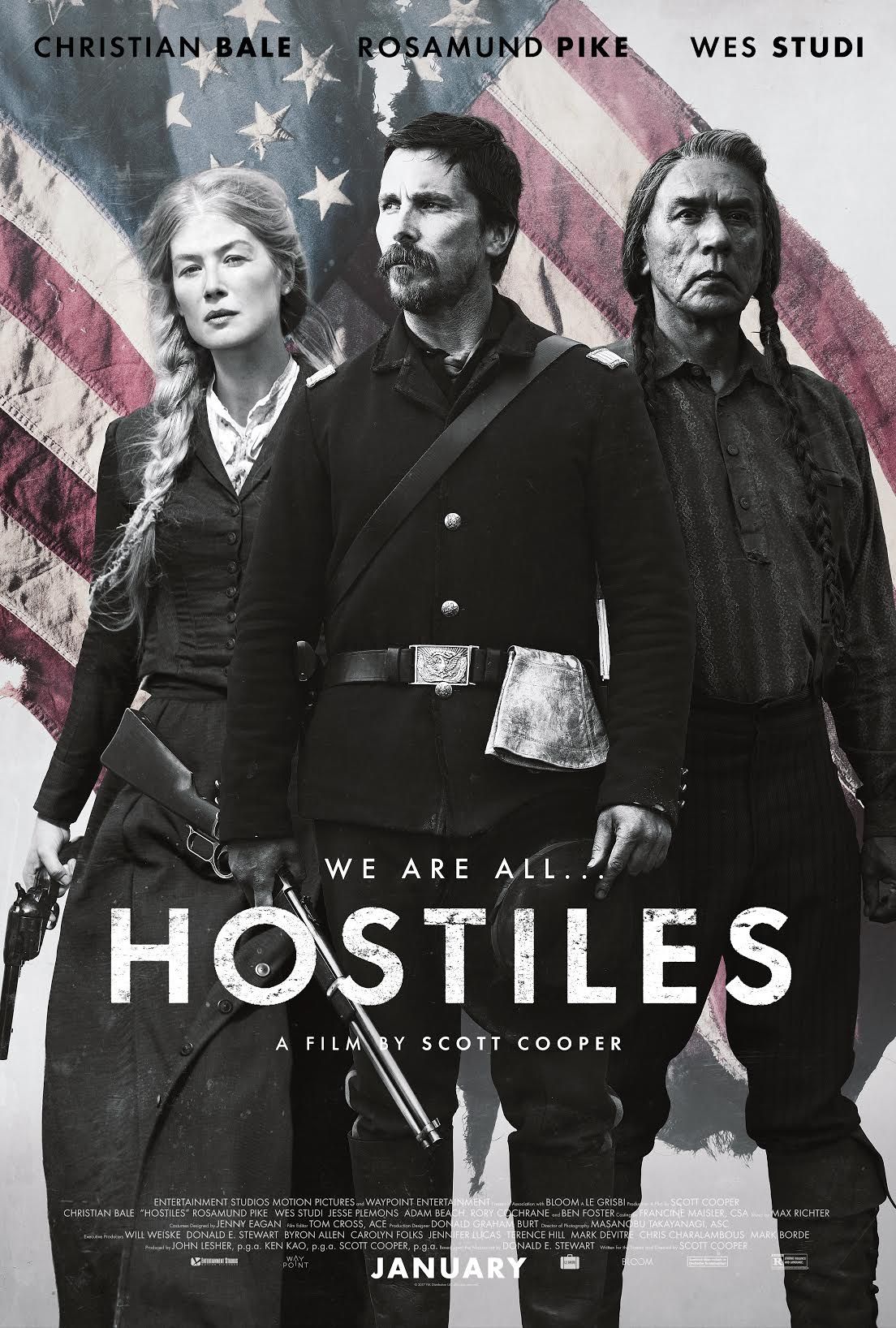
Hostiles (2017)

Cast: Rosamund Pike, Christian Bale, Wes Studi, Jonathan Majors, Stephen Lang, Jesse Plemons, Ben Foster
Director: Scott Cooper
released on blu-ray Apr 24, 2018
******* 7/10
IMDB: 7.2
Rotten Tomatoes: 73%, Audience Score 72%
The Guardian: ***

Scott Cooper is an American Director, screenwriter, producer, and sometimes actor. His list of director credits include Crazy Heart, Out of the Furnace, Black Mass, and now Hostiles. Having been active in the industry since 1998, Cooper spent the first decade of his career in the television industry, taking small acting roles before fully realizing that writing and directing was far more rewarding.

His directorial debut, Crazy Heart is nothing short of captivating, and shows a side of country music most of us miss. Plus, Jeff Bridges is amazing in it, so obviously Cooper recognizes casting quality over quantity. Hostiles also features a smaller cast and as it takes place in the late 19th century, has an authentic western flavour, but it’s not a misguided cowboys and indians kind of flick.

Special thanks to Nick Riganas for the IMDB summary of the film –

In 1892, after nearly two decades of fighting the Cheyenne, the Apache, and the Comanche natives, the United States Cavalry Captain and war hero, Joseph Blocker (Christian Bale), is ordered to escort the ailing Cheyenne chief, Yellow Hawk (Wes Studi)–his most despised enemy–to his ancestral home in Montana’s Valley of the Bears. Nauseated with a baleful anger, Joseph’s unwelcome final assignment in the feral American landscape is further complicated, when the widowed settler, Rosalie Quaid (Rosamund Pike), is taken in by the band of soldiers, as aggressive packs of marauding Comanches who are still on the warpath, are thirsty for blood. In a territory crawling with hostiles, can the seasoned Captain do his duty one last time?

What I loved about this movie is also what I ultimately hated about it. If I might be so contrarian. I’ve always been a fan of westerns as a young boy, and I attribute a lot of that love to the relationship I have with my father and grandfather, who were both small-town farmers. It wasn’t until my dad moved to the “big city” in his late twenties, met my mom, and had me that the lifestyle cycle started to shift. Either way, they both love westerns, and I have a kinship with anything associated with it.

Hostiles is not your classic John Wayne, Yul Brenner or Lee Van Cleef story – where the heroes and villains are depicted by how long their shadows cast. There is serious consideration of the effect of colonization on indigenous peoples and no ethnic group is cast in a particularly strong light of altruism and rightness, instead each character is morally ambiguous, having both good and bad qualities, just like life should be. But lines are drawn to show both groups and the impact each has on the other. And Cooper does an excellent job of depicting the effects of war and colonization.

Now, what I hinted at about loving, is that in it’s longer run, it tells a great western story, but for that same reason, it doesn’t give characters like Yellow Hawk room to breathe. Which is incredibly frustrating to watch, because Wes Studi is such a legendary actor. Sure Christian Bale and Rosamond Pike are great, and it’s awesome to see how their characters evolve, but if a third protagonist had been given due exposure, this movie would have been phenomenal.

Pros: It challenges our conventions of history and the stories constructed to retell that history. It’s by no means flattering to any party, but as a result it simultaneously feels more raw and empathetic. While not an innovation of the form, Rosamund Pike and Christian Bale deliver great performances.

Cons: The pacing is incredibly slow, and the inclusion of additional characters in the third act feels forced, drawing away from an examination of characters, and into a broader back story for Blocker, which is unnecessary at that point. But again I ask, where is the development of Chief Yellow Hawk and his family?

Runtime: 2 hours 14 minutes

Points of Interest: The film was shot in chronological order, and because it takes place mostly outdoors, the cast was exposed to the elements a lot. Production was shut down on a few occasions to account for weather. This is the second western Christian Bale has starred in – the first being 3:10 to Yuma remake.

It’s amazing to see how the life of Blocker has been shaped by living on a battlefield, and that because the American frontier is filled with tribes and peoples all trying to find their space, he never really gets to rest. Even more interesting that his final mission means escorting one of his early enemies home, and that they come to a better understanding of each other in the process, is very meaningful. I just wish I had seen more perspective from the Chief.

theories Summarized

A couple of final thoughts from me. Whether or not you enjoy westerns, this film is a great candidate to exposure of what western films have meant for American citizens for over a century now. They are effectively a propaganda told through the eyes of the victors. What hostiles does, is try to tell the story in a more nuanced way.

Yes, it does ultimately fall short of it’s goal, both due to pacing and character development, but the parts it succeeds at are well worth the struggle.

Speaking of struggles. I wanted to share this Watch Culture video I did on one of my all-time favourite animated classics – The Last Unicorn. Heavily influenced by classical literature, this is another movie which features Jeff Bridges in a voicing acting role, is directed by the team of Jules Bass and Arthur Rankin Jr. AND the band America did the soundtrack.

It’s highly underrated, in my humble opinion, but I hope this review gives you a chance to check it out or dust it off, as it were!

Lastly, please let me know what you thought of both of these reviews on love, like and share the video, and subscribe to the channel (and email) if you haven’t already. Lots more theories to come!

Tim!
Fields of Hopes and Dreams (Cross talk Ep. 24)

There are lots of great stories of triumph over adversity in the history of film. Movies that feature down on their luck athletes making it happen, business professionals that outsmart the man, and individuals with physical challenges that accomplish more in two hours then you and I could hope to in a year.

People watch these films with the hope that those amazing individuals will defy the odds and achieve the impossible in inspiring displays of courage, strength, intelligence, wit, and skill. Making the best of a situation and ultimately coming ahead despite the difficulty of the endeavour.

Right in the feels.

If you think of films like The Shawshank Redemption, Ray, Schindler’s List, Forrest Gump, and Cast Away, then you know your are on the right track to your own personal Field of Dreams.

Oh My Heart, It’s A Fish Out Of Water

This theme almost always focuses on an individuals in dire situations. A fish out of water if you will. And yet these people make it work for them, changing the circumstances and getting to the root of the problem, even if the solution seems unlikely.

But whenever we run an episode of Cross Talk, we want to talk through these topics in a meaningful way, focusing on interesting examples and testing out theories that can open up the conversation. Which is why episode number twenty four of Cross Talk is a genre defying theme that stands out – triumph over adversity.

We’re back at it, spending time on three case studies of film that exemplify this idea and which might not be your first pick. We talk about the accessibility of The King’s Speech, the imbalances of anti-heroes in The Big Short, and how Michael Keaton has finally turned it around in Birdman: Or The Unexpected Virtue of Ignorance.

This is gonna be an episode full of warm and fuzzies. Check it out below!

This episode should make you feel good in another way. We’ve officially added Mike Dadural to the cast! Yeah yeah!

Now for the repeater section of the test. What did you think of the episode? Any comments on how we can do things differently? Would you have chosen the three films that we did? We really do want you to join in on the conversation and let us know what you thought!

Please comment, subscribe, and share this video with friends. As always, be excellent to one another!

Tim!()

The New Anti-Heroes On The Block (The Big Short review)

The financial crisis of 2007-2008 was no laughing matter. A lot of people lost their jobs, homes, and hope because of the short-sided greed of those in much higher positions of wealth.

It threatened the potential collapse of the largest financial banks, which some feared would send us into a new dark ages, and was eventually prevented by monetary aid of national governments.

In brief, it was fucked up.

The aftermath was that we experienced a global recession for four years, and even now businesses are hesitant to share wealth and distribute resources as readily as they were before. This Theatrical Tuesday entry looks at the “heroes” who saw it coming, and how they dealt with it.


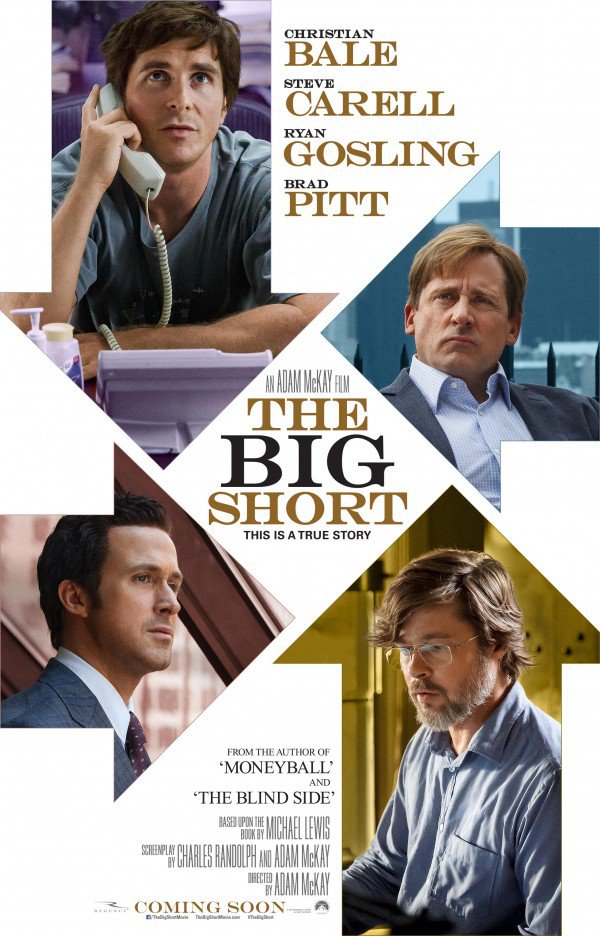
The Big Short (2015)

Cast: Christian Bale, Steve Carell, Ryan Gosling, Brad Pitt
Director: Adam McKay
released on blu-ray March 15, 2016
********* 9/10

The-Big-Short-600x936

IMDB: 7.8
Rotten Tomatoes: 88%, Audience Score 88%
The Guardian: ****/*****

Adam McKay is an American film director, producer, screenwriter, and actor. Known for his comedic chops, he has directed both Anchorman movies, Talladega Nights, Step Brothers, and The Other Guys, which are were all lead by his creative partner, Will Ferrell.

The Big Short is the first film McKay has directed which doesn’t star Will Ferrell, and while it is considered a more dramatic story, it has a lot of his typical satire elements, which fit nicely in the McKay fabric.

Taken from Wikipedia and edited,

In 2005, eccentric hedge fund manager Michael Burry (Christian Bale) discovers that the U.S. housing market is extremely unstable, being based on subprime loans that are high risk and providing fewer and fewer returns. Predicting that the market will collapse sometime in the second quarter of 2007, he realizes that he can profit from this situation by creating a credit default swapmarket, allowing him to bet against the housing market. He visits several major banks and investment dealers with this idea; these firms, believing that the housing market is secure, accept his proposal. This earns the ire of Burry’s clients who believe that he is wasting their money and demand that he stop his activities, but he refuses. As the predicted time of the collapse approaches, his investors lose their confidence and consider pulling their money out, but Burry places limitations on withdrawals, much to his investors’ anger. However, the market collapses just as he predicted and he produces 489% profits from the plan.

Trader Jared Vennett (Ryan Gosling) hears of Burry’s actions from one of the bankers Burry dealt with, and soon realizes that Burry’s predictions are likely true. He decides to put his own stake in the credit default swap market. A misplaced phone call alerts hedge fund manager Mark Baum (Steve Carell) to his plans, and Baum is convinced to join Vennett. The two discover that the impending market collapse is being further perpetuated by the sale of collateralized debt obligations (CDOs), groups of poor loans that are packaged together and given fraudulent AAA ratings due to the conflict of interest and dishonesty of the rating agencies.

When Baum attends the American Securitization Forum in Las Vegas, he interviews CDO manager Mr. Chau (Byron Mann), who has created synthetic CDOs, making what is described as a chain of increasingly large bets on the faulty loans. Baum realizes, much to his horror, that the scale of the fraud will cause a complete collapse of the economy. Baum’s business partners convince him to go through with the credit default swaps, profiting from the situation at the banks’ expense.

Eager young investors Charlie Geller (John Magaro) and Jamie Shipley (Finn Wittrock) accidentally discover a prospect by Vennett and also decide to become involved in the credit default swaps. Since they are below the capital threshold for an ISDA Master Agreement needed to pull off the trades necessary to profit from the situation, they enlist the aid of retired banker Ben Rickert (Brad Pitt). The three visit the Mortgage Securities Forum in Las Vegas, where they manage to successfully make the deals. Shipley and Geller are initially ecstatic, but Rickert is disgusted by their essentially celebrating an impending economic collapse and soon-to-be-lost lives. The two are horrified, and take a much more emotional stake in the collapse by trying to tip off the press and their families about the upcoming disaster. Ultimately, they profit immensely, but are left with their faith in the system broken.

How this movie manages to be both detail oriented and funny, while approaching a still raw subject, is kind of amazing, and what is more impressive is the fact that it does this while featuring an ensemble cast.

Pros: Steve Carell has a fantastic turn as neurotic and disenfranchised hedge fund manager Mark Baum. Christian Bale, Ryan Gosling, and Brad Pitt do okay too. Also the Margot Robbie bit, that kind of pokes fun at The Wolf of Wall Street was hilarious.

Cons: The movie runs a little long, and the slow start featuring fourth-wall breaking pieces feels strange at first, but then the movie tosses that out, speeds up really quick, and crams a lot in towards the end.

Runtime: 130 minutes

Points of Interest: No special effects were used for Michael Burry’s glass eye. That is all Christian Bale, and kinda mesmerizing. The character Mark Baum is based on real-life money manager Steve Eisman. This is the second Michael Lewis book that Brad Pitt has helped produce and acted in. The first was Moneyball.

This is both entertaining and engaging, with the heroes of the story being flawed and real, because they are based on real people and adaptations of real people who were involved in the housing crisis of 2008. The fact that The Other Guys is a McKay movie makes a lot of sense, as that movie features the same types of villains as this one.

The fact that The Big Short depicts it’s leads as heroes is a bit ridiculous if you ask me. It assumes that these men actually did something for the greater good. Yes, they dealt with danger, adversity, and their personal reputations to expose and react to the impending housing crisis, but most of them profited from it.

Michael Burry and Mark Baum “kind of” walked away, but they made a lot of money in the process. And even Brad Pitt’s financial guru pariah got something out of it.

I read a review that said you’ll leave the movie feeling angry, and that is true, but I get a sick feeling in my stomach when I think that we get excited about people making money in a situation when so many lost out. Something to chew on.

No more theories today, friends. Come back on Wednesday for some Wisdom.

Tim!