Down And Out (Manchester By The Sea review)

Life is an inexplicably complex thing, which we are constantly striving to simplify for ourselves. Unfortunately this is neither realistic nor healthy for us. We have to confront our problems head on, for fear of losing ourselves to a sea of sorrows.


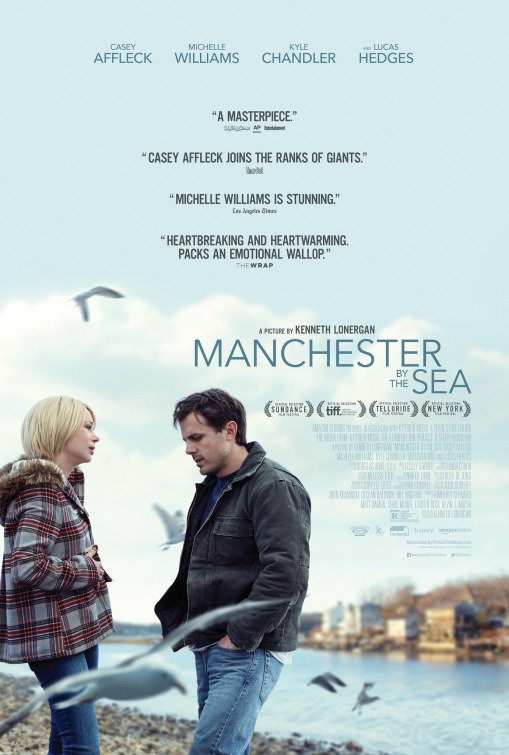
Manchester By The Sea (2016)

Cast: Casey Affleck, Michelle Williams, Kyle Chandler, Lucas Hedges
Director: Kenneth Lonergan
released on blu-ray February 21, 2017
********* 10/10
manchester_by_the_sea

IMDB: 8.0
Rotten Tomatoes: 96%, Audience Score 80%
The Guardian: *****/*****


Kenneth Lonergan is an American playwright, screenwriter, and director.

Something of a selective creator, he’s best known for his writing ability, having written the scripts for Analyze This, You Can Count On Me, The Adventures of Rocky and Bullwinkle, Analyze That, Gangs of New York, Margaret, Manchester by the Sea, and an upcoming miniseries called Howard. His directorial offerings are a little more slim but stemmed from his writing career – You Cant Count On Me, Margaret, Manchester by the Sea. I should also mention that while Lonergan is also a little slow to the table with his creative projects, when he serves as both director and writer, something good consistently happens.

Manchester by the Sea is the story of Lee Chandler (Casey Affleck), an anti-social janitor and handyman in  Quincy, Massachusetts, who learns from a family friend that his brother Joe (Kyle Chandler) has had a heart attack. Unfortunately Joe dies before Lee arrives at the hospital, and Lee heads to his home-town Manchester-by-the-Sea to bring his nephew Patrick (Lucas Hedges) the news. While arranging the funeral, Lee learns that Joe wanted him to be Patrick’s guardian.

Lee is unwilling to move back to Manchester, but does not want Patrick to be with his alcoholic mother, so he works to move Patrick to Boston instead. Patrick has many friends, two girlfriends and is in a band; he hates this idea.

We also learn that Lee used to live in Manchester with his wife Randi (Michelle Williams) and their three kids, but due to a mistake he made while intoxicated, a house fire took the lives of the children. He was never prosecuted, but Randi blamed him and they divorced. Lee then attempted suicide in a police station after he was found not guilty, but was contained. He moved to Boston shortly afterwards.

While they wait for the ground to thaw, Joe’s body remains in cold storage,and Lee stays in Manchester. Uncle and nephew become better friends and eventually Patrick’s mother Elise finds out about the situation. She offers to take Patrick in, but her sobriety is largely the responsibility of her controlling fiance Jeffrey. Lee also runs into a remarried Randi and her newborn. She regrets the things she said and confesses she still loves him. Lee does everything he can not to break down and leaves because he cannot stay in Manchester with her – He later picks a fight at a bar.

After finally arranging for family friend George to act as a legal guardian for Patrick, the pair have a heated discussion about why Lee cannot stay in Manchester any longer. After the funeral, Lee lets Patrick know that he is searching for a place with an extra room, so that Patrick can visit whenever he wants.

Pros: This might be a cliche, but this film is affecting. I was genuinely bummed out after watching it. The combination of raw performances, subtle scoring choices, and a well-laid script that pulls right out of the everyday make this film about death and mourning all the more powerful.

Cons: It takes a really long time to make it’s major points and there are a couple of moments where it feels like more of an exercise then a story.

Runtime: 2 hours 17 minutes

Points of Interest: This is the first film distributed by a streaming service to get an Oscar nomination for Best Picture. Matt Damon and John Krasinski were originators of the idea, asking for Damon to direct and Lonergan to write, and Damon to star in it, Damon eventually opted out due to scheduling conflicts, but remained on as a producer.

Lonergan understands intimately that life is full of grief. Wrongs which are never corrected plague us and while it can be nice to assume a storybook ending from a film, sometimes it doesn’t work out that way. The character of Lee is an excellent case study of a life unfulfilled, a responsibility not asked for, and working around the pain. A story about life lived in the world as it is, loose ends and all.

theories Summarized

Allegations and personal issues of Casey Affleck aside, the arresting nature of this story, and what it addresses capture the pains of life. It seriously broke my heart to watch this movie, ever so slowly, because I’ve loved and lost, and I’ve been on the ends of good and of bad as well. Affleck never redeems his character, but the glimmer of movement forward despite that unresolved pain makes it a worthwhile story, at least that’s my theory anyway.

Tim!

Better Than Your Parents Had It (Education)

Another post on the OECD index and inspired by postconsumers.com timotheories? Wow, haven’t you farmed this land enough yet?

Well… No, dear readers. Technically I still have to cover off the following – education, environment, governance, health, life satisfaction, safety and work-life balance. So we’re only a third of the way in! Plus, I could write at length about all of these topics and how they relate to being a good global citizen as well as a participant in your local community (and how it relates to the arts). This is a good thing, the website is called timotheories after all, it’s all about the curating the arts and connecting seemingly disparate theories together while having fun.

And this one is sure to be a good post. Education is one of MY FAVOURITE TOPICS. Ever. Period.

The Parents Broken Dream

One of the things I’ve learned as I transitioned from being a child into an adult, and as I recount experiences I’ve had with parents, my own and others, is that every parent wants to provide their children with a life better than they had growing up.

I’m not sure if this is one of those impulses ingrained in our brains OR if it’s a social conditioning similar to the idea that we need to have a good education and a stable job in order to have a good life, but it’s out there in the ether as a theory for success. I mean, life is hard, one minute you are living the dream and the next you are blindsided at 4pm on some idle Tuesday but an event that never crossed your troubled mind.

You can thank Baz Luhrmann for that tidbit. Back to my point.

0ejnefu

The economic privilege of the baby boomer generation is well behind us, dear readers. Baby boomers grew up with all kinds of benefits (free educations, established unions, more vacation time, company cars and trips) that generation x, millenials, and whatever comes next can only dream about. This is a major consequence of rising house prices. House prices in the 1970s and 1980s were incredibly low and the earnings on selling those houses has been significantly more lucrative for those families than what singles and young families could hope for today. On top of that, many retiring boomers are leaving behind debts and living on reduced pensions without any savings to back their lifestyles up.

If addressing gender and ethnic privilege are key tenements of politics today, we need to add in generational privilege as well. Skiing (spending the kids inheritance) is a thing of the past.

Investing In The Future

I hope you can see where this post is headed, and if you’re a futurist, like me, than you’ll appreciate the witticism, of that heading. For those of you without the blessing and/or curse of a dry sense of humour, investing in the future is never done. It’s an act of commitment to a process, not an effort towards a goal.

the-future-now

This is incredibly important in the face of a changing world creative cuties. When you make art you are expected to focus on the details, to see the bigger picture, or to pull from both camps. Effectively learning when to use your macro and micro lenses takes time, and an investment in the process, but as you gain skills you will gain confidence and see how your contributions to society are relevant.

This article from Forbes goes over it quite well, but I’m going to summarize it quick for you –

  1.  You need an authentic and personalized network of contacts. Yes social media connections factor into this bucket, but I’m referring to mentors and professionals you rely on for key advice. Who is your career expert? Who do you go to for construction and mechanical advice? And who is your health guru? Do you have someone you can go to for general advice? Spending time each day reaching out to these people is important – it gives you a support system. Plus it feels good to help others and will teach you invaluable things about people.
  2. Live outside your comfort zone, always. Whether it’s learning to wake up early, going out to a social event once a week, or finally starting that book of songs you’ve been dreaming about for years, tapping into your vast potential yields some fantastic dividends.
  3. Get your secondary business going. Maybe you weren’t expecting to have two jobs, maybe you hate the idea of doing more than your 40+ hour work week. But let’s be honest, you are more than your job and you definitely have skills that are being underutilized. You need to make practical use of your cooking skills, your computer programming skills, your animal husbandry (awesome word choice timotheories!), I could go on. You’re not out to get rich and famous, its to continue to develop your skills and to challenge yourself.
  4. Active and critical thinking. This one comes naturally to me, I can’t help it. I think a lot about a lot of different things. If we could visually showcasing what thinking, reading, and using our minds does for our mental capacity, I’d get compliments on my brain all the time. This is not arrogance, because we all think. But we need to think actively about the future, goals, how to improve relationships and solve problems. Don’t settle for your situation, think about how to change it – then go for it.

theories Summarized

In brief, education is important. And while I suspect your instinct was that I was headed towards a post about academic learning and certification, I should be clear and state that that kind of education has absolute value, but it’s not the only way to invest in the future and given how economic dynamics are changing, we need a new game plan. That’s my theory anyway.

Tim!

The 5 Love Languages (Gary D. Chapman)

Wednesday is typically a day for wisdom here on timotheories, as you know, dear readers.

It’s the day I share ideas from famous artists, motivational pieces of art, give suggestions on things you can do to make your life more fulfilling, and sometimes I dole out my own theories of global wisdom. For example, on one post in particular, I decided to construct my own reading list and then I came up with a catchy theme to describe the different types of books I would draw from to grow and shape my own journey. Like Liu Kang.

liu_kang

I even called it The Reading List. Not like Liu Kang.

Which makes perfect sense to me, even if it is a bit obvious. Like Liu Kang. But then as mentioned I took the post a bit further and came up with a conceptual framework to flesh out the types of books I would be reading going forward.

I called that concept the The 5 L’s of Language, not to be confused with the name of a book called The Five Love Languages, and which is authored by one Gary D. Chapman. Who happens to be this week’s featured author.

Just in case you forgot, this is what The 5 L’s of Language look like –


I will read one book a month from the 5 groupings below, slowly expanding the number of books read so that I reach the point of 5 books a month. A book for each group

  1. LIFE – Biographies/Art/Music
  2. LOVE – Classic Fiction/Non-Fiction/Graphic Novels
  3. LEARN – Business/Leadership/Self-Help
  4. LABEL – Philosophy/Sociology/Psychology
  5. LEET– The Internet

If you haven’t figured it out just yet, the topic o’ the day is LEARN. As In you need to learn your own unique primary love language as well as how the other four work. You do this so that you can properly love yourself, a romantic partner, and even manage other relationships better, whether you are single, married, a child, teenager, or even just a man.

Gary D. Chapman, Five Kinds of Love

Gary D. Chapman has authored at least five books related to the concept of five love languages and co-authored two books on the languages of apology and appreciation. He originally came up with the idea of The Five Love Languages after looking into twelve years worth of his own notes on common patterns he witnessed when counselling couples. He asked a very simple question – when someone feels unloved by their spouse, what do they want from them? And thus five categories of answers emerged.

If you can learn to appreciate the difference between words of affirmation, physical touch, acts of service, quality time, and gift giving, then you’re working towards a rather positive and generous view of love and how to share it.

I bet you’re hoping for more of a definition of each term, so that you can go out and apply these ideas ASAP. Well, okay, but I recommend that you read the book first, and then run a legit profile through Chapman’s website.

With that mentioned here is a quick overview of each language –

  • Words of Affirmation: spoken affection, praise, or appreciation.
  • Acts of Service: actions, rather than words, used to show and receive love.
  • Receiving Gifts: giving gifts that are meaningful.
  • Quality Time: expressing affection with undivided attention.
  • Physical Touch: sex, holding hands, hugs – affection via touch.

As you get comfortable with the languages friends, you’ll learn which of the five is most important to you, and then you begin to implement the philosophy into your own life.

For example, if your primary love language is “quality time” like me, that means you should spend time for yourself on meaningful activities, whether those activities include another party or two is up to you, but if you make art, you’ll like enjoy doing it on your lonesome. Or if physical touch is important to you, maybe you spend time in dance classes, making theatre with friends or regularly hugging your friends and family. But that’s just a theory.

Tim!