
The Power Of… Discipline (Build Discipline)
Dear readers, I’ve been thinking about the power of love a lot this past week!
If you’ve ever been witness to the wonder that is the Back To The Future trilogy at any point in your life, you’ll know the song I’m thinking of and the incredibly strong association it has with the original Back To The Future soundtrack, but also with the whole franchise as well.
If you haven’t seen the movies, I’ll just leave this here for your convenience.
If you have seen the movies before, now the song is stuck in your head too! Ha.
Man, I must have have some sort of strange fascination with movie franchises if I keep bringing them up? I think it probably has to do with the fact that the story arc in a film is often fleshed out a little better then in a TV episode. That and it is usually self-contained and more consideration goes into the writing.
JK. Or am I?
But I have not JUST been thinking about the power of love. That song/concept was not the only part of the movies that came to mind for me when I kept hearing over and over again from friends and media content that the future was now here – that the October 21, 2015 date which Doc Brown and Marty were headed to in Back To The Future Part II, was finally on our doorstep.
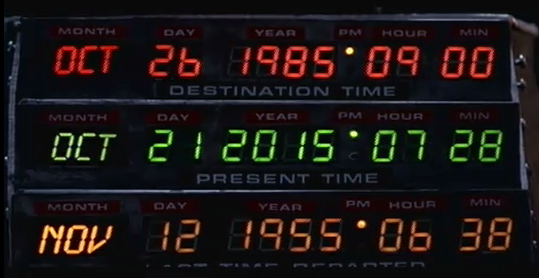
No, I had been thinking about a lot of the principles that the Back To The Future movies rely on to tell it’s story. Concepts of destiny, free will and the time-space continuum. And yes, also the power of love.
One of the major themes from the films interestingly enough is about society and how it changes over time.
This is best embodied in the relationship of Vice Principal Stickland and his family tree, versus the changing landscape of Hill Valley as the characters time hop through it. There are a ton of themes in the movies, but the Stricklands specifically are archetypes of morality and discipline. The Strickland of 1985 even has a favourite word to describe those who don’t uphold his version of etiquette. Slacker!
Admittedly this post is not about the movie Back To The Future, it’s just a device I’m using to get to the topic at hand. Discipline.
It’s funny to me how subjective a disciplined lifestyle can be from one individual to the next, but what I’ve always noticed about someone who is disciplined is that regardless of how they achieve their goals, they work out some sort of routine for themselves in order to accomplish their goals. Much like how fiction writers come to use techniques over and over again in order to create their stories.
I kind of hinted at this concept of discipline this past Wednesday, so if you don’t know what I am getting at, maybe do a rewind to a couple of posts ago and rejoin me when you are ready.
Glad everyone is going the same direction now…
Why am I writing about the concept of discipline and such? Well, I think Marty McFly has some issues with discipline in those movies, fears of rejection regarding his music in particular, and yeah he definitely grows up towards the end, but we are all in various states of disorganization at one time or another in our lives, but we don’t necessarily need to experience a traumatic event to shift positively.
So how do we work on this?
Well, a lot of people much smarter than I, have suggested that when we form good habits and have schedules, we can spend our brain power on increasingly interesting ideas and actions that propel us forward, rather than rebuilding the wheel, so to speak, every time we engage in an activity.
Let me give you a more concrete example to put it into perspective.
If you decide you want to get better at public speaking, you attend a public speaking course, get involved with toastmasters, start reading book, play brain training exercises, try your hand at improv, etc, etc. But in order to actually improve at those attributes, you do them regularly and allow the habits to form naturally as you commit to the practice of showing up.
Achieving results with creative endeavours is no different – if there are things you need to do in order to create works of fiction, illustrate comic books or piece together your next dress design, and those recurring tasks constantly come up, then you have to generate the brain power to remember to do those tasks.
But if you build a routine for yourself, you will eventually “know” what you need to do intuitively, and can focus your energy on experimenting, playing, and enjoying your talents.
Without building a routine for you, I’m going to share a link here to another article I enjoyed that’s done some of the legwork already and which also has citations.
What do you think of this theory? Are routines important? Do you like it better when you let your brain run on auto pilot and move you into the studio or at your desk where you can focus on the fun parts? Leave me some comments!
Tim!


 timotheories