We need a king to protect us from the evils humanity, as well as the darkness of jungle. That much should be obvious by now.
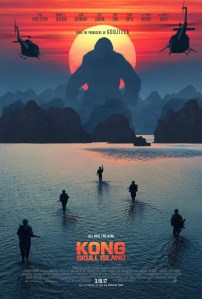
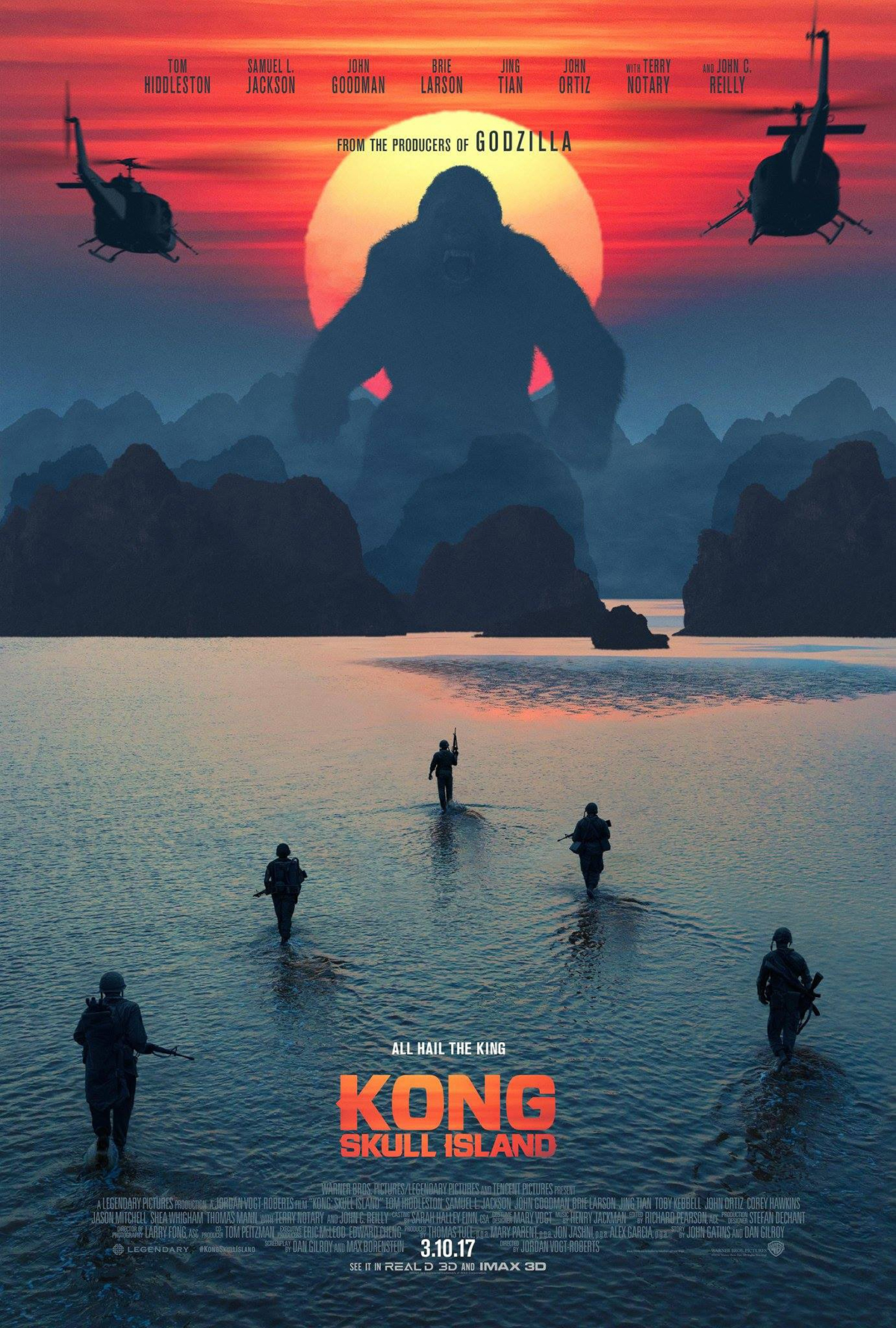
Kong: Skull Island (2017)
Cast: Tom Hiddleston, Samuel L. Jackson, Brie Larson, John Goodman, John C. Reilly, Corey Hawkins, John Ortiz
Director: Jordan Vogt-Roberts
re-released on blu-ray July 18, 2017
******** 8/10
IMDB: 6.8
Rotten Tomatoes: 76%, Audience Score 71%
The Guardian: n/a
Jordan Vogt-Roberts is an American director and screenwriter. His directorial debut came with The Kings of Summer, a coming of age comedy that was released in 2013. So a bit of an odd twist that he followed it up with this action gem, and that he will also direct the future Metal Gear Solid movie. But who knows what evil lurks in the hearts of men? That’s right, only The Shadow knows, also there is a surprising amount of comedy to be had here… and so I move on.
Kong: Skull Island is the second monster film in the new MonsterVerse franchise that Legendary Pictures started down the path with in 2014’s Godzilla. There are two more monster movies lined up in the next few years, another Godzilla movie which will introduce Mothra, Rodan, and King Ghidorah, and the much anticipated Godzilla vs Kong, expected to debut in 2020.
But enough about that, let’s get into the jungle and discuss the surprisingly entertaining Kong: Skull Island. One that both audiences and critics agreed upon!
Courtesy of Wikipedia…
After a dog fight, in the midst of World War II, two fighter pilots parachute to an island, and then engage in close combat, but the fight is interrupted by a behemoth ape known as Kong.
Fast forward to 1973, government agent Bill Randa (John Goodman) hires former British SAS Captain James Conrad (Tom Hiddleston), a skilled tracker, to guide an expedition to map out an island known as Skull Island. Escorted by a Vietnam War helicopter squadron led by Lieutenant Colonel Preston Packard (Samuel L. Jackson, the group is joined by photojournalist Mason Weaver (Brie Larson). Packard’s men begin the operation by dropping explosives developed by seismologist Houston Brooks (Corey Hawkins) to map out the island. However, the air unit is attacked by Kong, who kills a number of military personnel and scatters the survivors into two groups across the island.
After being confronted by Packard, Randa reveals his affiliation to the secret government organization Monarch, which was trying to prove the existence of monsters and determine their threat to humanity. The other survivors, including Conrad and Weaver, try to get to a rendezvous point to meet a resupply team arriving in three days’ time. They encounter the local Iwi natives and an older Marlow (John C. Reilly). He reveals that Kong is the island’s guardian, worshiped as a god by the natives for protecting the island’s inhabitants from many predators, including reptilian underground monsters dubbed “Skullcrawlers”. They have killed Kong’s ancestors, leaving him as the last of his kind.
Packard’s group begins making their way to Chapman, one of the survivors, whose helicopter crash-landed elsewhere. Meanwhile, Chapman is ambushed and eaten by a Skullcrawler. Conrad’s group helps Marlow complete a boat built from parts scavenged from the original downed planes. They regroup with Packard, who insists on searching for Chapman, though his true objective is to find and kill Kong.
Marlow leads the two groups to a mass grave littered with the bones of Kong’s kind. A Skullcrawler attacks the group, spitting up Chapmans dogtags and killing Randa and many soldiers. Learning about Chapman’s death, a vengeful Packard blames Kong for the deaths of his men and becomes determined to kill him. The two groups part ways, with Conrad and Weaver finally encountering Kong up-close, and resolve to save him.
Packard’s group triggers napalm explosions to lure him in. And it works. Conrad’s group arrives and persuades the other soldiers to spare Kong, but Packard refuses to stand down. Then, a massive Skullcrawler emerges from the lake, and Packard is crushed to death by a recovering Kong. The Skullcrawler overpowers Kong at first and chases the humans, but Kong rips it up. Kong also saves Weaver from drowning, as she had been knocked into the water during the fight, and allows the survivors to leave the island.
During the credits, Marlow returns home, reuniting with his wife, meeting his son for the first time, and watching a Chicago Cubs game on television. Post-credits reveal ancient drawings of Godzilla, Mothra, Rodan, and King Ghidorah, and even a fight between Godzilla and Ghidorah.
With just the right mix of action, over-the-top deaths, and seemingly unintentional comedy, Kong: Skull Island is an homage to the B grade monster movies of the past. You want to see Kong jump-punch a helicopter, and he does it. It’s even rewarding to watch all of the different creatures destroying the soldiers as they traverse the island.
What starts out as a slow ride with very little in the way of plot, speeds up in the second act, and we finally get a great story along with some silly characterizations that serve as filler for the the king.
Pros: Kong looks amazing and is incredible as a Lovecraftian type deity. John C. Reilly helps ground the story with his man-out-of-time bit. The CGI is well done too.
Cons: Almost all of the actors are mismanaged here, with Brie Larson coming off confused, Samuel L. Jackson feeling stiff, and Tom Hiddleston having nothing to do.
Runtime: 1 hour 56 minutes
Points of Interest: Vogt-Roberts was inspired by video games to include many POV shots of guns being fired, even taking inspiration from Resident Evil to show a helicopter hitting the ground. Marlow and Conrad are references to Joseph Conrads book, Heart of Darkness. As well as Apocalypse Now being a thematic and visual inspiration.
I think it needs to be emphasized that this is not a kind and compassionate Kong, he is fighter, tough as nails and only accepting of humans upon them proving themselves to him. The allusions to Heart of Darkness are welcome, and the shift away from the the three other adaptations is satisfying too. This is excellent popcorn fare.
theories Summarized
Despite the way too large ensemble cast, and the silliness that is needed to get us to Skull Island in the first place, this movie works well in so many ways. And thankfully John C. Reilly is able to serve a good role as something of a protagonist, despite such a small character arc. I think after the disappointing Godzilla remake, Legendary are finally on the right track.
But that’s not all the theories for today, I’ve got another Watch Culture episode to share too.
Direct quote from André “It’s cool in this era too, man,” which let’s you know that Luc Besson did good with this movie from the 1990s. But you should just watch the episode, because this episode is full of gold.
Tim!

 timotheories