Peek A Boo, I See You (Ghost In The Shell (1995) review)

Deus ex machina are supposed to reveal truths of the world, not leave it covered in darkness. Which is why this film is rather prophetic, and should probably be in the queue for monthly consumption, at a minimum.


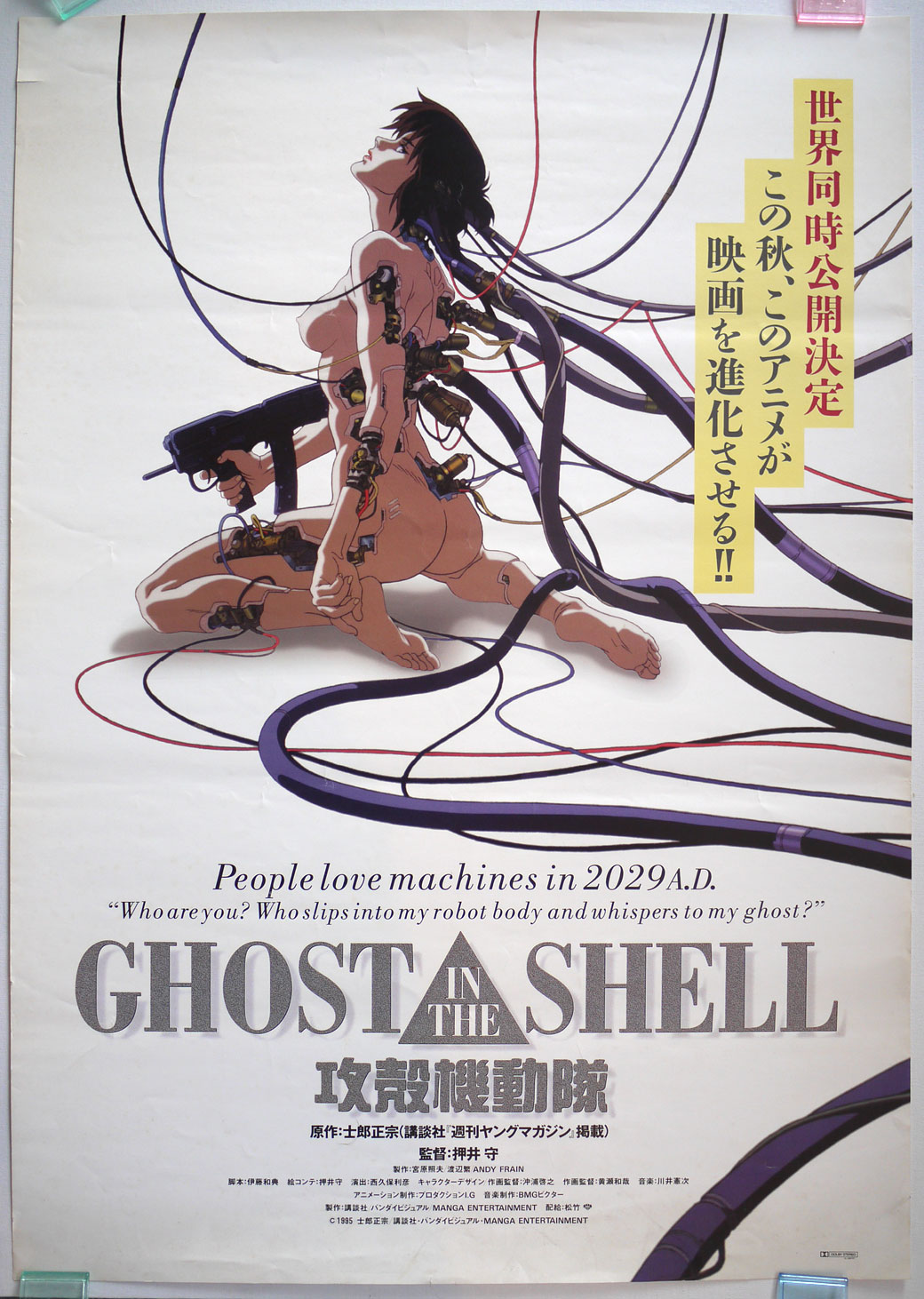
Ghost In The Shell (1995)

Cast: Atsuko Tanaka, Akio Otsuka, Koichi Yamadera, Yutaka Nakano, Tamio Oki, Tessho Genda
Director: Mamoru Oshii
re-released on blu-ray Sep 23, 2014
********* 9/10
IMDB: 8.0
Rotten Tomatoes: 96%, Audience Score 89%
The Guardian: ****/*****

Mamoru Oshii is a Japanese director and screenwriter. He has directed a ton of anime films and television shows, including Urusei Yatsura, Red Spectacles, Ghost in the Shell, Avalon, and Patlabor 2: The Movie. His directorial style has often been detailed in how different it is to most films made in the United States, with visuals being the most important element to him, followed by story, and then characterizations.

The Wachowskis and James Cameron have been in awe of his work for decades, especially with Ghost in the Shell, so I thought it fitting to time my review of the original film with the release of the live-action remake. Because, well, it’s even more relevant today than it was 20+ years ago.

Courtesy of Wikipedia

In 2029, with the advance of cybernetic technology, the human body can be “augmented” or even completely replaced with cybernetic parts. Another significant achievement is the cyberbrain, a mechanical casing for the human brain that allows access to the Internet and other networks. An often-mentioned term is “ghost”, referring to the consciousness inhabiting the body (the “shell”).

Major Motoko Kusanagi (Atsuko Tanaka) is an assault-team leader for the Public Security Section 9 of “New Port City” in Japan. Following a request from Nakamura (Tessho Genda), chief of Section 6, she successfully assassinates a diplomat of a foreign country to prevent a programmer named Daita (Mitsuru Miyamoto) from defecting.

The Foreign Minister’s interpreter is ghost-hacked, presumably to assassinate VIPs in an upcoming meeting. Believing the perpetrator is the mysterious Puppet Master (Iemasa Kayumi), Kusanagi’s team follows the traced telephone calls that sent the virus. After a chase, they capture a garbage man and a thug. However, both are only ghost-hacked individuals with no clue about the Puppet Master. The investigation again comes to a dead end.

Megatech Body, a “shell” manufacturer with suspected close ties to the government, is hacked and assembles a cybernetic body. The body escapes but is hit by a truck. As Section 9 examines the body, they find a human “ghost” inside its computer brain. Unexpectedly, Nakamura arrives to reclaim the body. He claims that the “ghost” inside the brain is the Puppet Master himself, lured into the body by Section 6. The body reactivates itself, claims to be a sentient being and requests political asylum. After the Puppet Master initiates a brief argument about what constitutes a human, a camouflaged agent accompanying Nakamura starts a diversion and gets away with the body.

Having suspected foul play, Kusanagi’s team is prepared and immediately pursues the agent. Meanwhile, Section 9 researches “Project 2501,” mentioned earlier by the Puppet Master, and finds a connection with Daita, whom Section 6 tries to keep from defecting the country. Facing the discovered information, Daisuke Aramaki (Tamio Oki), chief of Section 9, concludes that Section 6 created the Puppet Master itself for various political purposes. This is why Section 6 is desperately trying to reclaim the body.

Kusanagi follows the car carrying the body to an abandoned building. It is protected by a large walking tank. Anxious to face the Puppet Master’s ghost, Kusanagi engages the tank without backup and is nearly killed. Her partner Batou (Akio Otsuka) arrives in time to save her, and helps connect her brain to the Puppet Master’s.

The Puppet Master explains to Kusanagi that he was created by Section 6. While wandering various networks, he became sentient and began to contemplate his existence. Deciding the essence of humanity is reproduction and mortality, he wants to exist within a physical brain that will eventually die. As he could not escape section 6’s network, he had to download himself into a cybernetic body. Having interacted with Kusanagi (without her knowledge), he believes she is also questioning her humanity, and they have a lot in common. He proposed merging their ghosts, in return, Kusanagi would gain all of his capabilities. Kusanagi agrees to the merge.

Snipers from Section 6 approach the building, intending to destroy the Puppet Master’s and Kusanagi’s brains to cover up Project 2501. The Puppet Master’s shell is destroyed, but Batou shields Kusanagi’s head in time to save her brain. As Section 9 closes in on the site, the snipers retreat.

“Kusanagi” wakes up in a new cyborg child body in Batou’s safehouse. She tells Batou that the entity within her body is neither Kusanagi nor the Puppet Master, but a combination of both. She promises Batou they will meet again, leaves the house and wonders where to go next.

For me, it’s tough not to watch this movie and be reminded of The Matrix. I had the unfortunate experience of watching that movie a great many years before this classic, and the repeated viewings of The Matrix trilogy over the years haven’t helped either. And so, the story is a familiar one, exploring self-identity as we relate to machines in a time when humans and machines have become interchangeable. God praise the internet, amirite? And the timeline is not that far away either, in both the film and reality.

Consciousness, humanity, autonomy, empathy, and mortality are all explored in a relatively short hour and twenty-some minutes. In a time when international corporations have basically done away with national identity too.The ghost in the shell is literally a play on the wandering consciousness that inhabits the meaty husk, and it wants to know if we hear it’s voice.

Pros: Visually compelling and with a message which has allowed it to age far better then films like Blade Runner or Total Recall, Ghost in the Shell is violent, emotional, and poetic to experience.

Cons: The individual characters are difficult to warm up to, but it might just be all of the robot parts they have imbedded.

Runtime: 1 hour 23 minutes

Points of Interest: Motoko’s eye are intentionally animated to not blink very often, giving her a feel of a doll, rather then a human. The title of the manga which inspired the film is written as an homage to the Arthur Koestler work, The Ghost in the Machine.

theories Summarized

So is the 2017 film better than the 1995 one? I’d like to think not, and not for the obvious whitewashing allusions that have been to popular on the internet over the past year or so. In fact, Mamoru Oshii has gone on record to state that the Major may or may not be Japanese, but regardless of her current appearance, her name and body have changed numerous times, and so it is in fact acceptable to have Scarlett Johansson in that role.

But I think the problem is that the anime far better depicts the story at hand, and that the visuals are far more compelling with their mix of traditional drawing and CGI. The Matrix will never be the same for me. And that’s no theory.

And speaking of things that The Matrix tried to wreak… Andre and I have a new Watch Culture video up for your viewing pleasure. Please tell us if you agree that Equilibrium is worth a watch, and if not, your comments are appreciated.

Tim!

For The Love Of… Drugs (T2 Trainspotting review)

Against all odds, the protagonist survived the whole ordeal and came out the better for it.


T2 Trainspotting (2017)

Cast: Ewan McGregor, Robert Carlyle, Ewen Bremner, Shirley Henderson, Jonny Lee Miller, Kevin McKidd, Kelly Macdonald, Anjela Nedyalkova
Director: Danny Boyle
re-released on blu-ray June 27, 2017
******** 8/10

IMDB: 7.4
Rotten Tomatoes: 78%, Audience Score 82%
The Guardian: ****/*****

Danny Boyle is an English director, producer, and screenwriter; best known for Shallow Grave, Trainspotting, The Beach, 28 Days Later, Sunshine, Slumdog Millionaire, 127 Hours, and Steve Jobs. He has won BAFTA Awards and Academy Awards for his films and generally prefers to keep the genres and ideas he works with separate from each other, but he has dabbled with sequels having now created continuations of story arcs with both 28 Weeks Later and T2 Trainspotting.

Boyle admits that while his films are all over the map, a consistent theme runs through each – about overcoming insurmountable odds. As Dave Chapelle’s impersonation of Rick James would say, heroin is a hell of a drug.

Courtesy of Wikipedia

In the 20 years since Mark Renton (Ewan McGregor) stole £16,000 in drug money from his friends he has married and been living in Amsterdam. After going through a divorce which renders him homeless and being diagnosed with ACS, he decides to return to Edinburgh. Daniel “Spud” Murphy (Ewen Bremner), still a heroin addict, has lost his construction job and is estranged from his girlfriend, Gail (Shirley Henderson), and son, Fergus. Simon “Sick Boy” Williamson (Jonny Lee Miller) now abuses cocaine, owns a pub he inherited from his aunt, and engages in blackmail schemes with his Bulgarian dominatrix girlfriend Veronika (Anjela Nedalkova). Francis “Franco” Begbie (Robert Carlyle) is serving a 25-year prison sentence and is denied parole due to his violent temper.

Renton stops by his childhood home, where his father (James Cosmo) tells him of his mother’s death. He visits Spud at his flat, preventing him from committing suicide. Spud initially resents the intervention, but Renton offers to help him out of his addiction, telling him he needs to channel his addiction into something else. Renton then visits Simon at the pub intending to apologise and pay his share of the £16,000. They fight, but ultimately make peace.

Begbie escapes from prison and reunites with his wife and university-bound son, whom he wants to join him in burgling houses. Begbie visits Simon, and learns that Renton has returned. Simon keeps both Begbie and Renton unaware of his contact with the other.

Renton, Simon, and Veronika become partners in various crimes, using the proceeds to renovate the second floor of Simon’s pub into a brothel. They fraudulently apply for an EU business-development loan. Veronika begins an affair with Renton. One of Simon’s blackmail targets reports him to the police and Renton seeks legal advice from his former girlfriend, Diane (Kelly Macdonald), now a solicitor. The proceeds of their crimes are used up in legal fees. A menacing encounter with the owner of a rival brothel intimidates Renton and Simon into abandoning their brothel scheme. Veronika tells Renton and Simon that the business-development loan was approved and they have £100,000.

Begbie and Renton accidentally meet in the toilets of a nightclub, resulting in a chase from which Renton barely escapes. Begbie visits Spud and discovers he has been writing his memoirs, with Veronika’s encouragement. From the pages spread throughout Spud’s apartment, Begbie learns for the first time that Renton had left Spud his £4,000 share of the drug deal earnings. When Veronika stops by, Begbie takes her phone which he uses to trick Mark and Simon into meeting him at Simon’s pub.

Veronika asks Spud to leave with her, promising him half of the £100,000 loan money. He declines, but helps her steal the money by forging Renton’s and Simon’s signatures.

Simon and Renton meet at the pub, and Spud arrives to warn them of Begbie’s trap. Begbie arrives and knocks Simon unconscious. Renton hides upstairs, then falls from the rafters and gets caught in cables, which strangle him. As Begbie attempts to finish killing Renton, Simon revives and uses pepper spray on Begbie. As Begbie retrieves and loads a shotgun, Spud knocks him unconscious with a toilet bowl.

The three leave Begbie trapped in the boot of a car parked outside the prison from which he’d escaped. Veronika returns to Bulgaria with the £100,000. Spud channels his addiction into his writing and begins mending his relationship with Gail and Fergus. As Gail reads his writings, the implied title of the book is “Trainspotting”. Renton and Simon resume their old friendship. Renton moves back into his father’s home and embraces him before going into his bedroom and playing “Lust for Life” on his record player.

While this movie doesn’t have quite the same bite and rawness as its predecessor, it is a pure sequel, with the emotional pull between its ensemble cast and Boyle’s treatment of middle-agedness making this movie a worthy installment and bookend of these burnouts in a far off corner of the world.

Pros: It retreads what preceded in glorious fashion, we are happy to revisit the same characters twenty years later, and while the actors have aged themselves, each of the four leads provides the goods. Begbie and Spud in particular shine.

Cons: The constant references to the first film are a bit jilting at first and only feel necessary upon post-mortem reflection of the plot. I struggle with the limited screen time for both Spud and Begbies estranged wives. The relationship between Renton and Sick Boy feels strained, and not from the twenty years after the betrayal.

Runtime: 1 hour 57 minutes

Points of Interest: Robert Carlyle decided to stay away from his family during filming because he took on so many traits of Begbie. Ewan McGregor and Danny Boyle had a falling out around the time that Leonardo DiCaprio was cast as the lead for The Beach, and only recently reconciled. During filming, the movie was titled Porno, just as the second novel was titled.

Sometimes what follows an opportunity is a betrayal, but fortunately for us this was not the case with T2: Trainspotting. Danny Boyle does continue his theme of having his character overcomes all odds and walk away a better person for it. Realistically, Renton should have died this time around, but as luck would have it, he gets to walk away. It’s a mesmerizing film to watch, and even as it features some caper flick elements towards the end, it makes sense for the story.

theories Summarized

I’ll admit that I had not seen 1996’s Trainspotting until just before viewing this film, so maybe I can’t hold onto the nostalgia as tightly as some other viewers might, but I think in this case it afforded me with the ability to appreciate both films upfront and without the rose-coloured glasses. This is a solid sequel, which no one should feel ashamed in indulging. And unlike drugs, you won’t feel the effects of withdrawal.

But that said, if you are feeling some Watch Culture aches and pains, fear not creative cuties, we have another serving for you below. Enjoy and I’ll see you tomorrow with some wisdom!

Tim!

I Wanna Be Like You (The Jungle Book review)

In computing language, source code is meant to be instructions for computers, often in an executable format. But sometimes a programmer will include the source code so that other users and programmers might benefit from the information – to study it and hopefully modify the results.

Where technology intersects with human biology, that’s when it gets interesting. And conveniently, that’s what today’s film review is all about.


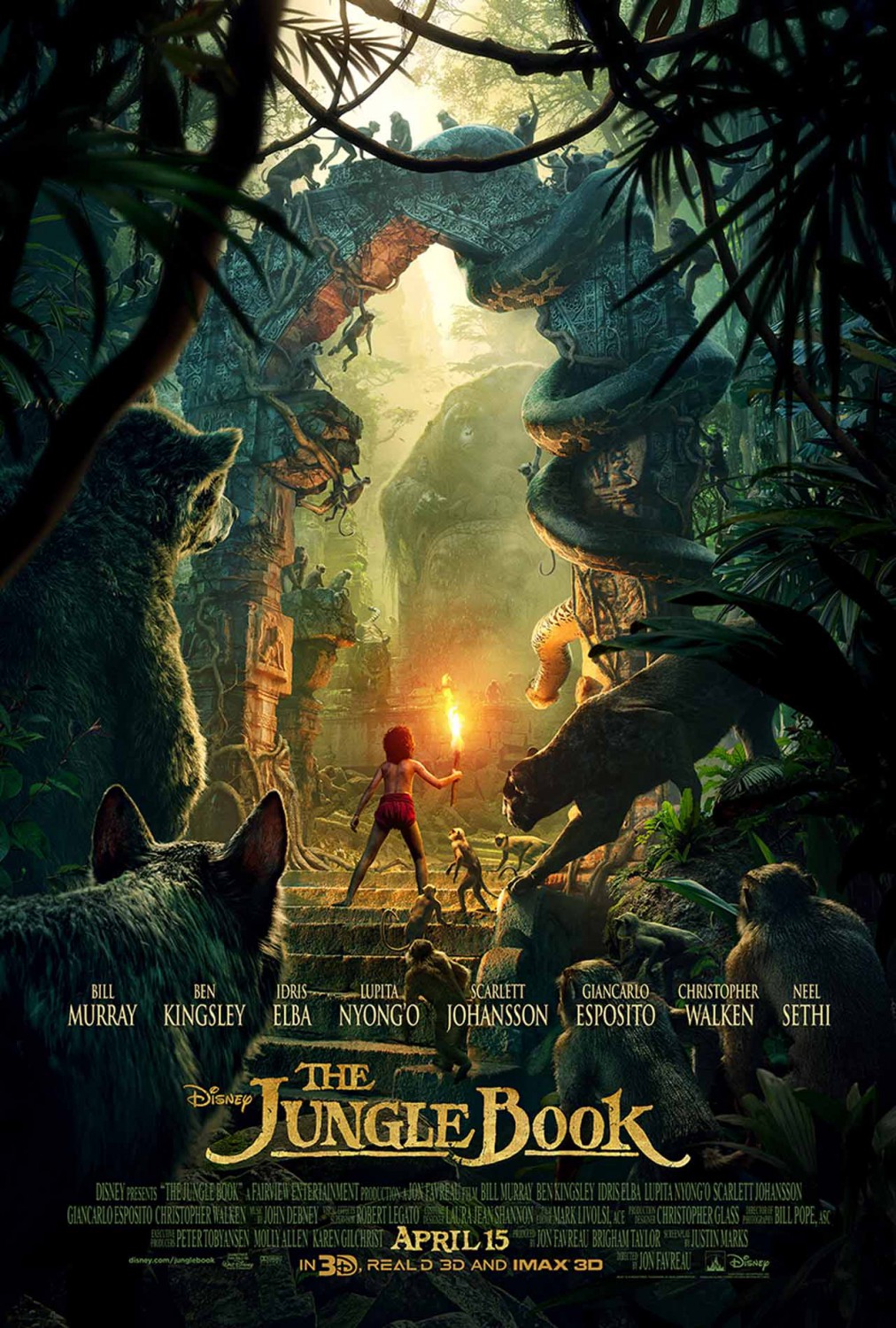
The Jungle Book (2016)

Cast: Neel Sethi, Ben Kingsley, Lupita Nyong’o, Idris Elba, Bill Murray, Scarlett Johansson, Christopher Walken, Giancarlo Esposito
Director: Jon Favreau
released on blu-ray August 30, 2016
********* 9/10

jungle_book_ver6_xlg

IMDB: 7.7
Rotten Tomatoes: 95%, Audience Score 88%
The Guardian: ****/*****

Jonathan (Jon) Kolia Favreau is an American actor, director and comedian. He’s acted in many of the films he has directed, with the exceptions of Zathura and Cowboys & Aliens. Favreau has also directed Chef, Elf, Iron Man 1 & 2, and most recently The Jungle Book remake – If you haven’t seen him acting in any of those movies you might also recognize him as Monica Geller’s boyfriend Pete from TV’s Friends. Favreau also produces movies under the banner Fairview Entertainment.

He’s been in the film industry since the early 1990s, but it wasn’t until his first financial success directing Elf that Favreau really became a big name. Which is why it’s not that surprising that he was able to land the directing role for Disney’s live-action/CGI reboot of The Jungle Book. Especially after having a hand in launching the MCU.

Filmed mostly with digital animation, and featuring a real-life Neel Sethi roaming around the jungle as Mowgli, this movie takes some cues from the book, but quite a number from the original animated adaptation from the 1960s.

I’m not going to spend a bunch of time hashing out the story as you’ve likely already seen the original movie. I mean who hasn’t? One of the major differences is that the animations are stronger and more tied into real depictions of animals – with the exception of King Louie who is much larger than life and definitely took me out of the story, even if Christopher Walken did an excellent job voicing him. On the positive side of things, the danger is made more real and the movements of Mowgli inside this world are so fluid, that you sometimes forget it’s all made up.

Pros: It manages to retain it’s humanity, while having almost no elements that exist in the real world. Exploring nature and the laws of the jungle haven’t seemed this fun in a long time.

Cons: There are some moments where the story feels mechanical, and I suspect that has something to do with the absence of ties to real environments, and when you see a 30ft ape, it’s a little disappointing.

Runtime1 hour 46 minutes

Points of Interest: Kaa the snake is portrayed as a female, rather than a male, which is a first and intentional as Jon Favreau felt there were too many male characters in The Jungle Book. Reference shots of remote jungle locations in India were used to help construct the settings for the movie.

I went into this movie somewhat sceptical that it could recapture the entertainment value of the original film, and when I heard “The Bare Necessities”, “Trust In Me” and “I Wanna Be Like You” I was quickly comforted, though it could have easily been the opposite. These riffs off of the original Disney movie were important to take, because the nostalgia factor remained high throughout, evening knowing how the story was going to end. This is an example of a movie where the remake is both excellent and respectful, allowing us to revisit the original or perhaps even expose new viewers to the source.


This technology driven re-imagining of The Jungle Book is amazingly faithful and yet it is a distinct property which can be consumed and shared with all of it’s strengths intact. As a case study of where animation is come from and where it’s headed. Much like how life cycles through and changes with each new generation, never changing so much that it is unrecognisable, but that it is distinct and authentic. You should definitely watch this movie, it gives I Wanna Be Like You a new meaning.

Tim!

A Non-Comical Book, Err Film (Batman: The Killing Joke, review)

Sexuality is a complicated thing, dear readers. People of all sexual orientations exist in this world – heterosexual, homosexual, bisexual, asexual, polysexual, pansexual, and transexual. And those are just the baseline, it gets more intricate then that. Which is a difficult thing to address because we have so much cultural material out there that mostly address heterosexuals, and to a lesser extent, homosexuals.

Every other persuasion gets considerably less attention.

Now, I’m writing about this challenge as a straight white male, so I realize my opinion is pretty limited, and that I am quite privileged in my perspective, but I will mention this, I have no idea how the actual percentages shake out on this sexuality matter.

Regardless, when we are reduced to our sexual motivations, that sucks. And not in a good way. Especially when it comes to art.


Batman: The Killing Joke (2014)

Cast: Kevin Conroy, Mark Hamill, Tara Strong, Ray Wise
released on blu-ray August 2, 2016
***** 5/10

batman_250x375_r5

IMDB: 6.8
Rotten Tomatoes: 48%, Audience Score 56%
The Guardian: N/A

Sam Liu is a Chinese American animation director, artist, and designer. He has directed several animated superhero films at both Marvel Entertainment and Warner Bros. Animation. I could list the heavy CV of films he has had a hand in, but it’s rather exhausting to look at, so let’s just take my word for it, okay?

As Bob Dylan once sang, the times, they are a changin’.

And this story probably didn’t need to be retold, especially the way it did, but before I tell you about the story, I’ll give you a bit of background first.

Batman: The Killing Joke is an adaptation of a rather slim graphic novel of the same name, which was originally created by Alan Moore and Brian Bolland in 1988, and which was itself also an adaptation of another story from the 1950s called The Man Behind the Red Hood which originally served as an origin story for Batman’s greatest foe, The Joker.

It has been widely lauded as one of the greatest Batman stories of all time, and has been critically reviewed as the definitive Joker story. It is a story describing both how The Joker came to be and for him to prove that anyone can sink into madness.

The flashbacks show a failed comedian and his very pregnant wife, and the comedian eventually decides to work with criminals to steal from a playing card company. It’s adjacent to his former work, which is a chemical plant. But his wife dies in a household accident, and he is forced to help the criminals anyway. The criminals dress him up as The Red Hood to implicate him if cops arrive. Cops do arrive, and then Batman. The comedian escapes from Batman, but is flushed out the chemical was pound lock – this turns his skin white, his lips red, and his hair green. He loses his sanity.

In the current timeline, The Joker invades the Gordon’s home, shoots Barbara (Batgirl), and kidnaps Commissioner Gordon. He then subjects him to sexualized images of his naked and bloody daughter, ridiculing him, and parading him through an abandoned amusement park. His hope is that Gordon will go insane just as he did, but this does not happen. Then Batman arrives, fights The Joker and proves to The Joker that he is the only insane one. The comic closes with Batman attempting to rehabilitate his foe, and The Joker responding with a joke that insights laughter from both parties, then the comic ends with an empty panel. Leaving the question of what happened to the reader.

It was a powerful story for the time, and still an interesting read, but Alan Moore has admitted that it lead superheroes down a dark road, and that while he wanted to show that comic books could be anything, all it did was darken the industry, and it hasn’t really recovered since. He regrets having written the story.

Now, let’s get to the update. Without diving too much into it, the new animated movie adds a prologue to help introduce us to Batgirl, even showcasing her challenges with a villain of her own, and a strained relationship with her mentor. The villain is sexually attracted to her, and of course gets in her head, which has Batman take Batgirl off the case. The story eventually shifts to a sexual tryst between Batman and Batgirl. Then Batgirl intervenes in the case anyway, and she ultimately resigns from crimefighting. Thus setting up the rest of the movie, which is a beat for beat repeat of the original story.

And so the story shifts the motivations of Batman and Batgirl, while removeing the weight of both The Joker and Gordon’s role in it’s outcome.

Pros: When the story sticks to the source material, it is engaging and an interesting account of both The Joker and his role with Batman.

Cons: We didn’t need to see a sexualized Batgirl. And we definitely didn’t need to see a 30 minute prologue story, when Batgirl should have gotten her own feature length animated film. Also, the animation is quite bad in many places.

Runtime1 hour 16 minutes

Points of Interest: Mark Hamill had retired from voicing The Joker, and would only come back if this story was adapted for film. The movie received a limited theatre release a week before it dropped in stores and online; the last time this happened was with the 1993 Batman: Mask of the Phantasm.

The fact that Alan Moore didn’t want his name on this adaptation might have been considered a sign that DC shouldn’t have green-lit this story, but that’s the perpetual struggle with comic book publishers, it’s a constantly dying industry, and they have to do something to inject life back into their business. And so an adaptation of an almost 30 year old Batman story was made into a movie. You can watch it, but I’m not sure that it’s worth it.


I really wish this movie didn’t turn out the way it did. I mean, the original story is interesting and noteworthy for a morality tale and cross-examination of Batman and The Joker as they relate to each other. And yes, Batgirl does plays a victim role in the original story, so it’s not like it’s the most brilliant piece of writing ever, but man did they screw up the adaptation with that prologue. It went from being an interesting story to something completely different. It just doesn’t mean the same thing with those changes. A story reduced to sexual motivations, and unnecessary sexualization of a female character.

Tim!

The Good, The Bad And The Last Airbender (Cross Talk Ep. 4)

Another week, another Stimulating Sunday on the horizon! Which technically is appropriate for both the beginning of the day and the ending of the day, dear readers. Especially now that the days are getting longer and dusk arrives around 9pm MST!

Conveniently for us, this is also the same time as when this post published!

Of course most of us already know the English language is mired with words with multiple definitions, a result of it adapting from other languages as it formed and slowly became one of the most common spoken languages on the planet. We that extra bit of daylight, I think we have time for a bit of quick trivia.

57039314

Did you know that for 339 million people, English is their first language, and that it is the second most common language after Mandarin, of which 900 million people claim it as their first choice?

But let’s look at the word adaptation as an example of this problem.

In biology an adaptation is a change or the process of change by which an organism or species fits into it’s current environment in a better way. However, in film an adaptation is a a transfer of work (written or otherwise), whether the whole work or a part, to make a feature film. It is a type of derivative work. A common form of film adaptation is the use of a novel as the basis of a feature film.

Both words are about change and originators, but for our purposes we’re gonna stick with the second option.

And because it’s about time for a Cross Talk post, and we decided to tackle film adaptations this month, it only makes sense that we define the rules of the game first. Yeah! We are going to go over the the challenges of producing an adaptation and what happens when you look back at the source material, fondly or otherwise.

You see dear viewers, there are still some issues with #whitewashing in film, gender inequality, character rewrites, and of course visual misrepresentation, so Chris and I decided to focus our attention to tackle the problems that happen when going to the movies or result in a debate on the couch.


I’ve included a direct link to the full video for you here, but as always the real action is just below for your convenience. Otherwise, please sit back and enjoy Episode 4 of Cross Talk!

I’m out of theories for now, but please check back tomorrow for a rather illuminating album review. It should be a good one! Please comment, subscribe and share this with you friends. We want to hear your feedback!

Tim!