Making Things Into Real Things.
My dad makes things. Real things.
That’s probably an important distinction to make right away, because apparently somewhere along the lifepath I decided some things were more thing than other things. If that makes sense.
My dad can build something.
He can fix something.
Take something apart, figure out how it works, put it back together and somehow end up with fewer leftover screws than I would.
There is usually a very obvious relationship between the work he does and the object that exists afterward.
There wasn’t a shelf.
Now there is a shelf.
That’s making something, in a very literal physical sense.
I write essays.
Which, obviously, is also making something.
I make art.
I’ve made websites.
I’ve designed board games.
I’ve built brands.
I’ve designed training workshops, podcasts, all kind of digital systems, theories, presentations, campaigns and probably several unnecessarily elaborate spreadsheets.
I’ve spent most of my adult life creating things.
But for some reason, when I think about someone who makes things, my brain doesn’t immediately picture me. A picture of my dad the carpenter comes up. Or a welder. A mechanic.
Someone with a traditional workshop.
Someone who knows what all the tools hanging on the wall are actually called.
Someone who begins with raw material and ends with an object you can put on a table.
Apparently I’ve been carrying around a hierarchy of making that I didn’t know I had. And then my friend Steve and I decided to make a board game together.
Two Guys Making Something
Steve and I have known each other for about twenty years. Which means we’ve had enough time to become very different kinds of nerds. For instance, I know board games. Not just I like playing board games.
I mean the annoying version. I know designers names and I know publishers.
I know all of the main types of game mechanics and even the less popular ones. I very often am familiar with hobby game expansions that are about to release. And the order that they came out in.
I know the major board game influencers. Their top ten lists.
I could go on and on about it and my obsession with this hobby. I have in fact.
For example, I could tell you why one worker-placement game feels completely different from another worker-placement game even though both involve putting little wooden people onto cardboard spaces one turn at a time.
Steve came at it from somewhere else. Despite us both going through the same university undergrad program (proud owners of a Bachelors of Fine Arts we are).
He routinely chooses to make things. There it is again.
3D printing.
Woood working.
Masonry.
Taking electronics apart and putting them back together.
And he likes to collect print-and-play games.
He also sketches ideas constantly. I make a drawing (or several) and turn them into other drawings. But he is always making visual sketches of literally everything and prototyping.
He’s the kind of person who can look at an idea and immediately start wondering what shape it should be.
Somewhere in the overlap between those two worlds, Steve told me about a story idea he had.
And I said, You know what this could be?
A game.
We started talking about what that might look like. And eventually, after the inciting event at one of his birthday parties, we agreed that this thing we’d been playing mental catch with should become a real project.
And eventually so did our company Barrel Roll Games
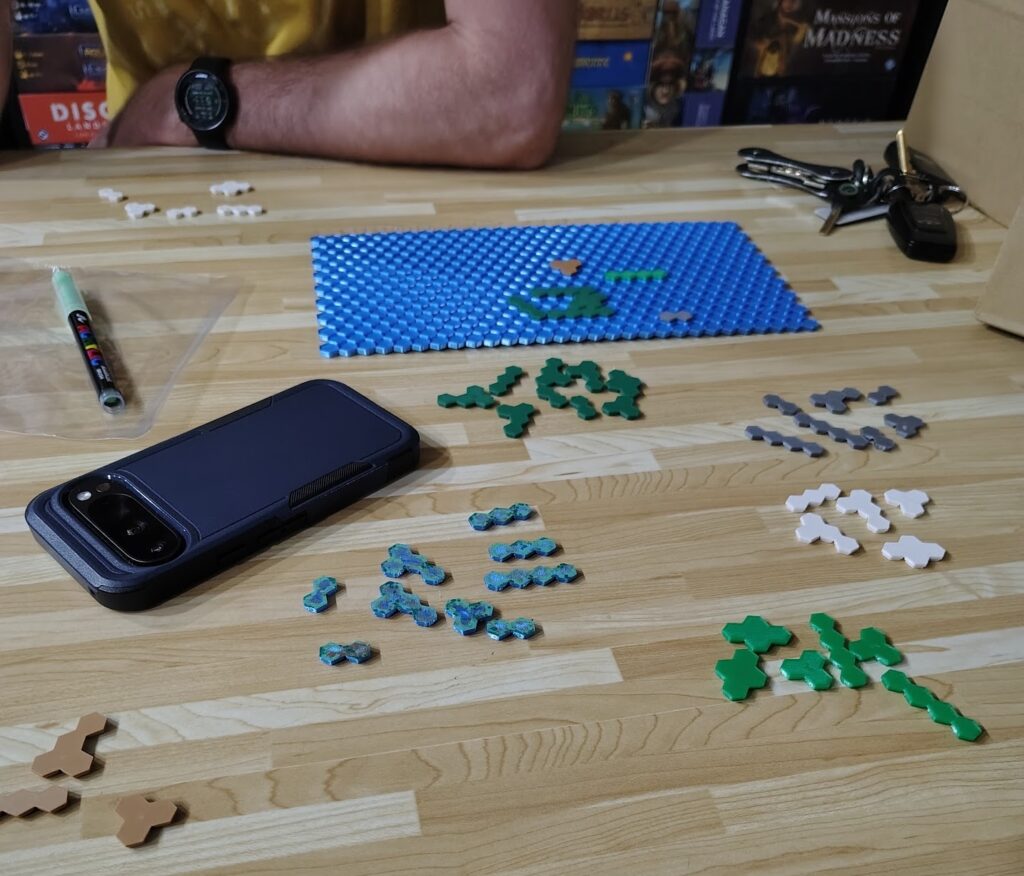
Blue Origin is a game about a civilization living aboard a massive spaceship.
Players aren’t playing the heroes. They’re administrators.
Generations pass.
Species interact in new ways.
Those interactions influence how the different civilizations aboard the ship develop and evolve.
At least that’s what it is now. And to be honest, that’s about all I want to say about it without giving away proprietary information.
That’s one of the strange things about making something:
You can describe the finished idea much more cleanly than you can describe how you got there.
Because we didn’t sit down one afternoon, imagine a complete Blue Origin, write everything onto a piece of paper, and then spend the next year manufacturing the thing we’d already invented.
We fucked around.
We tried things.
We talked about different kinds of games and intellectual properties. At least I did.
Steve made things. I recognized things.
I suggested things. He showed me something.
That then made me think of something else.
We changed it.
We played through the concept mechanically by making dials. And cards. And dice.
Some things didn’t work.
And then some thing else would work for a reason neither of us expected. Then one of us would say it: Wait.
Those are dangerous words in game design.
Wait
I think we misunderstand creativity because we spend so much time looking at finished things.
Finished things lie. Not intentionally. They’re just very good at hiding where they came from. You pick up a board game and everything appears inevitable. And sometimes you wonder if they even thought about it enough.
Of course the board looks like that.
Of course those pieces go there.
Of course the player does this before doing that.
Of course the designer chose those mechanics.
Of course it’s called that.
But you’re looking backward.
The final thing has erased thousands of versions of itself that never existed.
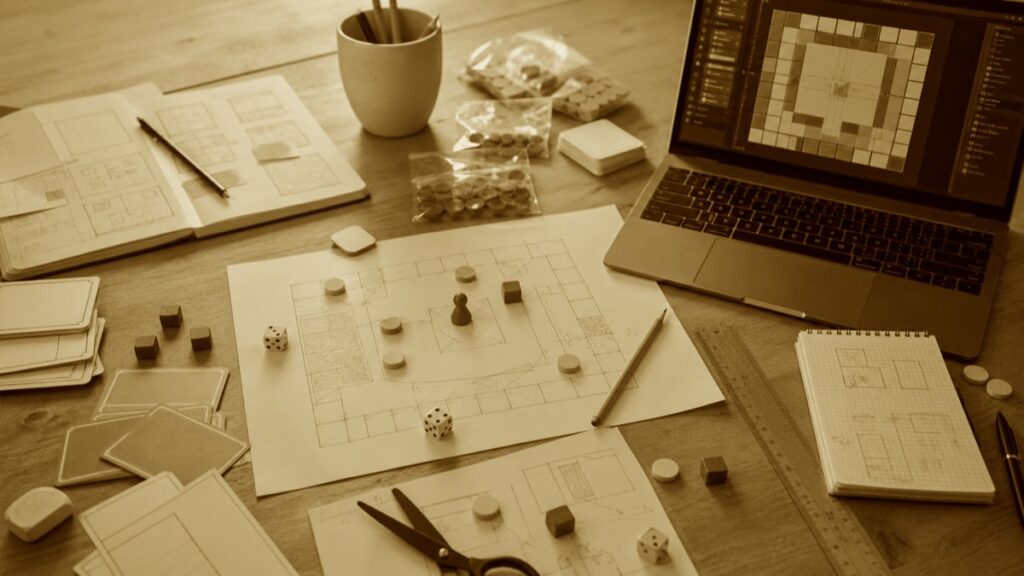
Or existed for twenty minutes.
Or existed on a scrap of paper.
Or were actually pretty good, but belonged to a different game.
I’ve been through this exercise many times before; and not always sitting at a table wrestling with a game design. Sometimes its with a drawing, sometimes with a painting or a video. Making something means spending an enormous amount of time with things that are not quite the thing. That’s true of writing too.
I rarely know exactly what I really think when I start an essay. That’s part of the reason why I even write them.
I have an irritation.
An observation.
A memory or a lyric.
Something catches me. Then I start pulling.
Eventually I can look backward and explain the argument as though I knew where I was going… I didn’t.
I discovered it by making it. Maybe that’s what Steve and I have been doing with Blue Origin too.
The Thing Thinks Back
Recently, Steve started playing with Einstein tiles and polyhedral possibilities.
In layman terms, they’re shapes that can cover a surface without repeating the same pattern.
Which is one of those sentences that makes immediate sense until you stare at the shapes long enough and your brain starts leaking out of your ears.
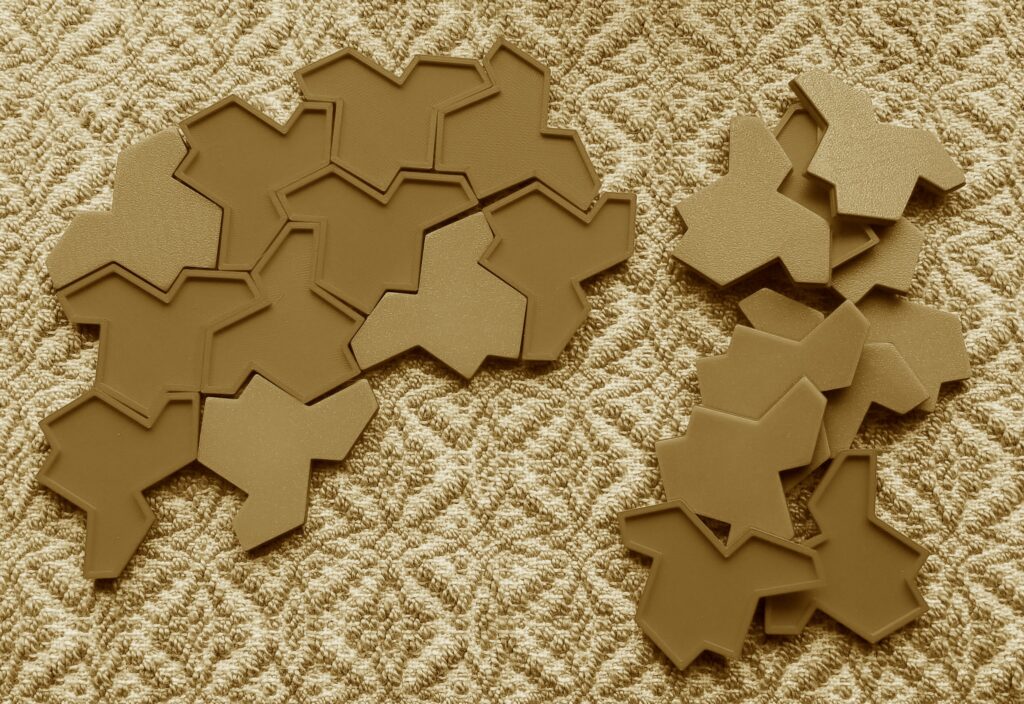
He saw infinite possibility in them.
Board.
Map.
World.
And suddenly this mathematical object that had absolutely nothing to do with Blue Origin was sitting inside the conversation, but making us wonder if it was an appropriate component to use with what we were trying to accomplish. A 4X game that also tells an ever-changing story (with a literal storybook). Oops I’m leaking info again.
Anyways, Steve has also started talking to ME about games.
He recently brought up the board game Inis. As an EXAMPLE of an atypical tile shape to consider. Which amused me greatly because now he’s wandering into my side of the hobby.
Meanwhile I’m learning more about 3D printing, prototyping and print-and-play.
We’re crossing the bridge from opposite directions.
And the game exists somewhere in the middle.
That’s important.
Because Blue Origin isn’t really my idea being physically executed by Steve. And it isn’t Steve’s “truth” that I’m decorating with board-game knowledge.
The collaboration changes the thing.
He introduces possibilities I wouldn’t have encountered.
I recognize patterns he wouldn’t necessarily have language for.
He asks a question.
I translate it through thirty+ years of playing tabletop games.
I make a suggestion. He translates that into something physical.
Then the physical thing changes how I understand the idea.
And around we go.
This is why I don’t think “execution” adequately describes making. Execution suggests the important intellectual work happened first. With the idea, and then the execution. But sometimes the execution creates more idea(s).
You make something so you can see what you’ve been thinking.
Then the thing you made thinks back.
Not literally. That would be terrifying.
Although depending on how Blue Origin develops, I suppose we shouldn’t rule an artificial intelligence out.
Harvest and Origin
Even the game name changed as we spent more time with it.
Blue Origin obviously already means something in the world of the game to Steve and I. But that’s not why I like it.
For me, there’s a Star Wars joke buried inside it. Blue Harvest was the fake working title famously used during the production of Return of the Jedi.
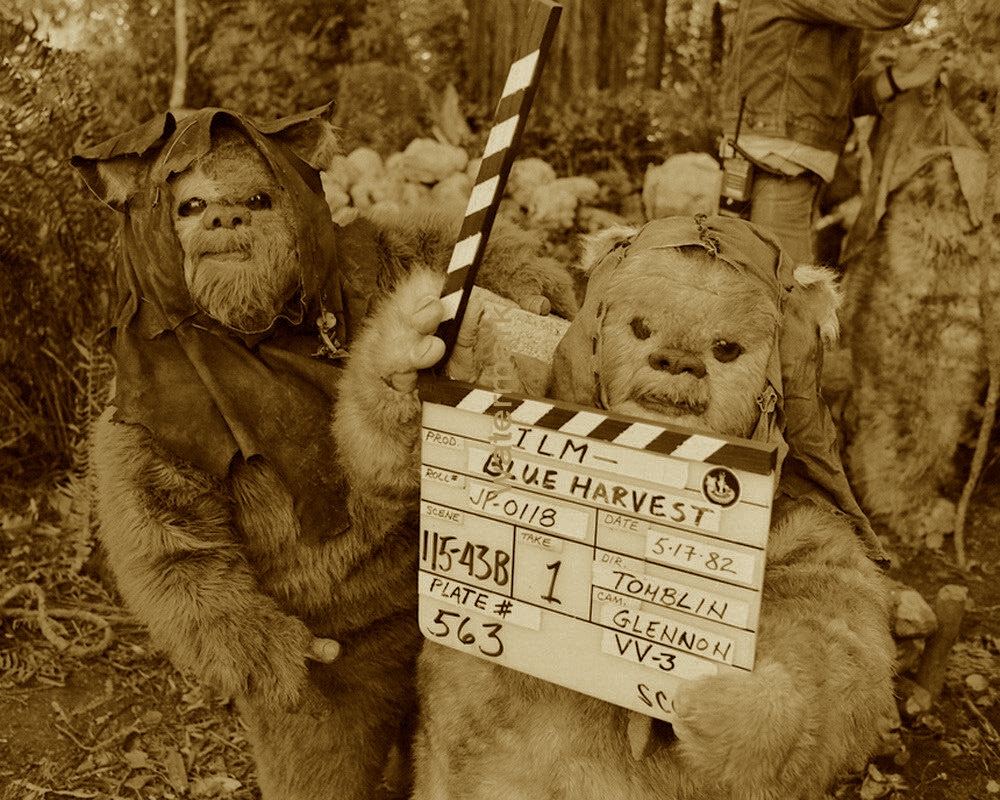
Steve and I are both varying degrees of Star Wars people. So Blue Origin became a little coded inversion.
Harvest and origin.
Ending and beginning.
And then the stupid joke started becoming weirdly appropriate. Because this is actually a game about generations, civilizations and worldbuilding.
Beginnings producing endings that produce beginnings.
A civilization being shaped by what came before it.
Origin.
Harvest.
Cause.
Consequence.
Suddenly a name that began partly as a reference was describing the thing we were making. Did we design all of that beforehand?
No.
We noticed it afterward.
And I honestly love that. It was a happy accident that the placeholder name we used as a bit of a joke became strangely accurate. Sometimes making isn’t the process of expressing meaning you already understand.
Sometimes you make something, iterate, pivot, and then discover what you’ve already been saying.
What Counts as Useful?
Which brings me back to my dad.
Why did I instinctively distinguish the things he makes from the things I make? I think part of it is usefulness. If someone builds a table, nobody asks why tables need to exist. You put things on them. Done.
A fence keeps something in or something out.
A cabinet holds things.
A repaired engine makes the car move again.
Utility makes the object’s legitimacy obvious.
But what does a board game do? Technically?
Nothing you need.
Human civilization will soldier on if Steve and I never finish Blue Origin. You will survive without another board game. Probably.
Some of you are looking at your shelves right now and realizing that kind of survival might not actually improve your quality of life.
So we keep making things.
We make paintings nobody needs.
Songs nobody asked for.
Films about people who didn’t exist.
We tell stories. And we make things.
Miniatures.
Quilts.
Gardens.
Pottery.
Written words.
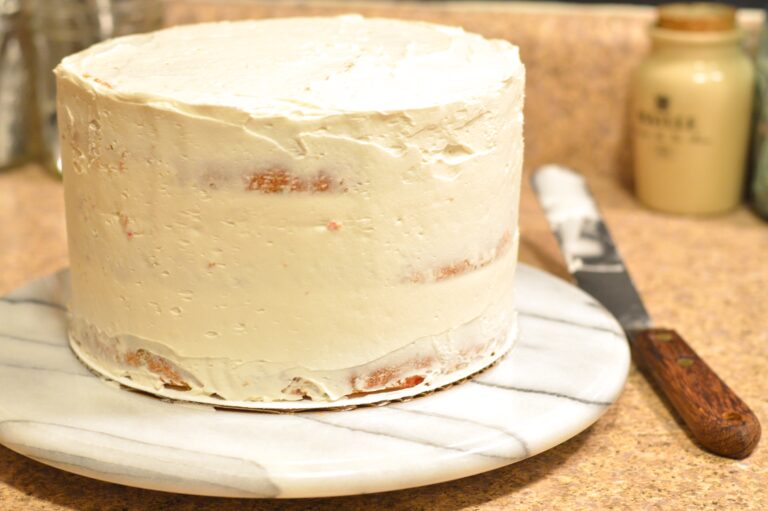
We decorate cakes that are going to be destroyed twenty minutes later. We spend hundreds of hours designing fictional worlds. Children, and lets be honest, more and more adults, build elaborate LEGO cities and then tear them apart.
Someone paints tiny details onto a miniature that most people will never notice. Someone else spends years restoring a car that was perfectly capable of being replaced.
That’s a tremendous amount of human effort devoted to things that aren’t particularly efficient. Which probably means efficiency isn’t the only point.
Maybe utility is broader than I was giving it credit for.
A board game gives people somewhere to meet. And a painting externalizes something somebody couldn’t say. That song gives an emotion a shape. A fictional world gives people somewhere to imagine.
That miniature with the extra details gives someone the satisfaction of making one tiny thing exactly the way they wanted it.
And sometimes the utility is simply: I wanted this to exist.
I’m starting to think that’s a perfectly respectable reason to make something.
From Nothing to Somethingness
There’s a particular moment in making that I don’t think I’ve ever properly named. An idea has existed for months. Maybe years. Probably decades.
You’ve talked about it.
Written about it.
Sketched it.
Changed it.
Argued about it.
But an idea isn’t quite a thing yet.
Which brings me, somehow to two seemingly unrelated cultural objects. The NeverEnding Story and Our Lady Peace. Stay with me.
The NeverEnding Story gave us The Nothing. A force that slowly consumes Fantasia as people in the human world lose their hopes and dreams. Our Lady Peace, several decades later and for completely unrelated reasons, gave us an album called Somethingness.
I didn’t intend to form a theory of creative making off these two properties, but making seems to exist somewhere between the two.
Let me explain further.
The Nothing is what we risk when possibility disappears. A loss of imagination puts a chokehold on that which doesn’t exist yet. And the Somethingness that Our Lady Peace wrote their album about, is what we should aspire to. It’s what happens when possibility starts taking up space.
And then one day, there’s something sitting on the table.
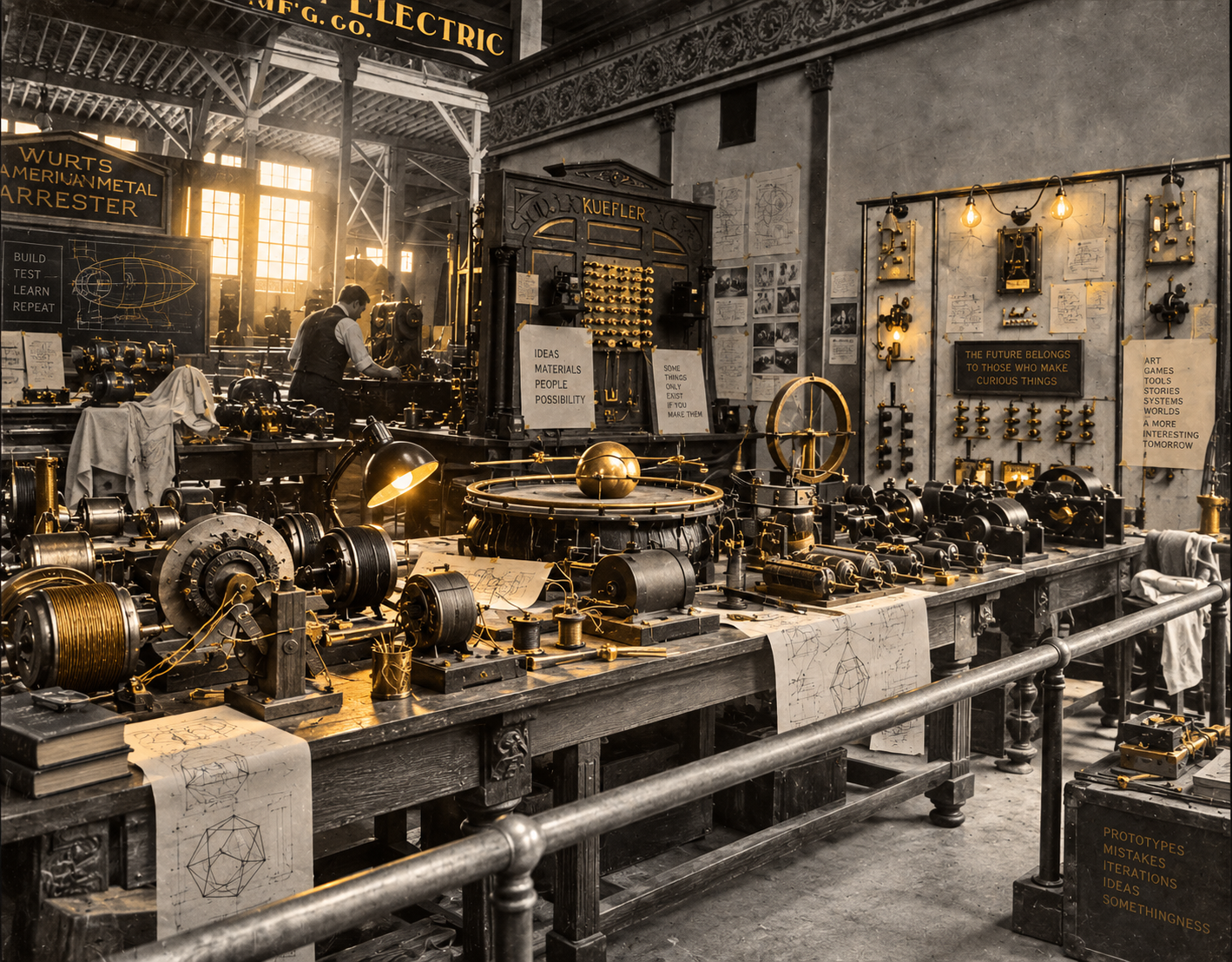
A prototype. Not finished. And probably ugly. Maybe held together with materials that were absolutely not intended for this purpose. But there it is.
Someone else can interact with something that previously existed only between a couple of brains. That’s the magic.
The prototype is not going to be impressive. It’s magic because an idea has become encounterable.
Possibility has taken up space. And once it exists, it can surprise you. That’s the part I keep returning to. That’s how we fight The Nothing.
We often describe creativity as self-expression. You have something inside yourself and you put it outside yourself. But my experience doesn’t feel that clean. Sometimes I put something outside myself specifically because I don’t completely understand what’s inside yet. Then I look at what I made. And it tells me something.
So I change it. And then it tells me something else.
That’s how I make visual art, and it’s how I write too. Apparently board games can work the same way. Maybe that’s what I’ve misunderstood about making all along.
Making isn’t simply the final stage of thinking. The idea doesn’t happen first and the making happen second. Sometimes the making is the thinking.
You make something so you can encounter your own somethingness.
Making isn’t merely expression.
Making is investigation.
The Distance Between Imagining and Making
I imagine things constantly. Most of them will never exist.
There aren’t enough years. That’s the arithmetic.
Ideas are cheap in the sense that I can generate far more of them than I could ever possibly execute. Making introduces resistance.
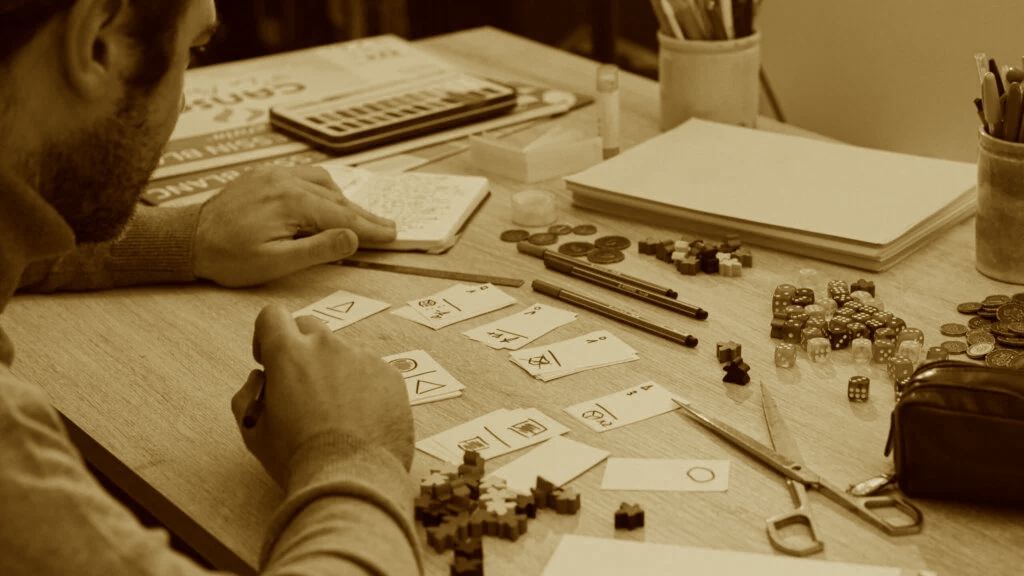
Materials don’t cooperate.
Rules create unintended consequences.
The essay refuses to make the argument you wanted it to make.
The painting looks wrong.
Money exists. Time exists.
Making forces the imagined thing to encounter reality. And reality gets a vote.
That’s why the thing that emerges is almost never identical to the thing you pictured. But either way, making requires surrendering some control over the idea.
You have to let it become what it can actually become.
Which might be why collaboration has been so interesting with Steve.
I can’t completely control Blue Origin.
Neither can he.
Good.
If either of us could, it would only contain one person’s imagination. Instead, we’re building something neither of us could have made alone.
theories Summarized
Maybe that’s another reason making matters. Making gives other people something to think with.
Steve encountered Einstein tiles and saw a board.
We encountered Blue Harvest and found a name.
I’ve played hundreds of games designed by other people, and all of those experiences are somewhere inside the way I think about Blue Origin.
Steve brings twenty years of his own experiences. None of us starts from nothing. So maybe I need to revise the sentence I started with. My dad makes things. That’s true.
But so do I.
So does Steve.
Where does that leave us? With a few theories about making things.
Making as Investigation — Sometimes the making is the thinking. We don’t always make things to express ideas we already understand. Sometimes we externalize an idea so we can encounter it, respond to it and discover what we were thinking.
Somethingness — Making gives possibility somewhere to exist. An idea can live in imagination indefinitely. Making crosses a threshold: something previously internal becomes encounterable by ourselves and eventually by other people.
Reality Gets a Vote — Making introduces resistance. Materials, rules, time, money, physics, collaborators and audiences change what an imagined thing can become. The finished thing isn’t necessarily a compromised version of the original idea. Sometimes the resistance makes it better.
Utility ≠ Legitimacy — Something doesn’t have to be necessary to be worth making. A table can hold objects. A board game can hold people around a table. Art, stories, games and other supposedly impractical things can hold ideas, emotion, play, connection and possibility.
The Thing Thinks Back — Once something exists, it can change the thinking that created it. A prototype reveals problems. A sketch suggests another direction. A collaborator sees something you didn’t. The thing becomes part of the conversation.
We make things. And sometimes, while we’re making them, they make something out of us too.