Why Community Building Feels Harder Now
I don’t think people miss pop culture.
I think people miss the benefits of automatic synchronization.
Friendships have become transportation vehicles for offloading shared interests. Not even connection, exactly. Just verbal diaherea for what you’ve experienced lately. At least, thats what operates on the surface.
What happens inside? Something much stranger than that. You finish a movie and immediately want to talk about it.
But now, nobody has seen it.
Or they saw it six months ago.
Or they watched clips on TikTok and never bothered with the movie itself.
You discover a song that completely consumes your week. You send it to three friends. One says they’ll listen later. Another forgets. The third responds with a thumbs up. Or worse, leaves you on read.
To put it another way, you find a YouTube video that perfectly explains something you’ve been trying to articulate for years. The comments are full of people who already had the conversation yesterday.
And it keeps happening; you’re late to the party before you even arrive. The majority of the feedback has happened well before you chimed in, and sometimes, being behind the majority even a few hours can read like a lifetime has passed.
And yet we’re supposedly more connected than ever.
Infinite access.
Infinite content.
Infinite communication.
Infinite entertainment.
Along the way we all collectively agreed that life got easier.
Food arrives at the door for whatever you might desire. Movies arrive on demand. Music arrives instantly.
Friends remain one text away.
And yet I think a lot of people feel lonelier than they expected. Because we aren’t synchronized anymore.
The End of the Auto Industry
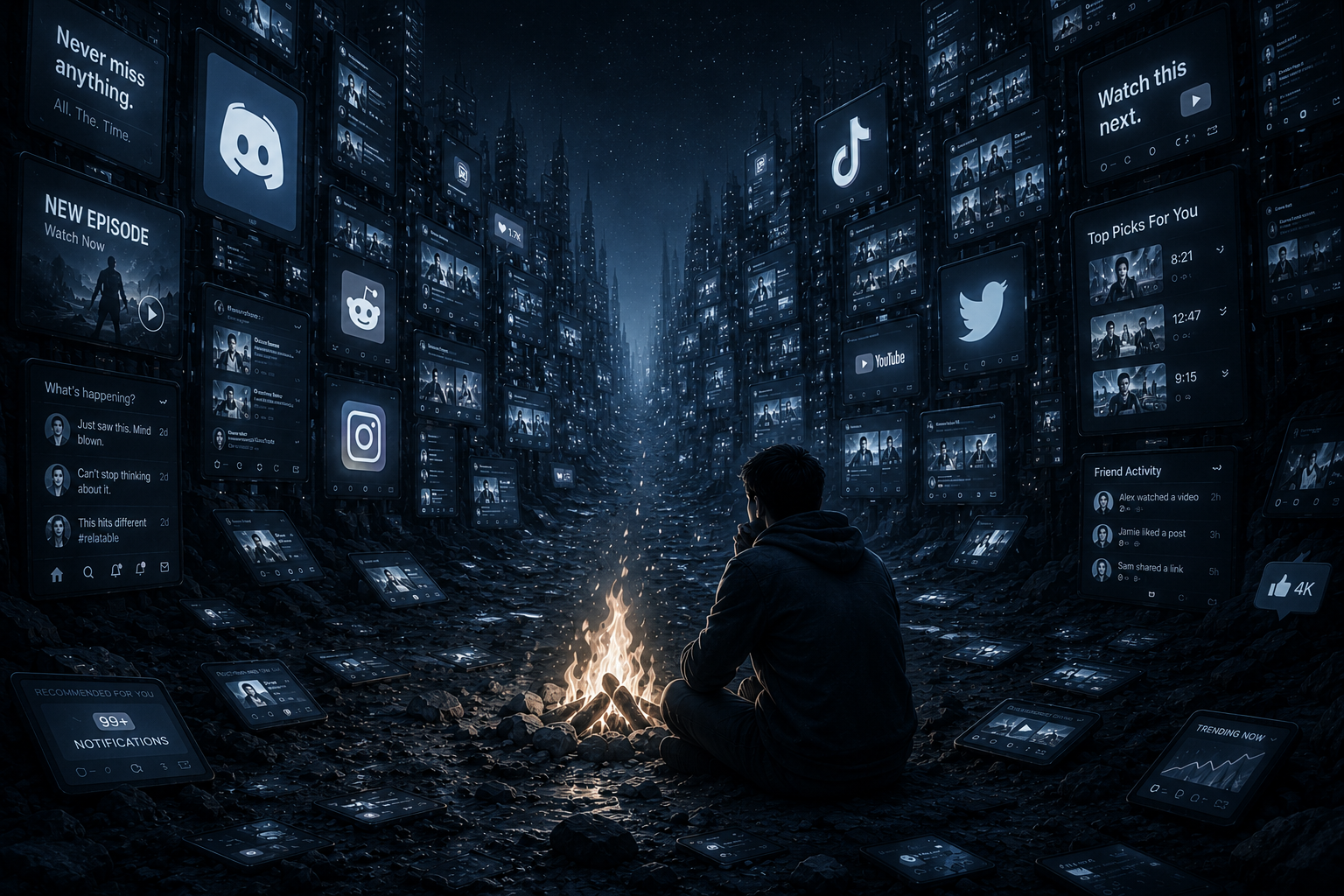
For most of human history, community was largely an automatic byproduct of geography, scarcity and shared experiences. You didn’t have to build a campfire. You mostly had to show up to one.
The internet gives us:
- information
- entertainment
- updates
But those concepts are not inherently tied to connection as we’ve determined in the past 20+ years. Watching something alone and talking about it online isn’t the same as experiencing it together and immediately sharing your experience.
So life got easier right?
Food arrives at the door.
Movies arrive on demand.
Music arrives instantly.
Friends remain one text away.
And yet I think a lot of people feel lonelier than they expected.
We often talk about losing community as though something was taken from us. But I think something else happened. The era of automatic community ended.
We still consume things. We just don’t necessarily experience them together.
I can watch a movie on Tuesday. And you can watch it three weeks later.
And that changes the experience before it ever gets to hold meaning.
When I think about the moments that stayed with me, they all seem to have one thing in common.
They weren’t passive.
They weren’t background noise.
They required presence.
Energy.
Meaning doesn’t arrive fully formed. It emerges through participation.
Now you have to consider what the next lesson is, which I started to circle in my essay on the fragmentation of culture (ie campfires).
Participation doesn’t happen automatically anymore. And that alone explains much of why community feels harder to build. Thats the lesson hidden inside cultural anchors.
For a long time, participation was baked into the experience. You watched the episode when it aired because there wasn’t another option. And you went to the midnight release because everyone else was going. Playing the game sitting beside your friends was the only option because online multiplayer didn’t exist yet.
Scarcity created synchronization.
Synchronization created participation.
The old campfires synchronized people automatically. The new ones don’t.
Participation Creates Meaning
Meaning emerges through participation. It seems like consumption should be enough, but that’s why some of the most meaningful things in our lives aren’t necessarily the highest quality things.
They’re the things we helped create:
The book club where nobody finished the book.
The board game night where the rules got mangled halfway through.
The fandom that developed its own inside jokes.
The podcast you listened to with a friend so you could discuss it afterward.
The movie that became “your movie” because you quoted it for ten years.
The tradition nobody remembers starting.
The shared joke that somehow survived multiple decades.
None of those experiences derive their value from the content alone.
They derive their value from participation.
Because participation creates ownership.
And ownership creates investment.
And investment, investment creates meaning.
When you help build something, even in a small way, you stop relating to it as a consumer. You become part of it. That’s why people remember the LAN party more than the game.
The road trip more than the destination.

It’s why the conversation matters more than the movie that started it. And why the ritual persists. Yes, the reason it began matters, but the ritual exists in concert.
The meaning wasn’t contained in the thing itself. It emerged between the people participating in it.
And that’s where I think many conversations about community accidentally go sideways. People assume the solution is better content. A better app. Apple versus Android. Sony vs Microsoft. A better platform. A better recommendation algorithm.
But community is built through connection, through participation. In other words, we don’t solely become attached to the activity, we become attached to the people we participated with.
Finding Your Campfires
If community no longer arrives automatically, then the skill isn’t consuming better culture.
The skill is finding, building and tending campfires.
Here’s the tension.
Many people:
- scroll
- watch
- consume
But rarely:
- discuss
- share
- gather
- contribute
Most people want a campfire.
Few people want to gather the wood.
The internet solved the access problem. It did not solve the problem of belonging, in fact, it made it a necessary skill to navigate the world. Complicating development further. Because there are now more communities available than any point in human history:
Board game groups.
Discord servers.
Subreddits.
Creator communities.
Book clubs.
Fandoms.
Gaming communities.
Volunteer organizations.
Professional networks.
Local hobby groups.
And I suspect you are starting to see that the challenge isn’t finding people. The challenge is figuring out which communities actually align with who you are.
That’s why community building feels harder.
Not because communities disappeared.
Because choice exploded.
And choice creates responsibility.
The internet didn’t eliminate community.
It privatized the responsibility for finding it.
You have to know yourself well enough to recognize your people when you find them. And the challenge isn’t finding communities. The challenge is becoming the kind of person who recognizes the right ones. And you have to know which campfires are worth tending.
Because now we’re talking about:
- identity
- participation
- belonging
- self-knowledge
Everywhere. All at once.
The most connected people aren’t necessarily the people who found a community.
They’re often the people who helped build one.
Becoming a Campfire Builder
Careful.
Not prescriptions.
Observations.
The people who seem most connected aren’t always the people who found a community. They’re often the people who created an opportunity for one. Who gave one a reason to exist.
Not intentionally.
Not strategically.
Almost accidentally.
A weekly game night.
A group chat.
A podcast.
A book club.
A standing lunch.
A Discord server.
A tradition.
A reason to keep showing up.
Starting conversations. Building rituals.
Most campfires don’t begin with a grand vision. They compound slowly because somebody brought wood, then someone brought some starter fuel. Somebody brought kindling. And somebody else came back the next week to stockpile. And eventually, nobody remembers who started it. Except maybe Billy Joel.
Only that it matters.
Starting A Fire
The people who seem most connected aren’t always the people who found a community.
They’re often the people who contributed to one. Not necessarily in dramatic ways. Often in ordinary ones.
- Starting the group chat.
- Organizing the movie night.
- Launching the podcast.
- Running the Discord.
- Inviting people to lunch.
- Creating the book club.
- Hosting the game night.
Notice how few of these examples require expertise. Most require initiative.
The person who starts the book club doesn’t need to be the smartest reader.
The person who hosts game night doesn’t need to own the best games.
The person who starts the conversation doesn’t need to have all the answers.
They simply decide gathering is worth the effort.
These people create the container. They create a reason to gather. These are all forms of starting a community fire.

Tending The Fire
Today belonging requires initiative.
Which means doing things that often feel uncomfortable. Most people wait to feel like they belong before participating.
Communities usually work in reverse. Participation comes first. Belonging arrives later.
- Attending regularly.
- Bringing snacks.
- Welcoming newcomers.
- Helping clean up.
- Commenting on someone’s work.
- Volunteering.
- Contributing to discussions.
- Inviting a friend.
These people keep the fire alive.
The New Responsibility
For most of human history, community was inherited.
You were born into it.
Worked inside it.
Married inside it.
Worshipped inside it.
Participated inside it.
Whether you wanted to or not.
Today we inhereit less.
Today it is increasingly something you curate.
That’s not better.
Or worse.
Just different.
The internet gave us access to almost everyone. The tradeoff is that it made belonging our responsibility.
Nobody decides for us anymore. Not geography, nor scarcity. Not the village.
We decide which communities matter.
Which conversations continue.
Which traditions survive.
Which campfires stay lit.

Whether we participate at all. What campfires we tend to.
If you want more community in your life, start by asking a different question.
Not “Where do I belong?”
But “Where am I willing to participate?”
Because meaning still emerges the same way it always has. Not through consumption. Through participation.
theories Summarized
The era of automatic community ended.
Scarcity created synchronization.
Synchronization created participation.
Participation created meaning.
The internet solved access. It did not solve belonging.
Choice exploded.
And choice created responsibility.
The challenge is no longer finding culture. The challenge is finding the campfires worth tending – and perhaps becoming one yourself.